A number of high-profile Android apps are still using an
unpatched version of Google’s widely-used app update library,
potentially putting the personal data of hundreds of millions of
smartphone users at risk of hacking.
Many popular apps, including Grindr, Bumble, OkCupid, Cisco
Teams, Moovit, Yango Pro, Microsoft Edge, Xrecorder, and
PowerDirector, are still vulnerable and can be hijacked to steal
sensitive data, such as passwords, financial details, and
e-mails.
The bug, tracked as CVE-2020-8913[1], is rated 8.8 out of
10.0 for severity and impacts Android’s Play Core Library versions
prior to 1.7.2[2].
Although Google addressed the vulnerability in March, new findings[3]
from Check Point Research show that many third-party app developers
are yet to integrate the new Play Core library into their apps to
mitigate the threat fully.
“Unlike server-side vulnerabilities, where the vulnerability is
patched completely once the patch is applied to the server, for
client-side vulnerabilities, each developer needs to grab the
latest version of the library and insert it into the application,”
the cybersecurity firm said in a report.
Play Core Library is a popular Android library[4]
that allows developers to manage the delivery of new feature
modules effectively, trigger in-app updates at runtime, and
download additional language packs.
First reported in late August by researchers at app security
startup Oversecured[5], the issue allows a
threat actor to inject malicious executables to any app relying on
the library, thus granting the attacker full access to all the
resources as that of the compromised application.
The flaw stems from a path traversal vulnerability in the
library that could be exploited to load and execute malicious code
(e.g., an APK file) onto a target app to steal users’ login
details, passwords, financial details, and other sensitive
information stored in it.
The consequences of successful exploitation of this flaw are
enormous. It can be used to “inject code into banking applications
to grab credentials, and at the same time have SMS permissions to
steal the two-factor authentication (2FA) codes,” grab messages
from chat apps, spy on users’ locations, and even gain access to
corporate resources by tampering with enterprise apps.
According to Check Point Research, of the 13% of Google Play
applications analyzed in the month of September 2020, 8% of those
apps had a vulnerable version.

After the cybersecurity firm responsibly disclosed their
findings, Viber, Meetup, and Booking.com updated their apps to the
patched version of the library.
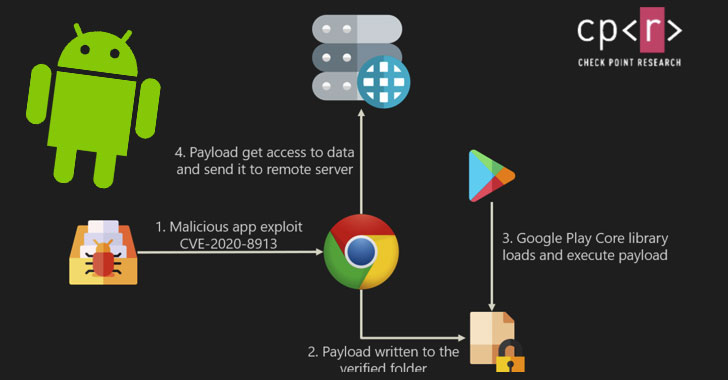
The researchers also demonstrated a proof-of-concept that used a
vulnerable version of the Google Chrome app to siphon the bookmarks
stored in the browser through a dedicated payload.
“We’re estimating that hundreds of millions of Android users are
at security risk,” Check Point’s Manager of Mobile Research, Aviran
Hazum, said. “Although Google implemented a patch, many apps are
still using outdated Play Core libraries. The vulnerability
CVE-2020-8913 is highly dangerous, [and] the attack possibilities
here are only limited by a threat actor’s imagination.”
References
- ^
CVE-2020-8913
(nvd.nist.gov) - ^
1.7.2
(developer.android.com) - ^
new
findings (research.checkpoint.com) - ^
Android
library (developer.android.com) - ^
Oversecured
(blog.oversecured.com)