Cybersecurity researchers today took the wraps off an on-going
cyber fraud operation led by hackers in Gaza, West Bank, and Egypt
to compromise VoIP servers of more than 1,200 organizations across
60 countries over the past 12 months.
According to findings published[1]
by Check Point Research, the threat actors — believed to be located
in the Palestinian Gaza Strip — have targeted Sangoma PBX, an
open-sourced user interface that’s used to manage and control
Asterisk VoIP phone systems, particularly the Session Initiation
Protocol (SIP) servers.
“Hacking SIP servers and gaining control allows hackers to abuse
them in several ways,” the cybersecurity firm noted in its
analysis. “One of the more complex and interesting ways is abusing
the servers to make outgoing phone calls, which are also used to
generate profits. Making calls is a legitimate feature, therefore
it’s hard to detect when a server has been exploited.”
By selling phone numbers, call plans, and live access to
compromised VoIP services from targeted businesses to the highest
bidders, the operators of the campaign have generated hundreds of
thousands of dollars in profit, alongside equipping them with
capabilities to eavesdrop on legitimate calls.
Exploiting a Remote Admin Authentication Bypass Flaw
PBX, short for private branch exchange[2], is a switching system
that’s used to establish and control telephone calls between
telecommunication endpoints, such as customary telephone sets,
destinations on the public switched telephone network (PSTN), and
devices or services on voice over Internet Protocol (VoIP)
networks.
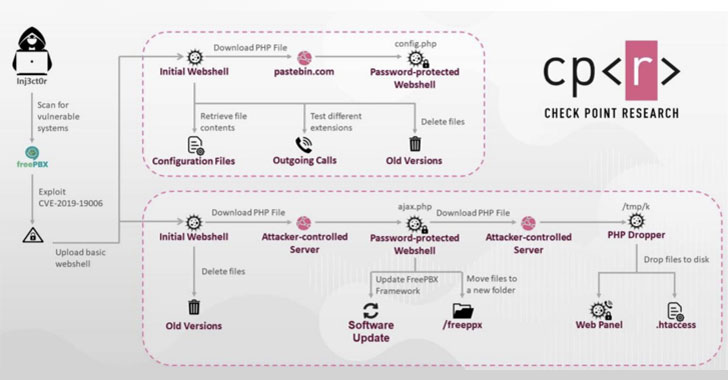
Check Point’s research found that the attack exploits CVE-2019-19006[3]
(CVSS score 9.8), a critical vulnerability impacting the administrator web interface[4] of FreePBX and PBXact,
potentially allowing unauthorized users to gain admin access to the
system by sending specially crafted packets to the affected
server.
The remote admin authentication bypass flaw affects FreePBX
versions 15.0.16.26 and below, 14.0.13.11 and below, and
13.0.197.13 and below and was patched by Sangoma in November
2019.
“The attack begins with SIPVicious, a popular tool suite for
auditing SIP-based VoIP systems,” the researchers noted. “The
attacker uses the ‘svmapmodule’ to scan the internet for SIP
systems running vulnerable FreePBX versions. Once found, the
attacker exploits CVE-2019-19006, gaining admin access to the
system.”
In one attack flow, it was discovered that an initial PHP web
shell was used to get hold of the FreePBX system’s database and
passwords for different SIP extensions, granting the attackers
unrestricted access to the entire system and the ability to make
calls out of every extension.
In the second version of the attack, the initial web shell was
utilized to download a base64-encoded PHP file, which is then
decoded to launch a web panel that lets the adversary place calls
using the compromised system with both FreePBX and Elastix support,
as well as run arbitrary and hard-coded commands.
The campaign’s reliance on Pastebin to download
password-protected web shells has tied the attack to an uploader by
the name of “INJ3CTOR3,” whose name is linked to an old SIP Remote
Code Execution vulnerability (CVE-2014-7235) in addition to a
number of private Facebook groups that are used to share SIP server
exploits.
A Case of International Revenue Share Fraud
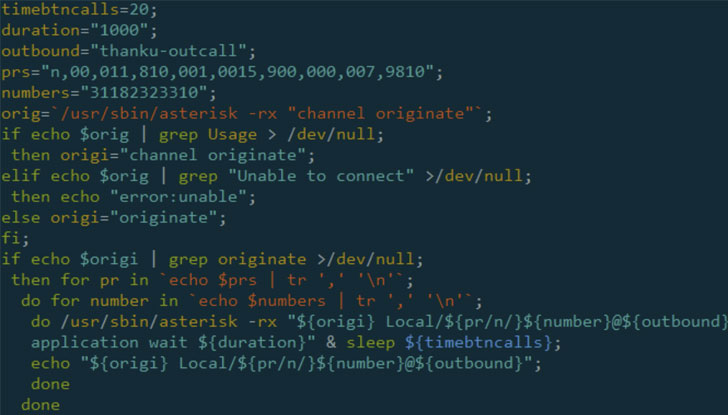
Check Point researchers posited that the hacked VoIP servers
could be employed by the attackers to make calls to International
Premium Rate Numbers (IPRN) under their control. IPRNs are
specialized numbers used by businesses to offer phone-based
purchases and other services — like putting callers on hold — for a
higher fee.
This fee is typically passed on to customers who make the calls
to these premium numbers, making it a system ripe for abuse. Thus,
the more calls the owner of an IPRN receives and the longer clients
wait in the line to complete the transaction, the more money it can
charge telecom providers and customers.
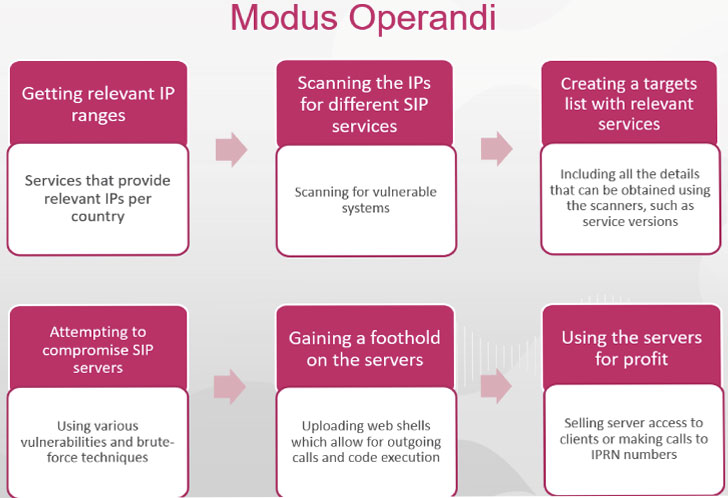
“Using IPRN programs not only allows the hacker to make calls
but also abuse the SIP servers to generate profits,” the
researchers said. “The more servers exploited, the more calls to
the IPRN can be made.”
This is not the first time switching systems have been exploited
for International Revenue Share Fraud (IRSF[5]) — the practice of
illegally gaining access to an operator’s network in order to
inflate traffic to phone numbers[6] obtained from an IPRN
provider.
Back in September, ESET researchers uncovered Linux malware
dubbed “CDRThief[7]” that targets VoIP
softswitches in an attempt to steal phone call metadata and carry
out IRSF schemes.
“Our research reveals how hackers in Gaza and the West Bank are
making their money, given the dire socio-economic conditions in the
Palestinian territories,” said Adi Ikan, head of network
cybersecurity research at Check Point.
“Their cyber fraud operation is a quick way to make large sums
of money, fast. More broadly, we’re seeing a widespread phenomenon
of hackers using social media to scale the hacking and monetization
of VoIP systems this year.”
“The attack on Asterisk servers is also unusual in that the
threat actors’ goal is to not only sell access to compromised
systems, but also use the systems’ infrastructure to generate
profit. The concept of IPRN allows a direct link between making
phone calls and making money.”
References
- ^
published
(blog.checkpoint.com) - ^
private
branch exchange (en.wikipedia.org) - ^
CVE-2019-19006
(www.checkpoint.com) - ^
administrator web interface
(wiki.freepbx.org) - ^
IRSF
(www.trendmicro.com) - ^
inflate
traffic to phone numbers
(ieeexplore.ieee.org) - ^
CDRThief
(thehackernews.com)