
A cyber-attacker successfully breaks into your environment and
begins sneaking around to find something valuable – intellectual
property, bank account credentials, company plans, whatever. The
attacker makes his way to a certain host on a network node to
browse the directories, and suddenly, his connection is cut off.
The stolen username and password he acquired no longer works.
Unknowingly, the attacker triggered a well-concealed trap that
detected his presence, took immediate action to sever his
connection, and then blocked his reconnect ability. Very cool.
The concept of Deception technology is pretty cool. And it can
be an extremely valuable security layer that comes into play when
other security layers are successfully bypassed. The problem,
however, is that only very large enterprises have been able to
leverage Deception technology due to its cost and complexity to
implement and maintain. Unfortunately, small to medium-sized
enterprises, the so-called SMEs, just don’t have the budgets and
staff required to leverage this valuable technology.
A Game Changer for Deception Technology
Cybersecurity company Cynet recognizes the tremendous value of
deception technology. So much so, in fact, that they built
deception technology natively into their XDR platform (Read more in this Deception
whitepaper[1]).
In this way, Cynet clients automatically receive robust
Deception technology, pre-integrated as part of their XDR platform.
In simple words: instead of buying deception technology on top of
the existing endpoint protection (NGAV/EDR) – you get Deception as
part of your endpoint protection solution, together with other
benefits of XDR.
This is a boon for those businesses that could not afford to
purchase Deception technology from a specialized vendor and for
those that simply didn’t want the headache of deploying,
integrating, operating, and maintaining yet another cybersecurity
solution. While cybersecurity seems to be getting more complicated,
requiring more solutions and more oversight, the Cynet approach is
a breath of fresh air.
Once the Cynet XDR solution is deployed, clients simply
configure various types of decoys across their environment, and
that’s that. Three types of decoys are configurable within the
platform:
File Deception
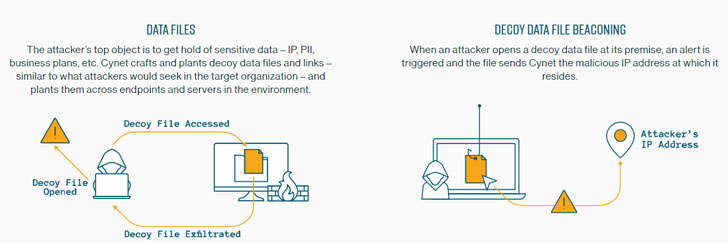
These are decoy data files and links that appear exactly as an
attacker would see for legitimate data files and links. When an
attacker opens a decoy data file, an alert is triggered along with
details surrounding the file access, such as the attacker IP
address, the victim IP address, hostname, and file name.
Clients can use off-the-shelf decoy files and even craft their
own. Just be careful that when naming a file “top secret
information.docx,” it may tip off attackers that you have Deception
technology in place. Keep decoy file names consistent with your
conventional file naming methods.
User Deception
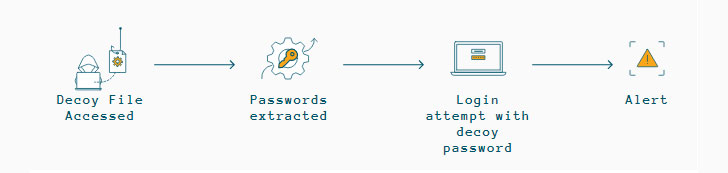
These are decoy user accounts that can be placed across multiple
endpoints. When an attacker uses decoy credentials to login with
one of the decoy users, an alert is created. Again, usernames and
account information should mimic conventions used within your
organization.
Network Deception
Adding decoy hosts within your network environment is another
way to uncover attackers on your network. The decoys are made to
appear as valuable systems that legitimate users interact with to
perform their tasks. One idea is to actually create far more decoy
hosts than real hosts, putting the odds in your favor that a
successful attacker will make the wrong move and expose his
presence – which is the right move from your perspective!
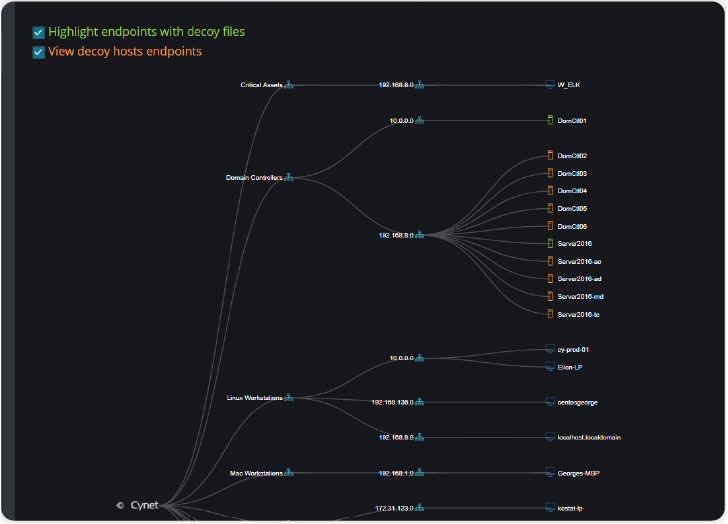 |
| Example showing Cynet deception hosts (shown in orange) on network |
Deception As A Platform Component
It seems that something as useful as Deception technology should
be deployed as a critical component of every company’s
cybersecurity technology stack. However, the expense and complexity
of adding this technology have certainly been a barrier to
widespread adoption. The approach Cynet is taking – included
Deception as one component of their robust XDR platform – changes
the narrative. Implementing Deception technology doesn’t cost
anything extra and can be implemented with the click of a mouse.
And I’m not pretending!
References
- ^
Read
more in this Deception whitepaper
(go.cynet.com) - ^
Download
Cynet Deception whitepaper here
(go.cynet.com)