
Cisco yesterday released security patches for two high-severity
vulnerabilities affecting its IOS XR software that were found
exploited in the wild a month ago.
Tracked as CVE-2020-3566 and CVE-2020-3569,
details for both zero-day unauthenticated DoS
vulnerabilities[1]
were made public by Cisco late last month when the company found
hackers actively exploiting Cisco IOS XR Software that is installed
on a range of Cisco’s carrier-grade and data center routers.
Both DoS vulnerabilities resided in Cisco IOS XR Software’s
Distance Vector Multicast Routing Protocol (DVMRP) feature and
existed due to incorrect implementation of queue management for
Internet Group Management Protocol (IGMP) packets on affected
devices.
IGMP is a communication protocol typically used by hosts and
adjacent routers to efficiently use resources for multicasting
applications when supporting streaming content such as online video
streaming and gaming.
“These vulnerabilities affect any Cisco device that is running
any release of Cisco IOS XR Software if an active interface is
configured under multicast routing and it is receiving DVMRP
traffic,” Cisco said in an advisory[2].
“An administrator can determine whether multicast routing is
enabled on a device by issuing the show igmp interface
command.”
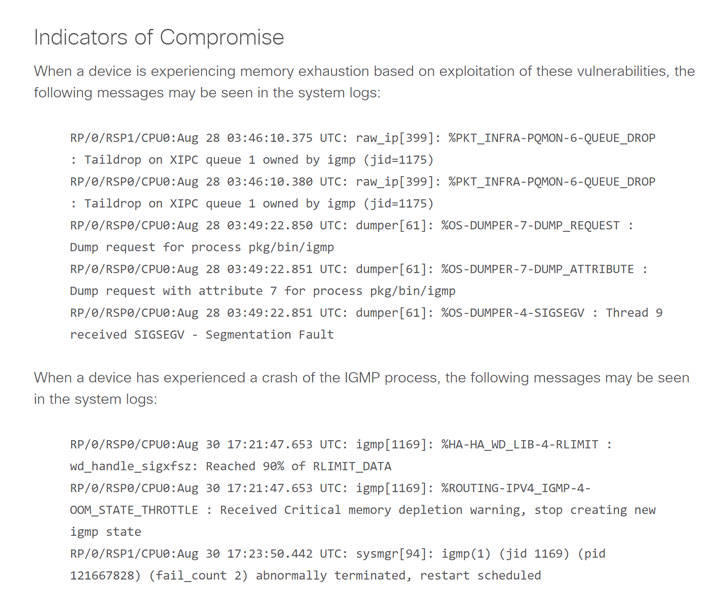
Successful exploitation of these vulnerabilities could allow
remote unauthenticated hackers to send specially crafted IGMP
packets to affected devices to either immediately crash the IGMP
process or exhaust process memory and eventually crash.
The memory consumption may negatively result in instability of
other processes running on the device, including routing protocols
for both internal and external networks.
The vulnerabilities affect all Cisco devices running any release
of Cisco IOS XR Software if an active interface is configured under
multicast routing, and it is receiving DVMRP traffic.
At the time Cisco initially made these vulnerabilities public,
the company provided some mitigation to resolve the issues and
block the active exploitation attempts, but now it has finally
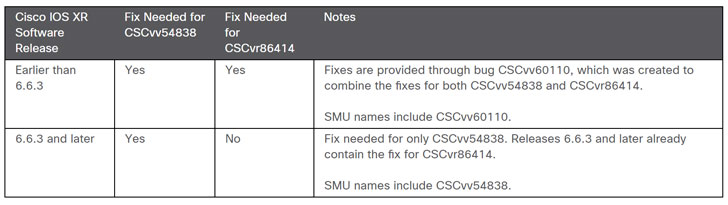
released Software Maintenance Upgrades (SMUs) to address the
vulnerabilities completely.
“Although there are no workarounds for these vulnerabilities,
there are multiple mitigations available to customers depending on
their needs,” the company said.
“When considering mitigations, it should be understood that for
the memory exhaustion case, the rate limiter and the access control
methods are effective. For the immediate IGMP process crash case,
only the access control method is effective.”
Cisco customers are highly recommended to make sure they are
running the latest Cisco IOS XR Software release earlier than 6.6.3
and Cisco IOS XR Software release 6.6.3 and later.
References
- ^
zero-day
unauthenticated DoS vulnerabilities
(thehackernews.com) - ^
advisory
(tools.cisco.com)
Read more http://feedproxy.google.com/~r/TheHackersNews/~3/LuBrMzEakT8/cisco.html