
cybercriminals would leverage the fear and confusion surrounding
the Covid-19 pandemic in their cyberattacks.
Of course, malicious emails would contain subjects relating to
Covid-19, and malicious downloads would be Covid-19 related. This
is how cybercriminals operate. Any opportunity to maximize
effectiveness, no matter how contemptible, is taken.
While many have anecdotally suggested ways in which Covid-19
related cyberattacks would unfold, we have little data supporting
the actual impact of Covid-19 on cybersecurity. Several have
reported that the number of malicious emails with the subject
related to Covid-19 has grown several hundred percent and that the
majority of Covid-19 related emails are now malicious.
Beyond the anticipated increase in Covid-19 related malicious
emails, videos, and an array of downloadable files, which we all
anticipated, what else is going on behind the scenes?
Interestingly, cybersecurity company Cynet has just released a
report (download here)
detailing changes in cyberattacks they’ve observed across North
America and Europe since the beginning of the Covid-19 pandemic.
The report shares several interesting data points and findings,
such as the cyberattack volume change observed in various industry
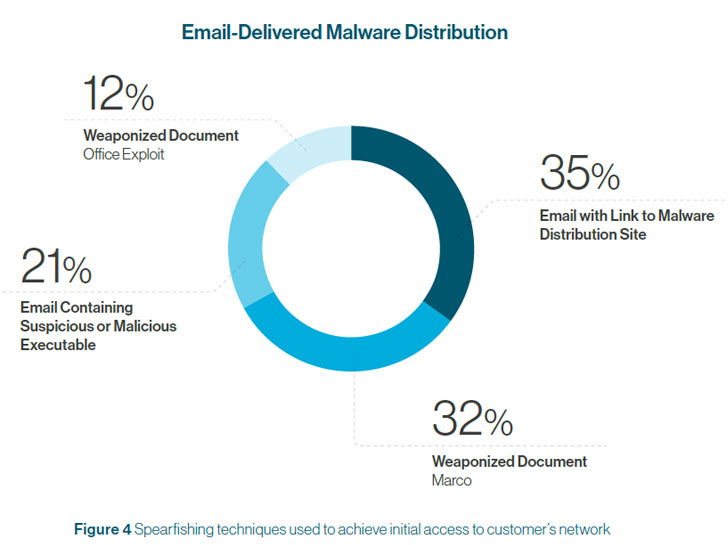
sectors, the increased use of spear-phishing as an initial attack
vector, and the approaches being used to distribute malware in
spear-phishing attacks.
[1]
Fighting Fire with Fire
Cynet found that cybercriminals are not just “sort of” leveraging
the Covid-19 pandemic, they’re going all in. Cybercriminals are
pulling out their entire arsenal of new attack methods to ensure
attack success best. This is like a sports team using all the new
plays they’ve developed in one game rather than spreading them out
across the season.
The report
states[2] that the percentage of
attacks using new techniques has historically been around 20%. That
is, 80% of attacks have used well-known techniques that are easily
identified, assuming companies have updated preventative measures
in place.
Since the Covid-19 pandemic, Cynet found that new attacks jumped
to roughly 35% of all attacks. New attack techniques cannot be
sufficiently detected by antivirus software alone and can only be
effectively discovered using newer behavioral detection mechanisms.
That is, the new detection approaches must be used to detect the
new attack techniques being deployed.
Overburdened Security Staffs
Another interesting observation in the Cynet report is a huge spike
in clients requesting expert assistance from their detection and
response team (which Cynet calls CyOps). Client engagements
increased a whopping 250% during the pandemic.
Beyond using advanced detection and response mechanisms, deep
cybersecurity skills are required to detect and mitigate the sharp
rise in the new attack techniques deployed during the Covid-19
pandemic.
The Cure?
Unfortunately, many companies do not yet have advanced detection
and response technologies, such as Extended Detection and Response
(XDR), or ongoing access to a 24×7 managed detection and response
(MDR) team. When cyberattacks using new techniques spike as they
are during this pandemic (or could do at any time), companies
without these advanced protections are at higher risk.
We strongly recommend investigating both XDR and MDR solutions
as a way to futureproof and immunize your cybersecurity stack.
And regardless of the security stack you have deployed, be wary
of new malware attacks. Use threat hunting techniques to scour your
systems to ensure new malware has not slipped through the cracks.
The uptick in new malware means prevention and detection become
trickier, and continuous threat hunting must become the norm.
Download the report
here[3].
References
- ^
download here
(go.cynet.com) - ^
report states
(go.cynet.com) - ^
report here
(go.cynet.com)
Read more http://feedproxy.google.com/~r/TheHackersNews/~3/3aXr-TXpuQw/covid-cybersecurity-report.html