
exposure on the Dark Web this year, global application security
company, ImmuniWeb,
uncovered that 97% of leading cybersecurity companies have data
leaks or other security incidents exposed on the Dark Web, while on
average, there are over 4,000 stolen credentials and other
sensitive data exposed per cybersecurity company.
Even the cybersecurity industry itself is not immune to these
problems, as demonstrated in ImmuniWeb’s research.
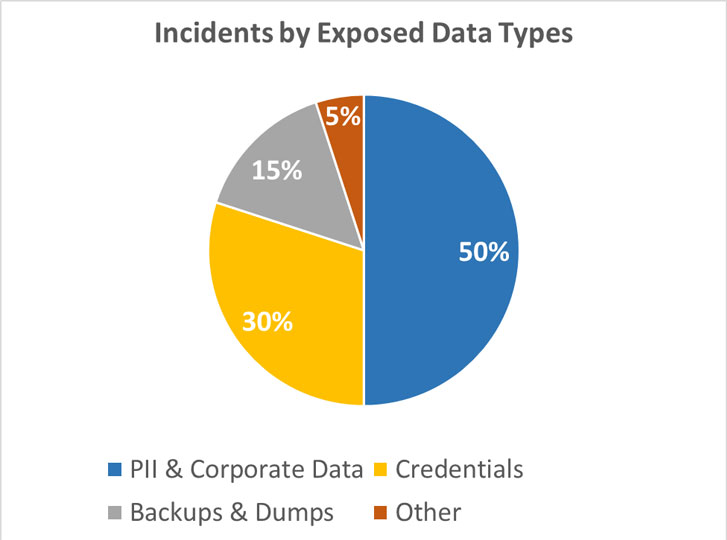
cybersecurity companies’ exposure on the Dark Web included:
- 97% of companies have data leaks and other security incidents
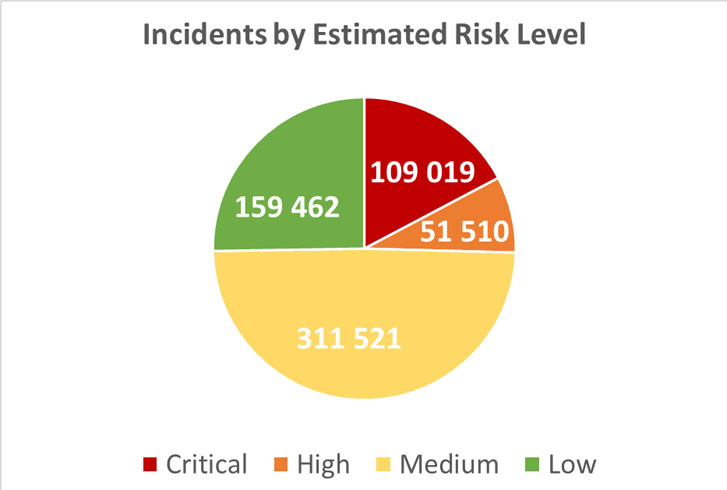
exposed on the Dark Web. - 631,512 verified security incidents were found with over 25%
(or 160,529) of those classed as a high or critical risk level+
containing highly sensitive information such as plaintext
credentials or PII, including financial or similar data. Hence, on
average, there are 1,586 stolen credentials and other sensitive
data exposed per cybersecurity company. Over 1 million unverified
incidents (1,027,395) were also discovered during ImmuniWeb’s
research, and only 159,462 were estimated as low risk. - 29% of stolen passwords are weak, employees from 162 companies
reuse their passwords – the research revealed that 29% of stolen
passwords are weak, with less than eight characters or without
uppercase letters, numbers, or other special characters and that
employees from 162 companies (around 40) reuse identical passwords
on different breached This boosts the risk of password re-use
attacks by cybercriminals. - Professional emails were used on porn and adult dating sites –
third-party breaches represented a considerable number of the
incidents, as ImmuniWeb’s research found 5,121 credentials that had
been stolen from hacked porn or adult dating websites. - 63% of websites of the cybersecurity companies do not comply
with PCI DSS requirements – which means that they use vulnerable or
outdated software (including JS libraries and frameworks) or have
no Web Application Firewall (WAF) in blocking mode. - 48% of websites of the cybersecurity companies do not comply
with GDPR requirements – because of vulnerable software, the
absence of a conspicuously visible privacy policy, or a missing
cookie disclaimer when cookies contain PII or traceable
identifiers. - 91 companies had exploitable website security vulnerabilities,
26% of which are still unpatched – this finding came from ImmuniWeb
referring to openly available data on the Open Bug Bounty[2]
project.
The research was run using ImmuniWeb’s free online Domain Security
Test, which combines proprietary OSINT technology enhanced with
Machine Learning, to discover and classify Dark Web exposure. 398
leading cybersecurity companies headquartered in 26 countries,
mostly the US and Europe, were tested.
risk incidents, followed by the UK and Canada, then Ireland, Japan,
Germany, Israel, the Czech Republic, Russia, and Slovakia.
Of the 398 cybersecurity companies tested, only those in
Switzerland, Portugal, and Italy did not suffer any high or
critical risk incidents, while those in Belgium, Portugal, and
France had the lowest number of verified incidents.
Ilia Kolochenko, CEO & Founder of ImmuniWeb, commented on the
research:
“Today, cybercriminals endeavor to maximize their profits and
minimize their risks of being apprehended by targeting trusted
third parties instead of going after the ultimate victims. For
instance, large financial institutions commonly have formidable
technical, forensic, and legal resources to timely detect,
investigate, and vigorously prosecute most of the intrusions, often
successfully.
“Contrariwise, their third parties, ranging from law firms to IT
companies, usually lack internal expertise and budget required to
react quickly to the growing spectrum of targeted attacks and APTs.
Eventually, they become low-hanging fruit for pragmatic attackers
who also enjoy virtual impunity. In 2020, one need not spend on
costly 0days but rather find several unprotected third parties with
privileged access to the ‘Crown Jewels’ and swiftly crack the
weakest link.”
“Holistic visibility and inventory of your data, IT and digital
assets is essential for any cybersecurity and compliance program
Today. Modern technologies, such as Machine Learning and AI, can
significantly simplify and accelerate a considerable number of
laborious tasks spanning from anomaly detection to false positive
reduction. This picture is, however, to be complemented with a
continuous monitoring of Deep and Dark Web, and countless resources
in the Surface Web, including public code repositories and paste
websites. You cannot protect your organization in isolation from
the surrounding landscape that will likely become even more
intricate in the near future.”
The full research
findings[3] can be viewed here.
References
- ^
ImmuniWeb
(www.immuniweb.com) - ^
Open Bug Bounty
(www.openbugbounty.org) - ^
full research findings
(www.immuniweb.com)
Read more http://feedproxy.google.com/~r/TheHackersNews/~3/XI4IeW6Cap0/dark-web-cybersecurity-report.html