significantly improve the effectiveness and efficiency of threat
detection and response.
Emerging Extended Detection and Response (XDR) solutions
aim to aggregate and correlate telemetry from multiple detection
controls and then synthesize response actions.
XDR has been referred to as the next step in the evolution of
Endpoint Detection and Response (EDR) solutions.
In fact, Gartner named XDR as the first of their Top 9 Security and
Risk Trend for 2020.
[1]
Because XDR represents a new solution category, there is no single
accepted definition of what capabilities and features should (and
shouldn’t) be included.
Each provider approaches XDR with different strengths and
perspectives on how what an XDR solution should include.
Therefore, selecting an XDR provider is quite challenging as
organizations must organize and prioritize a wide range of
capabilities that can differ significantly between providers.
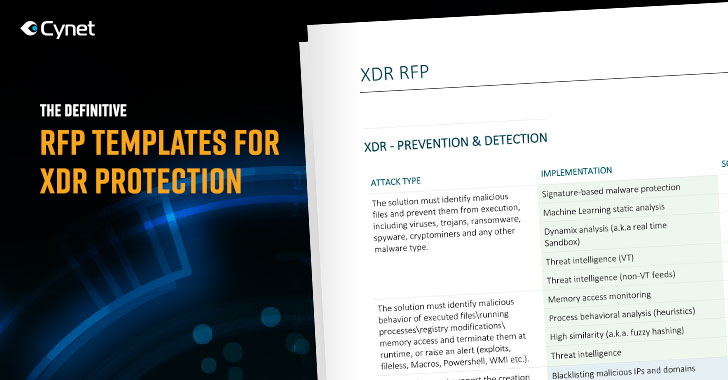
Cynet is now addressing this need with the Definitive RFP
Template for XDR solutions (download here[2]), an expert-made
security requirement list that enables stakeholders to accelerate
and optimize the evaluation process of the products they
evaluate.
The RFP template aims to capture the widest common denominator
in terms of security needs and deliver the essentials relevant to
any organization.
An XDR solution can benefit large companies that are awash in
alerts from multiple detection sources, rationalize the myriad
signals, and simplify response actions. Smaller companies benefit
by leveraging a single platform that would otherwise require
coordinating several expensive and complex point solutions.
Logically it makes sense for organizations to achieve greater
threat visibility along with reduced complexity.
“Despite all the security tools that have been deployed over the
years to prevent and detect breaches, attackers are still able to
find the seams in the protections,” says Eyal Gruner, CEO of Cynet.
“One of the main problems is that security teams simply cannot make
sense of the barrage of information and alerts coming at them from
multiple security tools. And, some organizations can’t afford to
deploy all of the necessary monitoring tools to ensure full
protection.”
To provide strong breach protection, organizations must collect,
synthesize, and make sense of signals from the primary attack
vectors as the first step to better defense. Then, automating
investigation and remediation to cover the full breadth of each
attack ensures all appropriate actions are taken to protect the
organization. This is where XDR comes in.
Using the ready-made templates can potentially save significant
time and resources otherwise spent on building a similar
requirement list from scratch. The XDR solution RFP can help
companies prioritize the capabilities available in emerging
solutions to improve their purchase decisions.
The RFP comprises five sections:
- Monitoring & Control—routine activities to gain visibility and
proactively discover and reduce attack surfaces. - Prevention & Detection—mechanism to thwart the wide array of
commodities and advanced attack vectors. - Investigation & response—an overall toolset for efficient
reaction to the detected live attacks. - Infrastructure—architecture, deployment, data collection, and
communication. - Operation—ongoing management of the solution
The RFP Guides ensure organizations are not overlooking important
aspects of security solution capabilities and thereby making
substandard decisions for critical enterprise purchases.
Download the XDR
RFP[3] here.
References
- ^
Top 9 Security and Risk Trend
(www.gartner.com) - ^
download here
(go.cynet.com) - ^
Download the XDR RFP
(go.cynet.com)
Read more http://feedproxy.google.com/~r/TheHackersNews/~3/T00ywCNtopE/extended-detection-response.html