of a new piece of malware, a sample of which they spotted on the
Virustotal malware scanning engine and believe the hacker behind it
is likely interested in some high-value computers protected behind
air‑gapped networks.
Dubbed ‘Ramsay,’ the malware is still under development
with two more variants (v2.a and v2.b) spotted in the wild and
doesn’t yet appear to be a complex attacking framework based upon
the details researcher shared.
However, before reading anything further, it’s important to note
that the malware itself doesn’t leverage any extraordinary or
advanced technique that could let attackers jump air-gapped
networks to infiltrate or exfiltrate data from the targeted
computers.
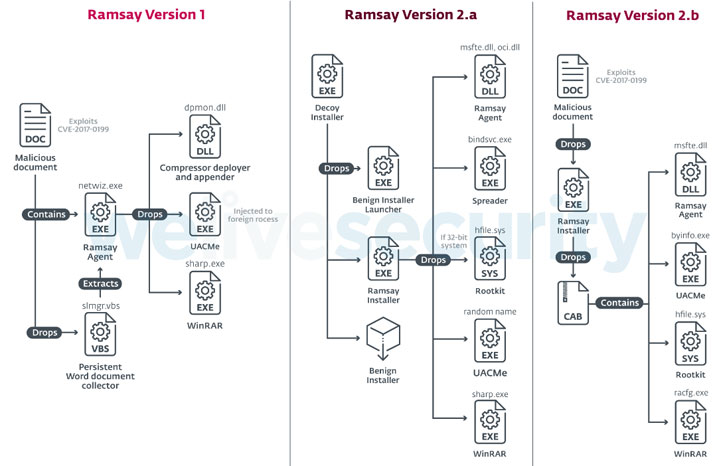
According to ESET researcher Ignacio Sanmillan, Ramsay infiltrates
targeted computers through malicious documents, potentially sent
via a spear-phishing email or dropped using a USB drive, and then
exploits an old code execution vulnerability in Microsoft Office to
take hold on the system.
‘Several instances of these same malicious documents were found
uploaded to public sandbox engines, labeled as testing artifacts
such as access_test.docx or Test.docx denoting an ongoing effort
for trial of this specific attack vector,’ the researcher
said[1].
Ramsay malware primarily consists of two main
functionalities:
- Collecting all existing Word documents, PDFs, and ZIP archives
within the target’s filesystem and storing them to a pre-defined
location on the same system or directly to a network or removable
drives. - Spreading itself to other computers being used within the same
isolated facility by infecting all executable files available on a
network shares and removable drives.
According to the researcher, the Ramsay samples they found do not
have a network-based C&C communication protocol, nor does any
attempt to connect to a remote host for communication
purposes.
exfiltrate data from a compromised system.
Honestly, there’s no clear answer to this at this moment, but
researcher speculate that the malware might have been ‘tailored for
air‑gapped networks’ with similar scenarios—considering that the
only option left is to physically access the machine and steal the
collected data with a weaponized USB.
‘It is important to notice that there is a correlation between
the target drives Ramsay scans for propagation and control document
retrieval,’ the ESET researcher said.
“This assesses the relationship between Ramsay’s spreading and
control capabilities showing how Ramsay’s operators leverage the
framework for lateral movement, denoting the likelihood that this
framework has been designed to operate within air-gapped networks.’
‘The current visibility of targets is low; based on ESET’s
telemetry, few victims have been discovered to date. We believe
this scarcity of victims reinforces the hypothesis that this
framework is under an ongoing development process, although the low
visibility of victims could also be due to the nature of targeted
systems being in air-gapped networks,’ he added.
However, a lack of technical and statistical evidence doesn’t
support this theory yet and remains a broad guess.
Moreover, since the malware is still under development, it’s too
early to decide if the malware has only been designed to target
air-gapped networks.
It likely possible that the future versions of the malware could
have an implication to connect with a remote attacker-controlled
server for receiving commands and exfiltrating data.
We have reached out to ESET researcher for more clarity on the
‘air-gap’ claim and will update this story once he responds.
UPDATE: Researcher Explains ‘Air Gap’ Scenarios
Researcher Ignacio Sanmillan, who discovered and analyzed Ramsay
malware, has provided the following explanation for our readers.
“We only have a copy of the Ramsay agent, which only has code to
aggregate and compress the stolen data in a very decentralized and
covert way on the local filesystem of the infected host. Based on
this, we assume that another component is responsible for scanning
the filesystem, locating the compressed files, and performing the
actual exfiltration.”
On asking if the attacker needs to rely on the physical
access for data exfiltration, Sanmillan said:
“There are several ways the attacker might do this. We have not
seen this operation performed; however, we have a few hypotheses on
how the attacker could do this. Those are only our best-educated
guess and pure speculation at this point, so please treat those two
hypothetical scenarios as such.”
“Scenario 1 — Imagine System A, connected to the Internet
and under full control of the Ramsay operators, and System B, an
air-gapped computer infected by the Ramsay agent. Then imagine a
legitimate user of those systems occasionally transferring files
between both systems using a removable drive.”
“When the drive is inserted into System A, the attacker could
decide to place a special control file on the removable drive
which, when connected to System B, would cause the Ramsay agent to
execute the Ramsay exfiltrator which would be built to retrieve the
staged stolen data and copy it to the removable drive for later
retrieval once the removable drive gets connected to System A. This
scenario is a variation of how Sednit / APT28 operated
USBStealer.”
“USBStealer systematically copied the stolen data on the
removable drive used between System A and System B, while Ramsay
stages the stolen data locally for a future explicit
exfiltration.”
“Scenario 2 — Imagine Ramsay agent running for days or
weeks in an air-gapped network, staging on the local filesystem all
the data it can find on network drives and all the removable drives
that got connected to the system.”
“Then at some point, the attacker decides it is exfiltration
time. He would need to gain physical access to the infected system
and either obtain code execution to run the Ramsay exfiltrator, or
in case the system does not have full-disk encryption, boot the
system from a removable drive, mount the filesystem, parse it to
retrieve the well-staged stolen data and leave.”
“This scenario is more elaborate and requires the physical
presence of an operative/accomplice, but it could still be
plausible as it would allow for a very quick on-site
operation.”
To answer if the malware author can integrate remote C&C
communication module in future versions, the researcher
said:
“Ramsay has a series of common functionality implemented across
their versions, which is the control-file based protocol and how
artifacts involved in this protocol are retrieved from Removable
media and Network Shares.”
“This denotes that evaluation for these techniques was taken
into account while designing this malware, all of which point
towards the implementation of capabilities for operation without
the need for any network connection.”
“It seems that if attackers would leverage techniques relying on
Network artifacts would not correlate to the philosophy of this
malware. We indeed think that Ramsay can be under development, but
we are highly inclined to believe that they won’t introduce a
Network-based exfiltration component.”
References
- ^
researcher said
(www.welivesecurity.com)
Read more http://feedproxy.google.com/~r/TheHackersNews/~3/bfDPCQF6AFk/airgap-network-malware.html