Attack—wherein a client system vulnerable to a path traversal
vulnerability could get compromised when remotely accessing a
server over Microsoft’s Remote Desktop Protocol?
Though Microsoft had patched the vulnerability (CVE-2019-0887)
as part of its July 2019 Patch Tuesday update, it turns out
researchers were able to bypass the patch just by replacing the
backward slashes in paths with forward slashes.
Microsoft acknowledged the improper fix and re-patched the flaw
in its February 2020 Patch Tuesday update earlier this year, now
tracked as CVE-2020-0655.
In the latest report shared with The Hacker News, Check Point
researcher disclosed that
Microsoft addressed the issue by adding a separate workaround in
Windows while leaving the root of the bypass issue, an API function
“PathCchCanonicalize,” unchanged.
[2]
Apparently, the workaround works fine for the built-in RDP client
in Windows operating systems, but the patch is not fool-proof
enough to protect other third-party RDP clients against the same
attack that relies on the vulnerable sanitization function
developed by Microsoft.
“We found that not only can an attacker bypass Microsoft’s
patch, but they can bypass any canonicalization check that was done
according to Microsoft’s best practices,” Check Point researcher
Eyal Itkin said in a report shared with The Hacker News.
For those unaware, path traversal
attacks[3] occur when a program
that accepts a file as input fails to verify it, allowing an
attacker to save the file in any chosen location on the target
system, and thus exposing the contents of files outside of the root
directory of the application.
“A remote malware-infected computer could take over any client
that tries to connect to it. For example, if an IT staff member
tried to connect to a remote corporate computer that was infected
by malware, the malware would be able to attack the IT staff
member’s computer as well,” the researchers described.
The flaw came to light last
year[4], and a subsequent
research in August found that it impacted Microsoft’s Hyper-V hardware
virtualization[5]
platform as well.
Here’s a demonstration video on the original vulnerability from
the last year:
An Improperly Patched Path Traversal Flaw
According to researchers, the July patch can be bypassed because of
a problem that lies in its path canonicalization function “PathCchCanonicalize,” which is used to
sanitize file
paths, thus allowing a bad actor to exploit the clipboard
synchronization between a client and a server to drop arbitrary
files in arbitrary paths on the client machine.
In other words, when using the clipboard redirection feature
while connected to a compromised RDP server, the server can use the
shared RDP clipboard to send files to the client’s computer and
achieve remote code execution.
Although Check Point researchers originally confirmed that “the fix
matches our initial expectations,” it appears there’s more to it
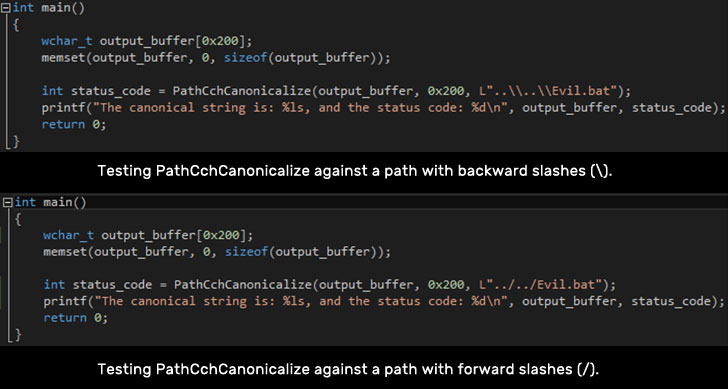
than meets the eye: the patch can be simply bypassed by replacing
backward slashes (e.g., file\to\location) in paths with forward
slashes (e.g., file/to/location), which traditionally act as path
separators in
Unix-based systems.
“It seems that PathCchCanonicalize, the function that is
mentioned in Windows’s best practice guide on how to canonicalize a
hostile path, ignored the forward-slash characters,” Itkin said.
“We verified this behavior by reverse-engineering Microsoft’s
implementation of the function, seeing that it splits the path to
parts by searching only for ‘\’ and ignoring ‘/.'”
examine Microsoft’s Remote Desktop client for Mac, an RDP client
that was left out from their initial analysis last year.
Interestingly, the macOS RDP client in itself isn’t vulnerable to
CVE-2019-0887.
With the main vulnerability still not rectified, Check Point
cautioned that the implications of a simple bypass to a core
Windows path sanitation function pose a serious risk to many other
software products that could potentially be affected.
“Microsoft neglected to fix the vulnerability in their official
API, and so all programs that were written according to Microsoft’s
best practices will still be vulnerable to a Path-Traversal
attack,” Check Point’s Omri Herscovici said. “We want developers to
be aware of this threat so that they could go over their programs
and manually apply a patch against it.”
References
- ^
Reverse RDP Attack
(thehackernews.com) - ^
disclosed
(research.checkpoint.com) - ^
path traversal attacks
(owasp.org) - ^
last year
(thehackernews.com) - ^
Hyper-V hardware virtualization
(thehackernews.com) - ^
PathCchCanonicalize
(docs.microsoft.com) - ^
sanitize file paths
(docs.microsoft.com) - ^
separators in Unix-based systems
(www.howtogeek.com)
Read more http://feedproxy.google.com/~r/TheHackersNews/~3/ZfVllQAorc0/reverse-rdp-attack-patch.html