
hard on the world’s economy, creating a high volume of uncertainty
within organizations.
Cybersecurity firm Cynet today revealed new data, showing that
the Coronavirus now has a significant impact
on information security[2]
and that the crisis is actively exploited by threat actors.
In light of these insights, Cynet has also shared a few ways to
best prepare for the Coronavirus derived threat landscape and
provides a solution (learn more here[3]) to protect employees
that are working from home with their personal computers because of
the Coronavirus.
The researchers identify two main trends – attacks that aim to
steal remote user credentials and weaponized email attacks:
Remote User Credential Theft
The direct impact of the Coronavirus is a comprehensive quarantine
policy that compels multiple organizations to allow their workforce
to work from home to maintain business continuity.
This inevitably entails shifting a significant portion of the
workload to be carried out remotely, introducing an exploitable
opportunity for attackers.
The opportunity attackers see the mass use of remote login
credentials to organizational resources that far exceed the norm.
As a result, remote connections are established by employees and
devices that have never done so before, meaning that an attacker
could easily conceal a malicious login without being detected by
the target organization’s security team.
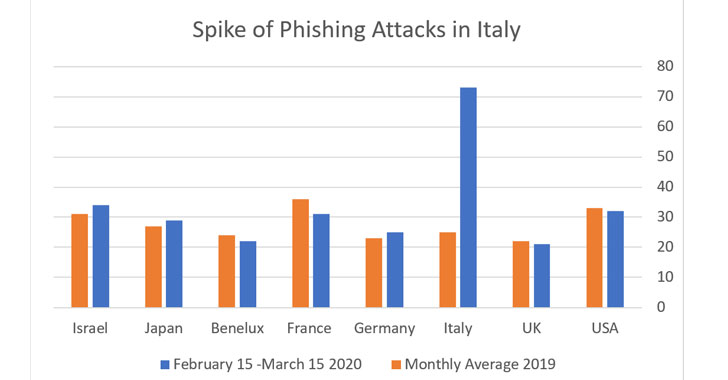
Cynet’s global threat telemetry from the recent three weeks
reveals that Italy features a sharp spike in phishing attacks in
comparison to other territories, indicating that attackers are
hunting in full force for user credentials.
detected anomalous logins to its customers’ environments, as well
as in customers actively reaching out to CyOps (Cynet MDR) to
investigate suspicious logins to critical resources.
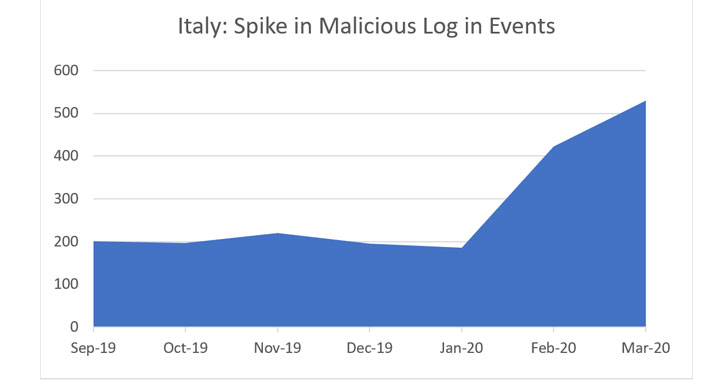
exploiting the Coronavirus derived havoc.
Weaponized Email Attacks
Employees that work from home often would do so from their personal
computers, which are significantly less secure than the
organizational ones, making them more vulnerable to malware
attacks.
Besides, Cynet released today’s figures that support the above
claim. Here is the double spike Cynet sees within its customers
from Italy of email-based attacks:

considerable threat to organizations that do not have advanced
protection in place:

to download a malicious executable embedded in the email body, the
vast majority included more advanced capabilities such as malicious
Macros and exploits or redirection to malicious websites – a
challenge that surpasses the capabilities of most AV and email
protection solutions.
Taking a closer look at how these attacks were blocked verifies
that they should be regarded as a severe risk potential:
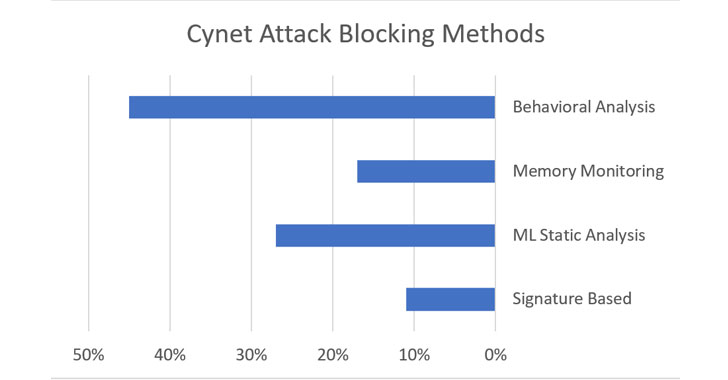
identified by its signature, indicates that the attackers behind
these campaigns are using advanced attacking tools to take
advantage of the situation’, says Eyal Gruner, CEO, and Co-Founder
of Cynet.
Moreover, there is another aspect to the Coronavirus impact. In
many cases, the functioning of the security team itself is impaired
due to missing team members in quarantine, making the detection of
malicious activity even harder.
From conversations with these companies, it turns out that the
operations of many security teams are significantly disturbed due
to quarantined team members, causing them to use Cynet’s MDR
service more often to compensate for the lack of staff.
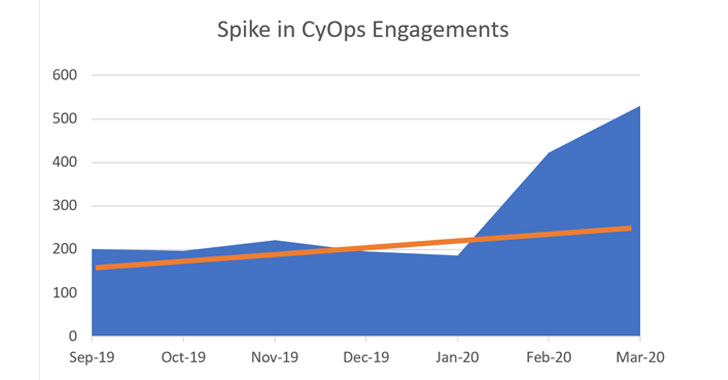
they have confirmed that a significant part of their workforce
works from home these days.’
To sum up the situation in Italy, employees working from home,
security teams that are not fully operational and general
atmosphere of uncertainty, create ideal conditions for attackers
that seek to monetize the new situation through phishing, social
engineering, and weaponized emails.
The data from Cynet’s Italian install base should serve as an
illustrative example of the cyber effect in a territory where
Coronavirus has a high prevalence. While this is not yet the case
for other countries, the rapid Coronavirus spread implies that the
cyber threat landscape in Italy would soon be duplicated in other
geolocations as well.
In order to efficiently confront these threats, CISOs should
evaluate the defenses they have in place and see whether they
provide protection against phishing and malicious logins.
As a breach protection platform, Cynet introduces a dedicated
offering tailored to the new Coronavirus related cyber risks.
For both existing and new customers, Cynet will allow, free of
charge (for 6 months), the deployment of its product, Cynet 360, on
personal computers used by employees working from home.
Cynet massively adds staff to CyOps, its MDR services team, to
be able to cover for companies with reduced security staff because
of the Coronavirus.
References
- ^
Coronavirus
(www.who.int) - ^
impact on information security
(thehackernews.com) - ^
learn more here
(www.cynet.com) - ^
Learn more about Cynet’s offering
(www.cynet.com)
Read more http://feedproxy.google.com/~r/TheHackersNews/~3/8ub8woGLdps/coronavirus-cybersecurity-ciso.html