
physical security key as hardware-based two-factor authentication
to securely log into a remote system via SSH protocol.
OpenSSH, one of the most widely used open-source implementations
of the Secure Shell (SSH) Protocol, yesterday announced the 8.2
version of the software that primarily includes two new significant
security enhancements.
First, OpenSSH 8.2 added support for FIDO/U2F hardware
authenticators, and the second, it has deprecated SSH-RSA
public key signature algorithm and planned to disable it by default
in the future versions of the software.
[1]
FIDO (Fast Identity Online) protocol based hardware security
devices are stronger and fool-proof mechanisms for authentication
because it enables public-key cryptography to protect against
advanced malware, phishing, and man-in-the-middle attacks.
“In OpenSSH, FIDO devices are supported by new public key types’
ecdsa-sk’ and ‘ed25519-sk’, along with corresponding certificate
types,” the OpenSSH 8.2 release note says.
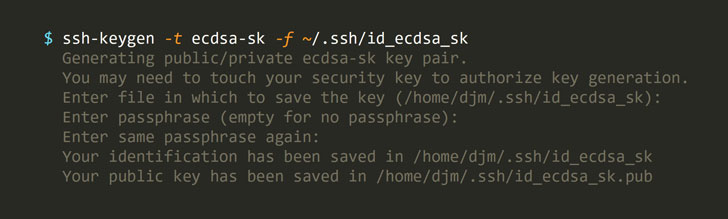
attached via other means such as Bluetooth or NFC. In OpenSSH,
communication with the token is managed via a middleware library.”
OpenSSH team first introduced the support for U2F/FIDO as
an experimental
feature[2] in November 2019, which
relied on the same middleware for Yubico’s libfido2 that is capable
of talking to any standard USB HID U2F or FIDO2 token.
A physical security key adds an extra layer of authentication to
an account on top of your password, and users can quickly log into
their accounts securely just by inserting the USB security key and
pressing a button.
That means, even if attackers manage to infect your computer or
somehow steal your SSH password, they would not be able to access
the remote system over SSH without presenting the physical security
key.
Besides this, the announcement to deprecate SSH-RSA public key
signature algorithm is also significant because SHA-1 hash
algorithm[3] is slow and potentially
insecure that can be cracked easily using fewer resources than ever
before.
“This algorithm is unfortunately still used widely despite the
existence of better alternatives, being the only remaining
public-key signature algorithm specified by the original SSH
RFCs.”
“A future release of OpenSSH will enable UpdateHostKeys by
default to allow the client to automatically migrate to better
algorithms. Users may consider enabling this option manually.”
If you are unaware, OpenSSH last year also introduced
another security feature that encrypts private
keys[4] before storing them into
the system memory, protecting it against almost all types of
side-channel attacks.
You can find more information about the latest release and guide
on how to generate hardware security keys with OpenSSH in the
release
notes.
[5]
References
- ^
FIDO/U2F hardware authenticators
(thehackernews.com) - ^
an experimental feature
(marc.info) - ^
SHA-1 hash algorithm
(thehackernews.com) - ^
encrypts private keys
(thehackernews.com) - ^
release notes
(www.openssh.com)
Read more http://feedproxy.google.com/~r/TheHackersNews/~3/PZoNEdHBet4/openssh-fido-security-keys.html