
the existence of 12 potentially severe security vulnerabilities,
collectively named ‘SweynTooth,’ affecting millions of
Bluetooth-enabled wireless smart devices worldwide—and worryingly,
a few of which haven’t yet been patched.
All SweynTooth flaws basically reside in the way software
development kits (SDKs) used by multiple system-on-a-chip (SoC)
have implemented Bluetooth Low Energy (BLE) wireless communication
technology—powering at least 480 distinct products from several
vendors including Samsung, FitBit and Xiaomi.
According to the researchers, hackers in close physical
proximity to vulnerable devices can abuse this vulnerability to
remotely trigger deadlocks, crashes, and even bypass security in
BLE products, allowing them to arbitrary read or write access to
device’s functions that are otherwise only allowed to be accessed
by an authorized user.
“As of today, SweynTooth vulnerabilities are found in the BLE SDKs
sold by major SoC vendors, such as Texas Instruments, NXP, Cypress,
Dialog Semiconductors, Microchip, STMicroelectronics and Telink
Semiconductor,” the researchers from the Singapore University of
Technology and Design said.
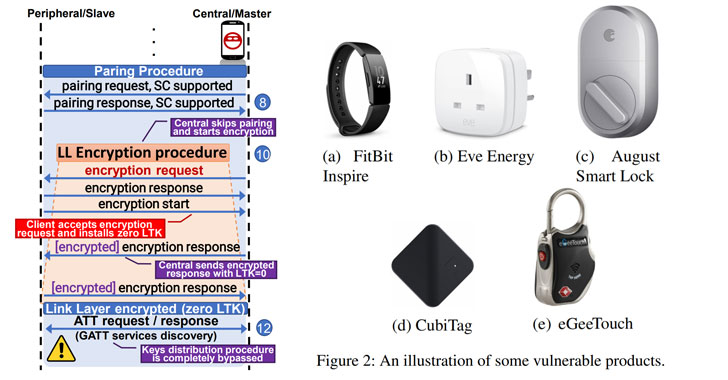
vulnerabilities:
- Link Layer Length Overflow (CVE-2019-16336,
CVE-2019-17519) — These allow attackers in radio range
to trigger a buffer overflow by manipulating the LL Length Field,
primarily leading to a denial of service attacks. - Link Layer LLID deadlock (CVE-2019-17061,
CVE-2019-17060) — These trigger deadlock state when a device
receives a packet with the LLID field cleared. - Truncated L2CAP (CVE-2019-17517) — This flaw
results due to a lack of checks while processing an L2CAP packet,
causing a denial of service and crash of the device. - Silent Length Overflow (CVE-2019-17518) — A buffer
overflow occurs when a certain packet payload with higher than
expected LL Length is sent, the peripheral crashes. - Invalid Connection Request (CVE-2019-19195) — When
devices do not properly handle some connection parameters while the
central attempts a connection to the peripheral, they could lead to
Deadlock state. - Unexpected Public Key Crash (CVE-2019-17520) — This
bug is present in the implementation of the legacy pairing
procedure, which is handled by the Secure Manager Protocol (SMP)
implementation, and can be used to perform DoS and possibly restart
products. - Sequential ATT Deadlock (CVE-2019-19192) — This flaw
lets attackers deadlock the peripheral by sending just two
consecutive ATT request packets in each connection event. - Invalid L2CAP fragment (CVE-2019-19195) — improper
handling of the PDU size of the packets can lead to deadlock
behavior. - Key Size Overflow (CVE-2019-19196) — This overflow
in the device memory issue is a combination of multiple bugs found
during the pairing procedure of devices, resulting in a crash. - Zero LTK Installation (CVE-2019-19194) — This critical
vulnerability is a variation of one of the Key Size Overflow. It
affects all products using Telink SMP implementation with support
for secure connection enabled.
The detailed
report[1] says affected products
include consumer electronics, smart home devices, wearables, and
are also being used in the logistics and healthcare industry,
malfunctioning of which can lead to hazardous situations.

SweynTooth are the medical products. VivaCheck Laboratories, which
manufacture Blood Glucose Meters, has many products listed to use
DA14580,” the researchers said.
“Hence all these products are potentially vulnerable to the
Truncated L2CAP attack. Even worse, Syqe Medical Ltd. and their
programmable drug delivery inhalation platform (Syqe Inhaler v01)
is affected alongside the latest pacemaker related products from
Medtronic Inc.”
According to the report, researchers disclosed these flaws last
year to all affect vendors, many of which have now released patches
for their respective SoCs.
Wheres, products developed by some SoC vendors, including
Dialog, Microchip, and STMicroelectronics, are unpatched at the
time of the disclosure.
References
- ^
detailed report
(asset-group.github.io)
Read more http://feedproxy.google.com/~r/TheHackersNews/~3/l6jCGcibHXw/hacking-bluetooth-vulnerabilities.html