
smartphones and tablets, using Qualcomm chipsets, are vulnerable to
a new set of potentially serious vulnerabilities.
According to a report[1] cybersecurity firm
CheckPoint shared with The Hacker News, the flaws could allow
attackers to steal sensitive data stored in a secure area that is
otherwise supposed to be the most protected part of a mobile
device.
The vulnerabilities reside in Qualcomm’s Secure Execution
Environment (QSEE), an implementation of Trusted Execution
Environment (TEE) based on ARM TrustZone technology.
Also known as Qualcomm’s Secure World, QSEE is a
hardware-isolated secure area on the main processor that aims to
protect sensitive information and provides a separate secure
environment (REE) for executing Trusted Applications.
Along with other personal information, QSEE usually contains
private encryption keys, passwords, credit, and debit card
credentials.
Since it is based on the principle of least privilege, Normal World
system modules like drivers and applications can not access
protected areas unless necessary—even when they have root
permissions.
“In a 4-month research project, we succeeded in reverse Qualcomm’s
Secure World operating system and leveraged the fuzzing technique
to expose the hole,” researchers told The Hacker News.
“We implemented a custom-made fuzzing tool, which tested trusted
code on Samsung, LG, Motorola devices,” which allowed researchers
to find four vulnerabilities in trusted code implemented by
Samsung, one in Motorola and one in LG.
- dxhdcp2 (LVE-SMP-190005)
- sec_store (SVE-2019-13952)
- authnr (SVE-2019-13949)
- esecomm (SVE-2019-13950)
- kmota (CVE-2019-10574)
- tzpr25 (acknowledged by Samsung)
- prov (Motorola is working on a fix)
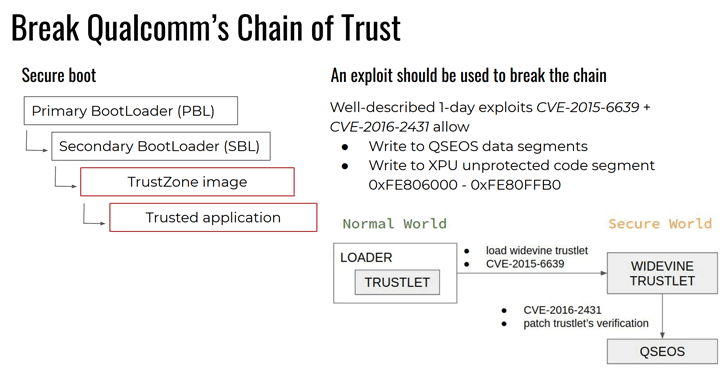
secure components of Qualcomm could allow an attacker to:
- execute trusted apps in the Normal World (Android OS),
- load patched trusted app into the Secure World (QSEE),
- bypassing Qualcomm’s Chain Of Trust,
- adapt the trusted app for running on a device of another
manufacturer, - and more.
“An interesting fact is that we can load trustlets from another
device as well. All we need to do is replace the hash table,
signature, and certificate chain in the .mdt file of the trustlet
with those extracted from a device manufacturer’s trustlet,”
researchers said.
vulnerable to a wide range of security threats, including the
leakage of protected data, device rooting, bootloader unlocking,
and execution of undetectable APT.
The vulnerabilities also affect a wide range of smartphone and
IoT devices that use the QSEE component to secure users’ sensitive
information.
Check Point Research responsibly disclosed its findings to all
affected vendors, out of which Samsung, Qualcomm, and LG have
already released a patch update for these QSEE
vulnerabilities.
Read more http://feedproxy.google.com/~r/TheHackersNews/~3/5GzLfHHH_EI/qualcomm-android-hacking.html