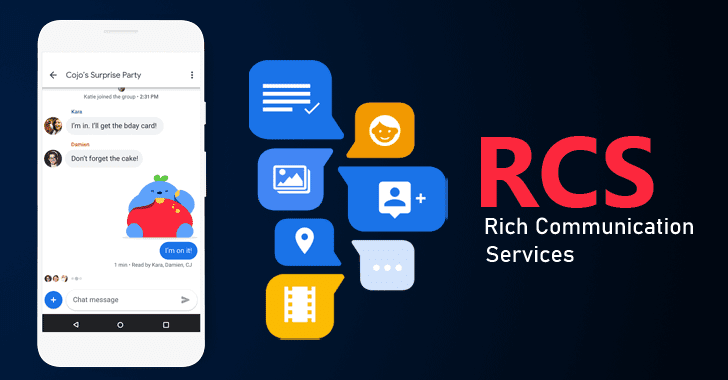
universal cross-carrier communication standard for the
next-generation RCS messaging service that is meant to replace SMS
and has the potential to change the way consumers interact
with brands for years to come.
All major United States mobile phone carriers, including
AT&T, Verizon, T-Mobile, and Sprint, have joined forces to
launch a new initiative that will replace SMS with RCS mobile
messaging standard.
What’s more? The initiative is also working with its carrier
ownership group and other companies to develop and deploy the new
RCS standard in a new text messaging app for Android phones that is
expected to be launched in 2020.
The goal of this joint venture, dubbed the Cross Carrier
Messaging Initiative (CCMI), is to deliver the GSMA’s Rich
Communications Service (RCS) industry standard to consumers and
businesses on each of the four carriers, both in the United States
and globally.
“Efforts like CCMI help move the entire industry forward so we can
give customers more of what they want and roll out new messaging
capabilities that work the same across providers and even across
countries,” said T-Mobile CEO John Legere.
Besides this, the initiative also wants to provide users with
the ability to communicate with businesses, so they can “chat with
their favorite brands, order rideshare, pay bills or schedule
appointments, and more.”
Why RCS Hasn’t Killed SMS Yet?
Although the RCS standard was developed over a decade ago, it has
never been adopted widely due to complicated mobile carrier and
phone maker politics; for example, Apple has no interest in RCS
because it is already offering more than that through iMessages.
Even a few carriers and services who are offering the new
messaging standard have implemented their non-universal
specifications of RCS standard, which limits the exchange of
RSC-based messages only to the subscribers of their networks.
Earlier this year, Google also independently released RCS
messaging for Android smartphones in two countries, the United
Kingdom and France, instead of waiting for cellphone carriers to
roll it out.
Not End-to-End Encrypted, But RCS Offers Some Integrity
Unlike ancient SMS technology, RCS-based enhanced text message
service supports high-resolution photo sharing, location sharing,
group messaging, animated stickers, read receipts, and some other
features like Apple iMessage, to significantly improve messaging
functionality that comes installed on phones by default.
However, unlike iMessage, Signal, and WhatsApp, RCS-based
messages are not end-to-end encrypted.
mechanisms to ensure users interact with legitimate brands,
protecting them from fraudulent accounts, impersonators, or
phishing attempts.
Besides this, SMS communicates over SMPP or insecure SS7
protocols, whereas RCS traffic between the device and the network
can be protected using SIP over TLS encryption.
Since the CCMI project has not yet fully developed its RCS-based
messaging standard, it’s not clear, at this moment, if the major
U.S. carriers would come up with something that will ensure users’
privacy from government surveillance.
However, the announcement does say that it will “enable an
enhanced experience to privately send individual or group chats
across carriers with high-quality pictures and videos,” the press
release says.
“The CCMI will bring a consistent, engaging experience that makes
it easy for consumers and businesses to interact in an environment
they can trust. As we have seen in Asia, messaging is poised to
become the next significant digital platform. CCMI will make it
easy for consumers to navigate their lives from a smartphone,” said
Sprint CEO Michel Combes.
“At Verizon, our customers depend on reliable text messaging to
easily connect them to the people they care about most. Yet, we can
deliver even more working together as an industry. CCMI will create
the foundation for an innovative digital platform that not only
connects consumers with friends and family but also offers a
seamless experience for consumers to connect with businesses in a
compelling and trusted environment,” said Verizon Consumer Group
CEO Ronan Dunne.
Android by next year, it will not be available to all Android users
at the same time, as users might also need to have a smartphone
that supports the standard.
Read more http://feedproxy.google.com/~r/TheHackersNews/~3/A_IuM5hpyBA/rcs-messaging-sms.html