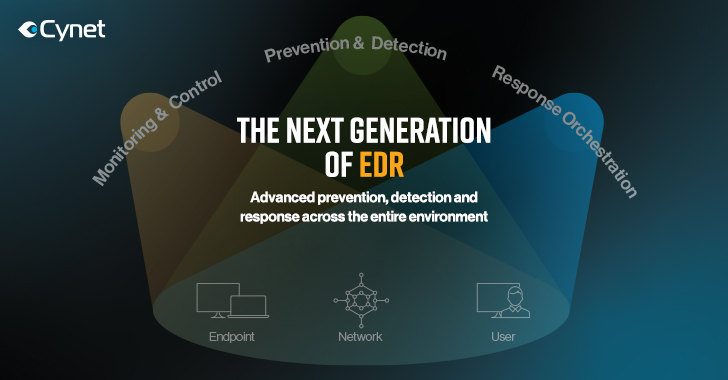
(EDR) as their main protection against breaches. EDR, as a
category, emerged in 2012 and was rapidly acknowledged as the best
answer to the numerous threats that legacy AV unsuccessfully
struggled to overcome – exploits, zero-day malware and fileless
attacks are prominent examples.
While there is no dispute on EDR’s efficiency against a
significant portion of today’s advanced threats, a new breed of
“next-generation EDR” solutions are now available (learn more
here[1]) which on top of
featuring all EDR capabilities, go beyond this to protect against
prominent attack vectors that EDR does not cover such as those
involving users and networks.
“Many people unknowingly mix two different things – endpoint
protection and breach protection,” explained Eyal Gruner,
co-Founder of Cynet[2] (a next-generation EDR
solution).
“It’s perfectly true that many attacks start at the endpoint and
involve malicious files and processes, making EDR a perfect
solution for the endpoint. However, the actual attack surface is
much broader than this, and at the end of the day, it’s not the
endpoints you want to protect – it’s your organization.”
Gruner, a former white-hat hacker (starting when he was
15-years-old), also founded BugSec, Israel’s largest cybersecurity
consulting company. Today, he is a world-recognized expert 0n
attacker tools, techniques, and practices.
“Think of it like this: by definition, each attacker’s activity
generates some kind of anomaly. It only makes sense, because what
we consider to be ‘normal behavior’ doesn’t include compromising
resources and stealing data. These anomalies are the anchor that
enable security products – or threat analysts for that matter – to
identify that something bad is happening and block it.”
places – process execution, network traffic, or user activity. For
example, ransomware generates a process execution anomaly since
there is a process that attempts to interact with a large number of
files.
Many types of lateral movement, on the other hand, include a
network traffic anomaly in the form of unusually high SMB traffic.
In a similar manner, when an attacker logs in to a critical server
with compromised user account credentials, the only anomaly is in
the user behavior. In both cases, it’s impossible to unveil the
attack through monitoring processes alone.
“EDR is a great tool for the attacks that can be identified
through process anomalies,” said Gruner. “It sits on the endpoint
and monitors process behavior, so you’re fairly covered against
this group of threats. But what about all the rest? There are many
mainstream vectors that operate on the network traffic and user
behavior without triggering the slightest process anomaly and EDR
is practically blind to these threats.”
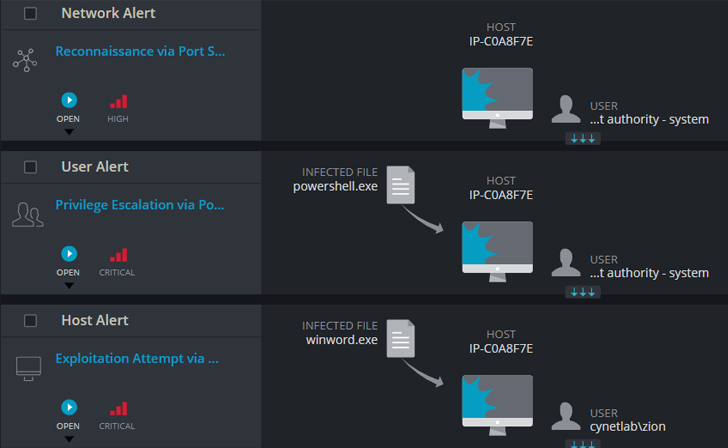 |
| Next Gen EDR Detecting Malicious Activity Across Endpoint, Network and Users |
To better understand the problem, let’s step into the attacker’s
shoes. He has successfully compromised an endpoint and is now
calculating his way onward in the environment, to access and then
exfiltrate sensitive data. There are several steps necessary to
accomplish this task. Let’s use one as an example – credential
theft.
High privilege credentials are essential to access resources in
the environment. The attacker might attempt to dump them from the
compromised endpoint’s memory. An EDR would probably catch this
because it would cause a process anomaly.
However, password hashes can also be harvested by intercepting
internal network traffic (utilizing techniques such as ARP
poisoning or DNS responder) which can be identified only through
monitoring for a network traffic anomaly – and EDR would miss this
altogether.
“From my experience, attackers that are good at their job usually
learn quickly what defense measures are in place and act
accordingly,” said Gruner. “If there’s a good EDR in place, they’ll
shift their techniques to the network and user fields and operate
freely under the EDR’s radar.”
“So, if you want a component in your security stack that will
protect you only from process-based attacks such as malware,
exploits, etc., EDR can provide coverage. If what you’re seeking is
protection from breaches, you need to think much broader – this is
why we created Cynet 360.”
user activity, providing full coverage of the attack vectors that
are used in today’s advanced attacks. This means essentially all
the capabilities of an EDR, expanded and integrated with User
Behavior Analytics and Network Analytics, and complemented by a
robust deception layer that enables operators to plant decoy data
files, passwords, network shares, etc. and deceive attackers into
luring their presence.
But Cynet gives much more than just incremental value. “It’s not
just process-based threats plus network-based threat plus
user-based threats, said Gruner. “The more advanced the attacker
is, the better he is at concealing his presence and activity. So
there are many attacks that are invisible if you only look at
processes or traffic or user behavior.”
“It’s only by joining these signals together to form a context
that you can identify that there’s something malicious going on.
Cynet 360 automates the creation of this context to unveil multiple
threats that are otherwise invisible.”
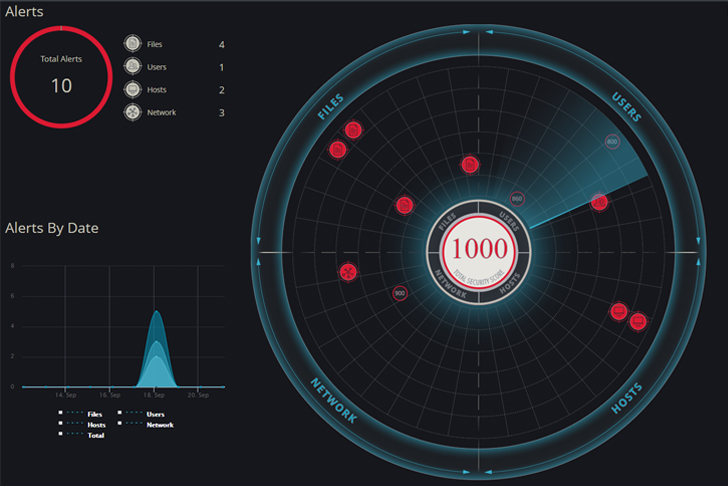 |
| Next Gen EDR delivers full visibility into all threats |
Gruner concludes, “No protection is one-hundred percent, but you
must have guards across all the main roads. Can attackers bypass
them? I guess the answer is yes if they are skilled, determined,
and resourceful enough. But if you monitor all the main anomaly
paths, it would force them to work really hard – more than most of
them would want to,” Added Gruner.
“EDR is an amazing thing, and that’s why Cynet 360 includes all
of its capabilities – plus more. EDR alone is not enough for sound
breach protection, and that’s why we gave Cynet 360 all the
rest.”
References
- ^
learn more here
(www.cynet.com) - ^
Cynet
(www.cynet.com) - ^
Learn more about next-generation EDR
here (www.cynet.com)
Read more http://feedproxy.google.com/~r/TheHackersNews/~3/SUc9TyO9Yrk/cynet-endpoint-detection-response.html