
have also asked you over an email for your assistance to help save
“the first African astronaut lost in space” have finally been
arrested by the FBI.
Don’t take it too seriously, as there’s no Nigerian prince or an
astronaut seeking your help.
Instead, it was an infamous ‘Nigerian 419’ scam email template
where fraudsters try to dupe you into making a quick online payment
by offering a share in a large sum of money on the condition you
help them transfer money out of their country.
The FBI today announced[1]
the arrests of 281 suspects from around the world as part of an
internationally coordinated law enforcement operation aimed at
disrupting multi-billion-dollar BEC email and wire transfer
scams.
With no surprise, the largest number of arrests were made in
Nigeria where authorities detained a total of 167 suspects, though
a significant number of arrests were also made in nine other
countries.
According to the United States Department of
Justice, 74 suspects were arrested in the United States, 18 in
Turkey, 15 in Ghana and the rest of the arrests were made in
France, Italy, Japan, Kenya, Malaysia, and the United Kingdom
(UK).
[2]
Dubbed Operation reWired, the four-month-long global
operation resulted in the seizure of nearly $3.7 million and
follows a June 2018 email scam enforcement operation known as ‘Wire
Wire,’ which lead to the arrest of 74 suspects around the world,
seizure of almost $2.4 million, and recovery of nearly $14 million
in fraudulent wire transfers.
The arrests primarily targeted scammers who were involved in
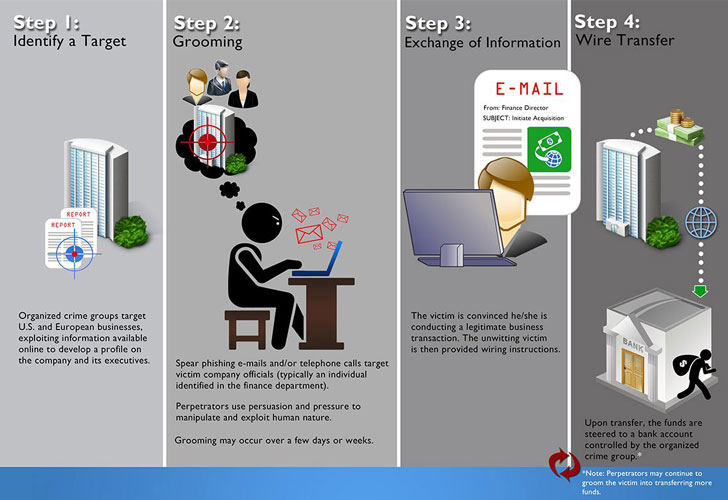
Business Email Compromise (BEC) schemes, also known as
“cyber-enabled financial fraud,” where cybercriminals use a spoofed
email or compromised account, impersonating the CEO or CFO, to
trick someone in the finance department of a targeted company into
initiating a money transfer to a fraudulent account.
“A number of cases involved international criminal organizations
that defrauded small to large-sized businesses, while others
involved individual victims who transferred high dollar funds or
sensitive records in the course of business,” the DoJ says.
“The devastating effects these cases have on victims and victim
companies affect not only the individual business but also the
global economy.”
forms of frauds such as romance scams, employment opportunities
scams, fraudulent online vehicle sales scams, rental scams, and
lottery scams.
May 2019 and discovered that “the conspirators stole more than
250,000 identities and filed more than 10,000 fraudulent tax
returns, attempting to receive more than $91 million in refunds,”
according to Chief Don Fort of IRS Criminal Investigation.
BEC Now A $26 Billion Online Fraud
According to the FBI’s Internet Crime Complaint Center (IC3),
between June 2016 and July 2019, there were over 166,000 domestic and
international reports[3]
of email scams resulting in more than $26 billion in losses, up
from a previous estimate of $12 billion.
In 2018 alone, nearly $1.3 billion, which is almost twice as much
as 2017, in loses was reported from BEC scams and its variant,
Email Account Compromise.
“Through Operation reWired, we’re sending a clear message to the
criminals who orchestrate these BEC schemes: We’ll keep coming
after you, no matter where you are,” said FBI Director Christopher
A. Wray.
“And to the public, we’ll keep doing whatever we can to protect
you. Reporting incidents of BEC and other internet-enabled crimes
to the IC3 brings us one step closer to the perpetrators.”
two dozen US Attorney’s Offices, US Secret Service, Homeland
Security Investigations, IRS Criminal Investigation, US Postal
Inspection Service, and US Department of State’s Diplomatic
Security Service.
References
- ^
announced
(www.fbi.gov) - ^
Department of Justice
(www.justice.gov) - ^
166,000 domestic and international
reports (www.ic3.gov)
Read more http://feedproxy.google.com/~r/TheHackersNews/~3/bdjACX-V6wo/nigerian-bec-scams-arrested.html