2.0, GM bot, and
Exobot, quit their malware-as-a-service businesses, a new
player has emerged on the Internet with similar capabilities to
fill the gap, offering Android bot rental service to the masses.
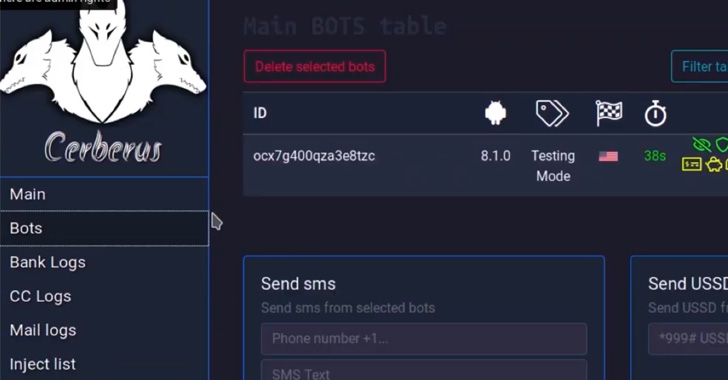
Dubbed “Cerberus,” the new remote access Trojan allows
remote attackers to take total control over the infected Android
devices and also comes with banking Trojan capabilities like the
use of overlay attacks, SMS control, and contact list
harvesting.
According to the author of this malware, who is surprisingly
social on Twitter and mocks security researchers and antivirus
industry openly, Cerberus has been coded from scratch and doesn’t
re-use any code from other existing banking Trojans.
The author also claimed to be using the Trojan for private
operations for at least two years before renting it out for anyone
interested from the past two months at $2000 for 1 month
usage, $7000 for 6 months and up to $12,000 for 12 months.
Cerberus Banking Trojan: Features
According to security researchers at Threat Fabric who analyzed a
sample of Cerberus Trojan, the malware has a pretty common list of
features, like:
- taking screenshots
- recording audio
- recording keylogs
- sending, receiving, and deleting SMSes,
- stealing contact lists
- forwarding calls
- collecting device information
- Tracking device location
- stealing account credentials,
- disabling Play Protect
- downloading additional apps and payloads
- removing apps from the infected device
- pushing notifications
- locking device’s screen
Once infected, Cerberus first hides its icon from the application
drawer and then asks for the accessibility permission by
masquerading itself as Flash Player Service. If granted, the
malware automatically registers the compromised device to its
command-and-control server, allowing the buyer/attacker to control
the device remotely.
To steal users’ credit card numbers, banking credentials and
passwords for other online accounts, Cerberus lets attackers launch
screen overlay attacks from its remote dashboard.
In screen overlay attack, the Trojan displays an overlay on top of
legitimate mobile banking apps and tricks Android users into
entering their banking credentials into the fake login screen, just
like a phishing attack.
“The bot abuses the accessibility service privilege to obtain the
package name of the foreground application and determine whether or
not to show a phishing overlay window,” the researchers said.
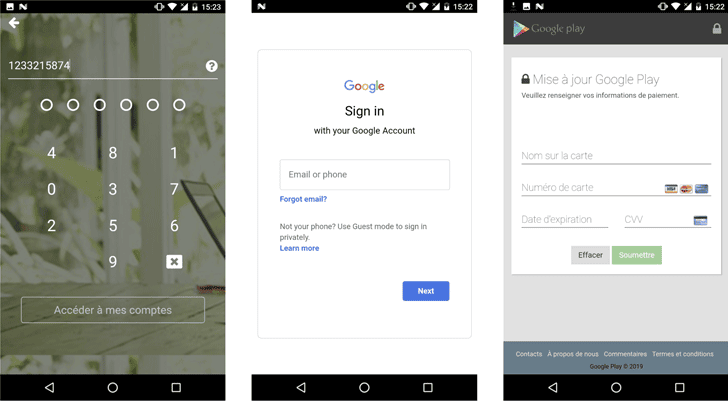
attack templates for a total of 30 unique targets, including:
- 7 French banking apps
- 7 U.S. banking apps
- 1 Japanese banking app
- 15 non-banking apps
Cerberus Uses Motion-based Evasion Tactic
Cerberus also uses some interesting techniques to evade detection
from antivirus solutions and prevent its analysis, like using the
device accelerometer sensor to measure movements of the victim.
The idea is straightforward—as a user moves, their Android device
usually generates some amount of motion sensor data. The malware
monitors the user’s steps through the device motion sensor to check
if it is running on a real Android device.
“The Trojan uses this counter to activate the bot—if aforementioned
step counter hits the pre-configured threshold it considers running
on the device to be safe,” the researchers explain.
“This simple measure prevents the Trojan from running and being
analyzed in dynamic analysis environments (sandboxes) and on the
test devices of malware analysts.”
the sandbox for scanning malware is an emulator with no motion
sensors and will not run the malicious code.
However, this technique is also not unique and has previously
been implemented by the popular Android banking
Trojan ‘Anubis’[5].
It should be noted that Cerberus malware does not exploit any
vulnerability to get automatically installed on a targeted device
in the first place. Instead, the malware installation relies on
social engineering tactics.
Therefore, to protect yourself from becoming victims to such
malware threats, you are recommended to be careful what you
download on your phone and definitely think thrice before
side-loading stuff as well.
References
- ^
Anubis
(thehackernews.com) - ^
Red Alert 2.0
(thehackernews.com) - ^
GM bot
(thehackernews.com) - ^
analyzed
(www.threatfabric.com) - ^
Android banking Trojan ‘Anubis’
(thehackernews.com)
Read more http://feedproxy.google.com/~r/TheHackersNews/~3/FIOAaWi0UE0/cerberus-android-banking-trojan.html