
lawsuit that accused the company of knowingly selling video
surveillance system containing severe security vulnerabilities to
the U.S. federal and state government agencies.
It’s believed to be the first payout on a ‘False Claims
Act‘ case over failure to meet cybersecurity standards.
The lawsuit began eight years ago, in the year 2011, when Cisco
subcontractor turned whistleblower, James Glenn, accused Cisco of
continue selling a video surveillance technology to federal
agencies even after knowing that the software was vulnerable to
multiple security flaws.
According to the court documents seen by The Hacker News, Glenn
and one of his colleagues discovered multiple vulnerabilities in
Cisco Video Surveillance Manager (VSM) suite in September
2008 and tried to report them to the company in October
2008.
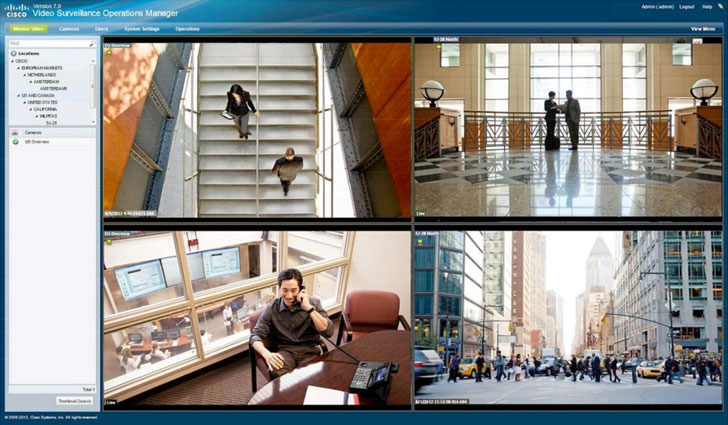
Cisco Video Surveillance Manager (VSM) suite allows
customers to manage multiple video cameras at different physical
locations through a centralized server, which in turn, can be
accessed remotely.
The vulnerabilities could have reportedly enabled remote hackers
to gain unauthorized access to the video surveillance system
permanently, eventually allowing them to gain access to all video
feeds, all stored data on the system, modify or delete video feeds,
and bypass security measures.
working at that time, fired him shortly after he reported Cisco’s
security violations, which the company officially described as a
cost-cutting measure.
However, in 2010, when Glenn realized that Cisco never fixed
those issues neither notified its customers, he informed the U.S.
federal agency, who then launched a lawsuit claiming Cisco had
defrauded U.S. federal, state and local governments who purchased
the product.
Cisco, directly and indirectly, sold its VSM software suit to
police departments, schools, courts, municipal offices and airports
as we as to many government agencies including the U.S. Department
of Homeland Security, the Secret Service, the Navy, the Army, the
Air Force, the Marine Corps and the Federal Emergency Management
Agency (FEMA).
“Cisco has known of these critical security flaws for at least two
and a half years; it has failed to notify the government entities
that have purchased and continue to use VSM of the vulnerability,”
the lawsuit states.
“Thus, for example, an unauthorized user could effectively shut
down an entire airport by taking control of all security cameras
and turning them off. Alternately, such a hacker could access the
video archives of a large entity to obscure or eliminate video
evidence of theft or espionage.”
the vulnerabilities (CVE-2013-3429, CVE-2013-3430, CVE-2013-3431)
and released an updated version of its VSM software suit.
As part of the lawsuit, Cisco has finally agreed to pay $8.6
million in the settlement—of which Glenn and his lawyers will
receive $1.6 million and the rest $7 million going to the federal
government and the 16 states that purchased the affected
product.
In response to the latest settlement, Cisco issued an official
statement[2]
Wednesday saying it was “pleased to have resolved” the 2011 dispute
and that “there was no allegation or evidence that any unauthorized
access to customers’ video occurred” as a result of its VSM suit’s
architecture.
However, the company added that video feeds could “theoretically
have been subject to hacking,” though the lawsuit has not claimed
that anyone had exploited the vulnerabilities discovered by
Glenn.
References
- ^
acknowledged
(tools.cisco.com) - ^
statement
(blogs.cisco.com)
Read more http://feedproxy.google.com/~r/TheHackersNews/~3/aHxCowF2yo0/cisco-surveillance-technology.html