
trick the plane’s electronic systems into displaying false flight
data to the pilot, which could eventually result in loss of
control?
Of course, the attacker would never wish to be on the same
flight, so in this article, we are going to talk about a potential
loophole that could allow an attacker to exploit a vulnerability
with some level of “unsupervised” physical access to a small
aircraft before the plane takes off.
The United States Department of Homeland Security’s (DHS) has
issued an alert for the
same, warning owners of small aircraft to be on guard against a
vulnerability that could enable attackers to easily hack the
plane’s CAN bus and take control of key navigation systems.
[1]
The vulnerability, discovered by a
cybersecurity researcher at Rapid 7, resides in the modern
aircraft’s implementation of CAN (Controller Area Network) bus—a
popular vehicular networking standard used in automobiles and small
aircraft that allows microcontrollers and devices to communicate
with each other in applications without a host computer.
Rapid7 researcher Patrick Kiley demonstrated that a hacker with
physical access to a small aircraft’s wiring could attach a
device—or co-opt an existing attached device—to the plane’s
avionics CAN bus to insert false data and communicate them to the
pilot.
“Modern aircraft use a network of electronics to translate signals
from the various sensors and place this data onto a network to be
interpreted by the appropriate instruments and displayed to the
pilot,” Kiley said in a report[3] published Tuesday.
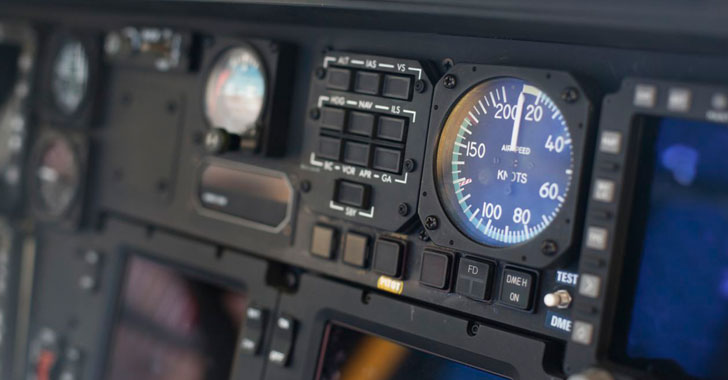
- Engine telemetry readings
- Compass and attitude data
- Altitude, airspeed, and angle of attack (AoA) data
“The researchers have further outlined that a pilot relying on
instrument readings would be unable to distinguish between false
and legitimate readings, which could result in loss of control of
the affected aircraft,” the DHS’ cyber division warned Tuesday.
Kiley demonstrated the attack after investigating avionics
systems—an electronic control and navigation system fitted in an
aircraft—from two unnamed commercial aircraft manufacturers
specialized in light aircraft.
Kiley found that the key problem with the avionics CAN bus is that
it is integrated into the aircraft’s other components without any
firewalls or authentication, which means untrusted connections over
a USB adapter attached to the plane can send unauthorized commands
to its electronic systems.
“In avionics, these systems provide the foundation of control
systems and sensor systems and collect data such as altitude,
airspeed, and engine parameters such as fuel level and oil
pressure, then display them to the pilot,” the researcher said.
“CAN packets also do not have recipient addresses or any kind of
built-in authentication mechanism. This is what makes the bus easy
to implement, but it also removes any assurance that the sending
device was the actual originator of the message.”
“unsupervised” physical access to a plane, given “current industry
practices and regulations,” nevertheless, the Rapid7 report is
worth paying attention to.
The researcher also pointed out that the avionics sector is
lagging behind the automotive industry when it comes to the CAN bus
system.
The automotive industry has made advancements in implementing
safeguards, such as CAN bus-specific filtering, whitelisting, and
segregation, that prevent similar physical attacks to CAN bus
systems. Aircraft makers should also implement these
safeguards.
The DHS’ CISA is urging aircraft manufacturers to consider
network protections around the CAN bus system and make sure they
restrict access to their planes to the best of their abilities.
Read more http://feedproxy.google.com/~r/TheHackersNews/~3/b2qV9Cria-0/airplane-can-bus-hacking.html