Doppelgänging is actively being used by not just one or two but
a large number of malware families in the wild, a new report shared
with The Hacker News revealed.
Discovered in late 2017, Process
Doppelgänging[1]
is a fileless variation of Process Injection technique that takes
advantage of a built-in Windows function to evade detection and
works on all modern versions of Microsoft Windows operating
system.
Process Doppelgänging attack works by utilizing a Windows
feature called Transactional NTFS (TxF) to launch a malicious
process by replacing the memory of a legitimate process, tricking
process monitoring tools and antivirus into believing that the
legitimate process is running.
Few months after the disclosure of this technique, a variant of the
SynAck
ransomware[2] became the first-ever
malware exploiting the Process Doppelgänging technique, targeting
users in the United States, Kuwait, Germany, and Iran.
Shortly after that, researchers discovered a dropper (loader)
for the Osiris banking
trojan[3] that was also using this
technique in combination with a previously discovered similar
malware evasion technique called Process Hollowing.
Now, turns out that it was not just SynAck or Osiris, but more
than 20 different malware families—including FormBook,
LokiBot,
SmokeLoader,
AZORult, NetWire, njRat, Pony
stealer, and GandCrab
ransomware—have been using malware loaders that leverage this
hybrid implementation of Process Doppelgänging attack to evade
detection.
[4][5][6][7][8]
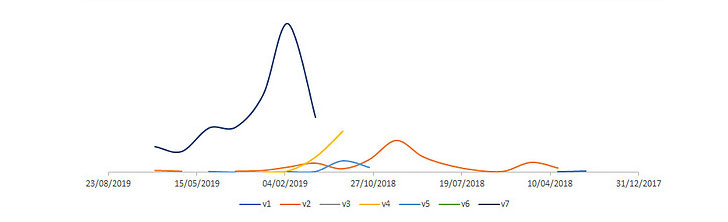
researchers at enSilo discovered[9] at least seven distinct
versions of such loader, which they dubbed “TxHollower,”
used by various malware authors.
“Attackers are known to reuse resources and tools in their attack
chains, most notable are droppers, packers, and loaders. It
highlights that shared components and code make tracking and
attributing various groups even more complicated,” researchers
said.
cybercriminals through some offensive framework or exploit kit,
eventually increasing the use of process doppelgänging-like
techniques in-the-wild.
The earliest sample of the loader with TxHollower feature was used
in March 2018 to distribute Netwire RAT, and then later also found
bundled with multiple GandCrab
versions[10], starting with v5 and
going all the way to v5.2.
Besides this, researchers at enSilo also found a few samples
wrapped in an additional layer such as MSI files and in some cases,
loaders were nested with each other.
“While we didn’t observe the actual infections, we were able to
find a few samples we suspect to be related to the infection chain
like downloaders and droppers of TxHollower. The type of files
include PE executables, JavaScript and documents,” the researchers
said.
Doppelgänging attack[11] technique works,
you can read the previous article we published in 2017, and if you
want to know more about various versions of TxHollower loader, you
can head straight on to enSilo blog post published today.
References
- ^
Process Doppelgänging
(thehackernews.com) - ^
SynAck ransomware
(thehackernews.com) - ^
Osiris banking trojan
(blog.malwarebytes.com) - ^
FormBook
(thehackernews.com) - ^
LokiBot
(thehackernews.com) - ^
SmokeLoader
(thehackernews.com) - ^
njRat
(thehackernews.com) - ^
GandCrab ransomware
(thehackernews.com) - ^
discovered
(blog.ensilo.com) - ^
GandCrab versions
(thehackernews.com) - ^
Process Doppelgänging attack
(thehackernews.com)
Read more http://feedproxy.google.com/~r/TheHackersNews/~3/sIQI9TGaGvc/process-doppelganging-malware.html