
Beware! You should be more careful while playing a video on your
smartphone—downloaded anywhere from the Internet or received
through email.
That’s because, a specially crafted innocuous-looking video file
can compromise your Android smartphone—thanks to a critical remote
code execution vulnerability that affects over 1 billion devices
running Android OS between version 7.0 and 9.0 (Nougat, Oreo, or
Pie).
The critical RCE vulnerability (CVE-2019-2107) in question resides
in the Android media framework, which if exploited, could allow a
remote attacker to execute arbitrary code on a targeted device.
To gain full control of the device, all an attacker needs to do
is tricking the user into playing a specially crafted video file
with Android’s native video player application.
Though Google already released a
patch[1] earlier this month to
address this vulnerability, apparently millions of Android devices
are still waiting for the latest Android security update that needs
to be delivered by their respective device manufacturers.
“The most severe vulnerability in this section [media framework]
could enable a remote attacker using a specially crafted file to
execute arbitrary code within the context of a privileged process,”
Google described the vulnerability in its July Android Security
Bulletin.
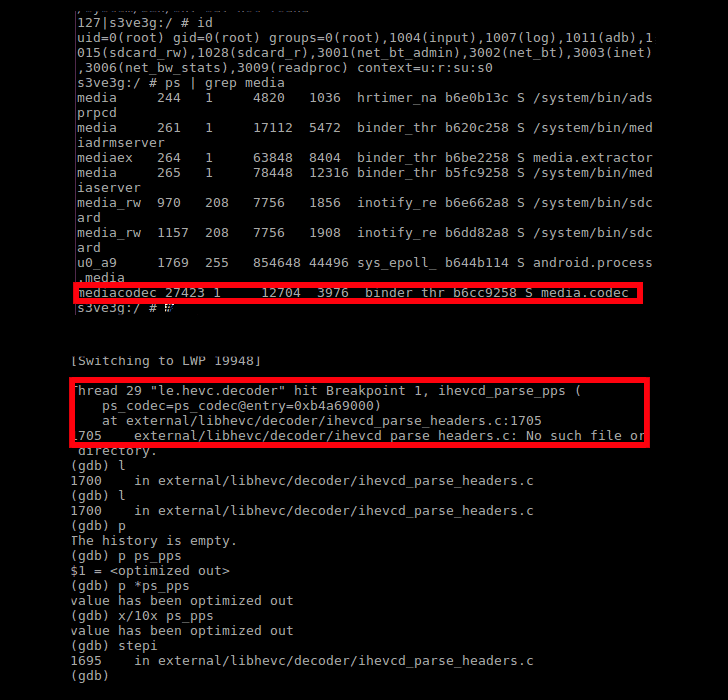
Android developer Marcin Kozlowski has uploaded a proof-of-concept for
this attack on Github.
Although the PoC shared by Kozlowski, an HEVC encoded video,
only crashes the media player, it can help potential attackers
develop their exploits to achieve RCE on targeted devices.
However, it should be noted that if such malicious videos are
received through an instant messaging app like WhatsApp or Facebook
Messenger or uploaded on a service like YouTube or Twitter, the
attack won’t work.
That’s because these services usually compress videos and
re-encode media files which distorts the embedded-malicious
code.
The best way to protect yourself from this attack is to make
sure you update your mobile operating system as soon as the latest
patch becomes available.
Meanwhile, you are recommended to avoid downloading and playing
random videos from untrusted sources and follow basic security and
privacy practices.
References
- ^
released a patch
(thehackernews.com) - ^
proof-of-concept
(github.com)
Read more http://feedproxy.google.com/~r/TheHackersNews/~3/mJkk0we54jw/android-media-framework-hack.html