
all existing Counter-Strike 1.6 game servers available online are
malicious that have been set-up to remotely hack gamers’ computers.
A team of cybersecurity researchers at Dr. Web has disclosed
that an attacker has been using malicious gaming servers to
silently compromise computers of Counter-Strike gamers worldwide by
exploiting zero-day vulnerabilities in the game client.
According to the researchers, Counter-Strike 1.6, a popular game
that’s almost two decades old, contains unpatched multiple remote
code execution (RCE) vulnerabilities in its client software that
let attackers execute arbitrary code on the gamer’s computer as
soon as they connect to a malicious server, without requiring any
further interaction from the gamers.
It turned out that a Russian gaming server developer, nicknamed
‘Belonard,’ has been exploiting these vulnerabilities in the wild
to promote his business and create a botnet of compromised gamers’
systems by infecting them with a custom Trojan.
Dubbed Belonard, the Trojan named after its developer has
been designed to gain persistence, replace the list of available
game servers in the vulnerable game client installed on the
infected systems, and create proxies to further spread the
Trojan.
“As a rule, proxy servers show a lower ping, so other players will
see them at the top of the list. By selecting one of them, a player
gets redirected to a malicious server where their computers become
infected with Trojan.Belonard,” Dr. Web said in a report[1] published Wednesday.
or pirated version of the game client via his website that is
already infected with the Belonard Trojan.
One of the 11 components of the Trojan acts as a protector of the
malicious client that “filters requests, files, and commands
received from other game servers and transfers data about attempted
changes to the client to the Trojan developer’s server.”
Here’s the attack flow diagram demonstrating how Belonard works
and infects gamers computers:
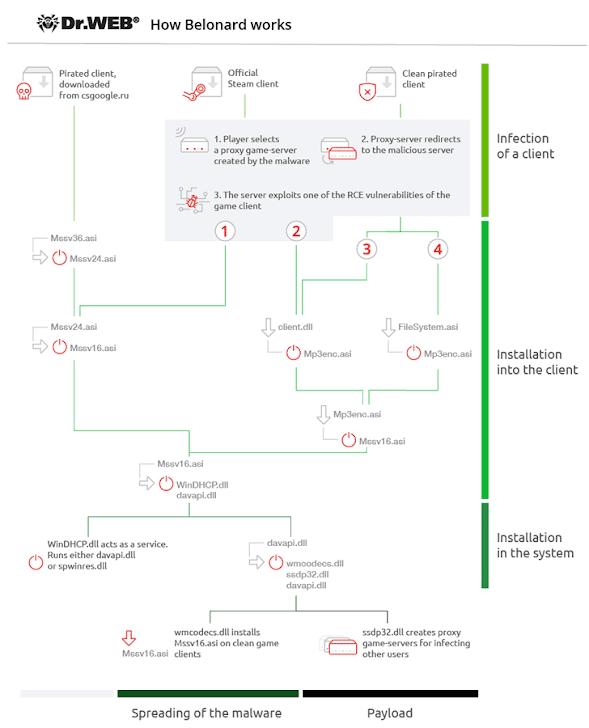
Steam API and uses encryption to store data on the system and to
communicate with its remote command-and-control server.
“According to our analysts, out of some 5,000 servers available
from the official Steam client, 1,951 were created by the Belonard
Trojan,” the researchers say.
“This is 39% of all game servers. A network of this scale
allowed the Trojan’s developer to promote other servers for money,
adding them to lists of available servers in infected game
clients.”
Corporation, developer of the Counter-Strike 1.6 game.
Additionally, Dr. Web researchers also reported malicious domain
names used by the malware developer to the Russian web registrar,
who then suspend multiple domains in an attempt to take down the
botnet.
However, taking down a few domains would not stop attackers from
setting up more malicious servers unless the Counter-Strike
developers patch the reported remote code execution vulnerabilities
in its gaming software.
Read more http://feedproxy.google.com/~r/TheHackersNews/~3/hPNtrFCCmBw/counter-strike-game-servers.html