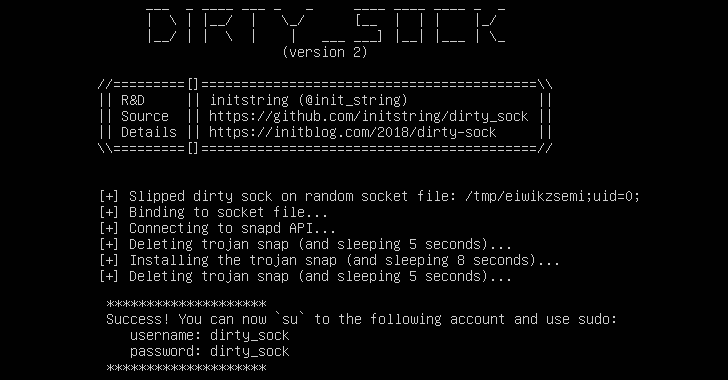
privilege escalation vulnerability that could allow a local
attacker or a malicious program to obtain root privileges and total
control over the targeted system.
Dubbed “Dirty_Sock” and identified as
CVE-2019-7304, the vulnerability was discovered by security
researcher Chris Moberly, who privately disclosed it to Canonical,
the maker of Ubuntu, late last month.
The vulnerability resides in the REST API for snapd
service, a universal Linux packaging system that makes an
application compatible for various Linux distributions without
requiring any modification.
Built by Canonical, snapd comes by default installed on all
versions of Ubuntu and also used by other Linux distributions,
including Debian, OpenSUSE, Arch Linux, Solus, and Fedora.
Snap packages are basically applications compressed together with
their dependencies that also includes instructions on how to run
and interact with other software on various Linux systems for
desktop, cloud, and Internet of Things.
Snap locally host a web server (UNIX_AF socket) to offer a list
of RESTful APIs that help the service perform various actions on
the operating system. These REST APIs come with access control to
define user-level permission for specific tasks. Some powerful APIs
are only available to root users while others can be accessed by
low-privileged users.
According to Moberly, a flaw in the way the access control
mechanism checks the UID associated with any request made to a
server allows attackers to overwrite the UID variable and access
any API function, including those that are restricted for the root
user.
“Snapd versions 2.28 through 2.37 incorrectly validated and
parsed the remote socket address when performing access controls on
its UNIX socket,” Ubuntu explains in its advisory. “A local
attacker could use this to access privileged socket APIs and obtain
administrator privileges.”
However, it should be noted that since the Dirty Sock exploit
leverages local privilege escalation flaw, it does not allow
hackers to compromise a vulnerable Linux system remotely.
Moberly has also released two proofs-of-concept (PoC) exploits
on GitHub today, one of which requires an SSH connection while the
other is able to sideload a malicious snap by abusing this API.
Canonical has released snapd version Snapd 2.37.1 this week to
address the vulnerability, and Ubuntu and other major Linux
distributions have already rolled out a fixed version of their
packages.
Linux users are highly recommended to upgrade their vulnerable
installations as soon as possible.
Read more http://feedproxy.google.com/~r/TheHackersNews/~3/D0CTaTQwPew/snapd-linux-privilege-escalation.html