Do you have an AWS interview in a few days? Then this article is
for you. Amazon web service platform is serving the cloud industry
with its multi-layered services. However, the unique need for AWS
certified professionals and associates is still there. Developers,
Engineers, and cloud platform enthusiasts are reaching out for the
AWS certifications for career
development. If you are one of them, you already know that you have
to face the companies and recruiters. The meetings or the
interviews would be great if you can get the idea of frequently
asked AWS interview Questions and answers, which of course, include
AWS solution architect interview questions, AWS lambda interview
questions as well. [1]
We understand the struggle for finding out the helpful and
authentic AWS interview questions. Our editors have covered
questions that are being asked in the discussions for several years
and picked the best answers to them. If you are a lambda
enthusiast, our AWS lambda interview questions might be helpful for
you.
If you are a computer architect, our AWS solution architect
interview questions might help. Of course, you need to have intense
preparation regarding the ins and outs of the AWS. Yet, a little
help from the experienced AWS certified individuals who have been
facing the interviews can make a more significant difference. Let’s
discuss the AWS cloud interview questions.
Essential AWS Interview
Questions
Here is the fact, the preparation is all up to you, we don’t
have anything to do with that. What we can do is a little help with
your development. Let us help you with your career growth. Today we
are going to provide you the list of frequently asked questions and
answers in an AWS interview that will help you to face your next
meeting and possibly to get the job. We will be focusing on AWS
solution architect questions, AWS lambda interview questions, and
AWS cloud interview questions besides the general questions.
Basic AWS Interview
Questions
We are going to start with the very basic and commonly asked AWS
interview questions. This list will be beneficial for both beginner
and medium level individuals. There are certain parts that
primarily you need to cover. We will be focusing on the primary and
basic parts of the AWS platform, such as AWS cloud interview
questions in this segment.
1. What are the basic services
from AWS?
Amazon Web Service solely provides cloud-based services that are
compatible with cloud platforms. There are:
- cloud computing service
- networking service
- cloud storage service
2. What do you understand by
“AWS”?
AWS means Amazon Web Service. It is a cloud-based platform that
provides several demanding services such as web services,
networking services, web-applications, management systems, database
services, and more to be followed.
3. Can you explain what EBS volume
is?
The full form of EBS is elastic block stores. EBS volumes are
the persistent volumes that can be used to attach to the EC2 instances. We use EBS volume for
providing access to multiple users to the blocks, and data security
for every single block. Even if the instances stop, your data will
be secured and safely stored.[2]
4. Are there any types of
EBS volumes?
Yes, the EBS volumes come in four categories. These
volumes are categorized based on what kind of storage is used on
the volume. Basically, SSD and HDD are used in these volumes.
SSD-based volumes are used for frequent usage, and HDD-based
volumes are used for larger data storage.
- gp2 volume
- io2 volume
- st1 volume
- sc1 volume
5. Can you explain GP2
volume?
GP2 uses the SSD volume for better performance. The GP
stands for general purpose. This comes in 1 Gibibyte to 16 Gibibyte
storage. The test environment, dev environment, and overall system
volume can be covered up by gp2. GP2 also provides several virtual
desktops, bootable volumes, and 2,375 MB per second. For a wide
range of workloads and a secured development environment, GP2 is
highly recommended.
6. What is io1 volume? How gp2 and
io2 are different than each other?
io2 EBS volume is set up for more extensive and sensitive data.
io2 is known as the provisioned IOPS SSD, which is sufficient for
the more massive databases, sustainable applications, and critical
environmental operations.
gp2 is used for generalized environment type workload. When you
need more significant databases and complex applications to
execute, you need io2 volume.
7. What EBS volume would you
suggest for a low budget configuration?
In both st1 volume and sc1 volume, there is HDD instead of SSD
and can cover up a more considerable amount of data. Still, sc1
(also known as Cold HDD volume) is cheaper than any other ESB
volumes. If you need to access continuously to your data, you
can pick st1 volume. It is affordable and also capable of covering
up orderly workloads. If you need to store a significant
amount of data, sc1 could be your option.
8. Can you name a few frequently
used products from AWS?
All the products from AWS are based on their basic services. If
we are talking about cloud computing[3], there are EC2, Lambda,
Elastic Beanstalk. If we consider the networking service, there are
Route53, VPC, and if we consider the storage service, EBS, S3, and
EFS are their frequently used products.
9. What do you understand by
Auto-scaling?
This is an automated function that can automatically
measure, scale-up, scale down, expand, or shrink your instances
depending on the processing unit resources or the storage ability.
Autoscaling is a feature of the Amazon EC2 instances. You might
need several resources at the same time, and you need to manage the
resource instances. They all will not be the same in size and
performance. You can easily set up the instances according to your
needs with the auto-scaling feature.
10. Why do we need
subnets?
In AWS interview questions, subnetting is one significant
topic. Subnetting means dividing a network into separate pieces. We
need subnets for various reasons, such as flawless performance
in-network, avoiding network over-loading, Enhanced security, or
easier administration execution methods. For better performances,
while having a large traffic incoming, you must divide the networks
into subnets. Not only the subnets help to increase the
performance, but also it helps to have multiple secured
networks.
11. Can you tell me what EIP
is?
EIP stands for elastic IP. Dynamic cloud computing[4]
requires a lot of transactions, and they have to be frequent. EIP
plays an important role here. When the customers are interacting on
the AWS platform, they will be using the virtual private cloud.
When launched an EC2 instance, you will receive a public IP
address. To avoid this problem, we use EIP, which will not change
the instances even if you start or stop the instances.
12. What is
Geo-targeting?

Every business has a targeted audience, and you need to reach
them with customized content. To reach the customers, you need to
figure out the possible customer base geographically. Geo-targeting
is the method to show your customized content to the audience that
have pre-defined requirements, without changing your URL.
13. What is Amazon
CloudFront?
Amazon CloudFront is known as a content delivery system. This
service works globally. This AWS service provides a secured content
delivery system in both user and developer-friendly environment.
You need to deliver content constantly to your audience, and that
also has to be flawless. Amazon CloudFront provides this flawless
content delivery system to you.
14. Can you tell me the steps for
the CloudFormation solution?
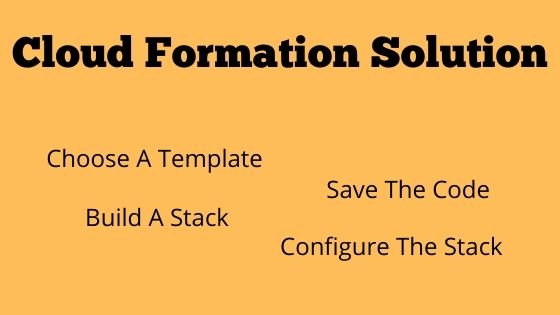
For starter, Get a template for CloudFormation. You can either
create it or choose from the existing templates. Secondly, You need
to save the code template in the s3 bucket, or you can save it
locally. Finally, You need to build a stack depending on your code
template using AWS CloudFormation and configure the stack.
15. Can you explain
Cloudwatch?
Cloudwatch is a monitoring tool for the AWS platform. You can
check all the components such as network, security, application
through the Cloudwatch. There are two types of Cloudwatch available
that are:
- Basic monitoring Cloudwatch.
- Detailed monitoring Cloudwatch.
in the previous list, here you have commonly asked AWS Interview
Questions, which can help you to know the basics and face the
interviews with confidence. For further development, please check
the AWS solution architect interview questions and AWS lambda
interview questions in the following sections.
In this segment, we will be focusing on the cloud platform,
service details, and solution architectural question answers. This
list will be effective for the intermediate level of individuals
who have the experience of working on an AWS platform before,
willing to go for better opportunities.
16. How many of S3 buckets can you
create?
The S3 bucket list depends on the size you are planning to use.
The maximum amount of buckets you can use in S3 is 100. Each S3
bucket can store a maximum of 5 Gigabytes of data or objects. You
can store from 0 bytes to 5 gigabytes in each bucket. In 100 of the
S3 buckets, you can store up to 5 Terabytes of data or objects.
17. What do you understand
by SQS?
Queuing is important for any kind of constant textual or verbal
communication system. SQS provides the flawless queuing service for
the frequently sent or received messages. The inbound and outbound
messages also can be stored by SQS. There are standard and FIFO
queuing available in SQS.
18. Can you name all the storage
classes in S3?
- S3 standard
- S3 intelligent tiering
- S3 standard infrequently accessed
- S3 one zone
- S3 glacier
- S3 glacier deep archive
19. Can you explain
Fargate?
Fargate is a convincingly effective way to operate and manage
the containers. Fargate is a virtual engine that can monitor, set
up, and round up the clusters. For all the packing of virtual
machine cluster components, Fargate is one perfect solution as it
provides an abstract server. You no longer need to shape anything
up, and you can concentrate on the design directly.
20. How can you control the
data access to S3 buckets?
There are four ways to control data access in S3 buckets.
They are
- Identity and Access Management User Policy: IAM specifies
the users to use certain buckets and objects in a programmatic
way. - Bucket Policy: Using the policy generator, the users can
be given the authority to use specific buckets. - S3 Block Public Access: This actually allows public
access to the buckets but in a minimal volume. All the users can
access the buckets in this way. - Access Control List: ACL is used whenever the bucket
policy exceeds 20 KB in size.
In AWS interview questions, you are going to face a lot of s3
bucket segments.
21. What is S3 one zone
infrequent access?
S3 one zone infrequent access is used for infrequently
accessed data. This is designed for secondary data backup or
replicated data backup. You might need to store a large volume of
data with the proper security module. This is also a
budget-friendly option for users. You can directly store the data
in the S3 one zone. This is also available for the commercial
region as well.
22. What is direct
connect?
AWS direct connect is used for the secured network connectivity
among the AWS platform and the datacenter. It allows you to create
a dedicated network connection. It works for any specified network
and directs connect networks.
23. Suppose, you need to log
in to the AWS account. What are the close alternatives for the
console that you can use?
Yes, there are a few tools that can be used to login to the
cloud environment, such as
- Eclipse: This is one of the Java IDE, which is used for
development. There is an open-source AWS toolkit that can help you
to log in from the eclipse directly. This is also an amazing option
for AWS application development. - AWS SDK: This is also an open-source java API with which
you can easily get access to several AWS services. You can
take advantage of login as well. - AWS CLI: This is a unified tool from the AWS platform to
control and manage several services of AWS beside the
login. - Putty: This is an open-source SSH and telnet client which
has several amazing features like remote desktop, reconnection,
dynamic port forward, protocol bridge. You can easily log in to
your AWS account with putty.
24. What is AWS CloudTrail?
AWS CloudTrail is used for monitoring, auditing, maintain,
and operate the components for the AWS accounts. This is also used
for the logs, activity charts, troubleshooting security components,
and tracking. CloudTrail is proper monitoring and operational
service from AWS, which can save a lot of time. You can easily
manage the internal audit, event history checking, and resource
management.
25. What is the storage
class? Does S3 come with any default storage
class?
There is a property called storage class in every S3
storage. You can change the class after you log in and configure.
You always have a default class in every storage. The default
storage class in S3 is the standard frequently accessed. You can
change the storage when you configure the environment for
storage.
26. What do you understand
by Role?
You can assign specific accessibilities to different
individuals to use the AWS account. Accounts with different
permission layers are called roles. Users can use the options
according to their permissions. There are separate categories of
roles for different users. An admin will have a different role than
a general user.
27. Why is AWS Config
useful?
AWS Config service is used for the primary and advanced
configuration in the AWS environment. With different requirements,
you need to configure the environment differently. With the AWS
inventory, you can configure, check the configuration history,
notifications, and the connections with the resources.
28. What is
RDS?
Relational database service, also known as RDS, allows you
to set up your database easily. This also allows you to set up
automated backups, hardware provisions, and database relocation.
This is one of the cost-effective automated database management
services. You can also resize and relocate your database in no
time.
29. Can you tell me about the
logging capabilities of AWS security?
You can use separate login options from AWS. There are a few
default configured login options from AWS that are available. Some
of them are directed, and a few have the account-oriented login
system. For AWS Config and AWS CloudTrail, they have the
account-oriented login system for their specific services.
30. How does the website
metrics monitoring work in AWS?
Another important topic for AWS interview questions here,
and the answer would be; Yes, AWS has the CloudWatch service to
monitor the applications and environmental statuses. You can
monitor the API calls, sign-ins, auto-scaling events, State changes
in EC2, and other scheduled events. You can use the CloudWatch for
custom data as well. You can also get the result through AWS
management console or statistic consumer.
31. What are the edge
locations?
Edge locations are the pre-defined places where the specific
content will be showcased. Users get to see the content from the
edge location in the first place. However, if the content is not
available, it can be copied from the original location and stored
in the edge location.
32. Can you tell me about the
policies?
Policies are the pre-defined rules or the permissions that you
provide to the users. Users have a certain layer of permissions to
use any service. There are two kinds of policies for AWS; they have
managed policies and inline policies.
33. What do you understand by
VPC?
Virtual private cloud, also known as VPC, is used for isolated
and customized networks. For security purposes, you need to have a
private cloud IP that can work as a proper IP address. VPC has the
IP address, security services, IP ranges, subnets, and
gateways.
34. Explain NAT
gateways.
To securely connect with a private network without the
other interruption, we use NAT gateways. A NAT gateway supports a
maximum of 5 Gbps of bandwidth. Multiple subnets can be easily
connected with NAT gateways. TCP, ICMP, and UDP are the supported
protocols for this gateway.
35. Can you explain the storage
gateways?
AWS storage gateway service allows you to have accessibility to
the virtual cloud storage. This is a hybrid storage service that
also allows you to manage your storage, move the data, archive
data, process data, or recovery the data. There are three kinds of
storage gateway in AWS, they are:
- File Gateway
- Tape Gateway
- Volume Gateway
36. Can you explain the S3 data
encryption?
Data encryption means transforming your raw data into an
encrypted form for security purposes. Whenever you are
sending or receiving data, you need to use data encryption as you
don’t want anyone to see the data except for the authorized
individuals. In S3, elastic block store encryption is available to
encrypt the whole block of data. Data encryption is available in
three ways. They are:
- S3 AES 256 encryption
- Key management service
- Client-side encryption
Here you have AWS Interview Questions and answers for your
intermediate level interview and skill comparison.
Expert Level AWS
Interview Questions
Finally, in this part, we will be focusing on the experienced
individuals who are already working on the AWS platform and trying
to go for better opportunities. These AWS interview questions and
answers would be perfectly applicable for experienced individuals
with expertise. This list of AWS interview questions can also
benefit the beginner and intermediate level individuals.
37. What do you understand
by snowball?
Data transportation service is one of the major services
from AWS. Snowball is highly effective for the larger amount of
data transfer. Snowball takes less time and provides secured data
transfer from one place to another. you can transport up to
petabyte-scale of data with snowball service. Snowball also offers
analytic, genomic, media type data for faster service. There are
also backup and archive options for large amounts of
data.
38. Explain the AWS virtualization
categories.
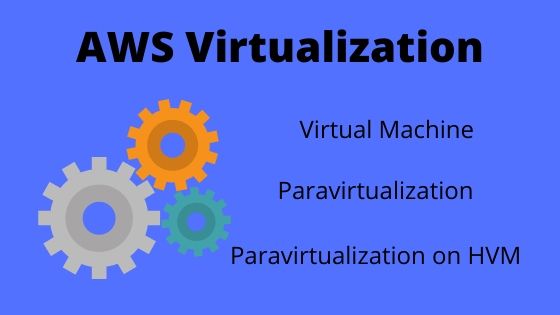
Three different types of virtualization are available. They
are:
- Hardware virtual machine: HVM works as the fully equipped
virtual hardware. - Paravirtualization: Paravirtualization works as the boot loader
for the PV AMIs. - Paravirtualization on HVM: It enables the OS to make a secure
connection between the storage and networks.
39. Can you name a few AMI
designs?
There are several types of AMIs available to use. A few commonly
used AMIs are:
- Hybrid AMI
- JeOs AMI
- Fully baked AMI
40. What do you understand
by redshift?
AWS Redshift[5]
is a hugely accepted data warehouse service. You can use up to
petabyte-scale data on this virtual data warehouse. You need to set
up a bunch of nodes that are known as the AWS clusters. In the
individual nodes, you can upload your data depending on your needs.
Data analysis and operation are quite flexible in redshift cluster
management.
41. Are there any backup
types in the RDS database?
There must be at least one RDS related topic in the AWS
interview questions list. Yes, there are five types of backups in
the RDS database. They are:
- Automated Backup: It turns on automatically and backs up
all of your data regularly. It backs up the data on scheduled time
every day. It can take up to thirty minutes. - Point in time: This backup service requires a new
instance to restore the database. You can use the console or the
command line to make a new instance. It can take up to five minutes
to back up. - Snapshots: This backup service requires user attempts.
User needs to manually create a new instance and restore the
database. - Snapshot copies: You can copy a snapshot and manually
change it. - Sharing Snapshot: Though it is an unencrypted backup
service, you can share the snapshots with other authorized
users.
42. What is
ELB?
Whenever there is massive traffic gets in, ELB
automatically separates and distributes the traffic into separate
containers and instances. There are a few categories that involve
the application, network, and classic load balancers for user
convenience. You can control the traffic, secure your network, and
scale up your instances with ELB.
43. Can you convert a public
subnet to a private subnet?
Yes, a public subnet can be converted into a private subnet. In
order to convert a public subnet into a private subnet, you need to
need to remove the IGW. You also need to add NAT gateway, which
will be available in the private route table.
44. How can you provide access to
any specific user to a bucket?
You need to follow these steps to give access to any specific
bucket to any user:
- Check your instances and put them into the category
- Give the authorization to the user depending on the specific
servers. - Make sure the tags are locked-down.
- Assign the policies to the IAM users.
45. Can you name the deployment
models for the cloud?
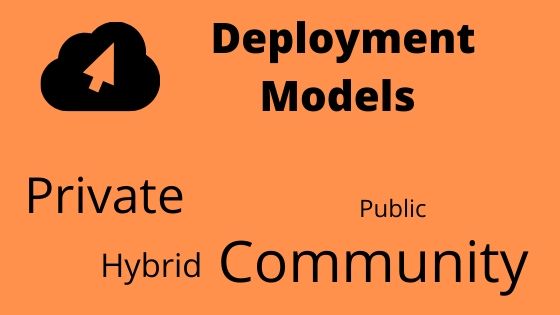
Cloud deployment models configure the cloud infrastructure
depending on a few key components. There are four major deployment
models for the cloud. They are:
- Public Cloud: It supports all kinds of users.
- Private Cloud: It supports a single organization
- Hybrid Cloud: It supports interconnected private networks.
- Community Cloud: It supports multiple organizations sharing one
network.
46. Explain the different cloud
service models.
There are three cloud service models available for the AWS
platform and general cloud computing platforms[6] as well. They are:
- SAAS: Software as a service is an application distribution
model. The service providers host the application as a service, and
the users can use the application in a complexity-free way. - PAAS: Platform as a service is a total platform in the cloud
where the developer can work and build applications such as AWS
Elastic Beanstalk. - IAAS: Infrastructure as a service provides virtual computing
components and provides the total computing environment online. AWS
platform is itself an example.
47. What is Amazon
Lightsail?
Amazon Lightsail service helps to launch, organize, and
manage the virtual private server. This service provides an
environment, storage, secured networks, and static Ip as well.
Amazon Lightsail is basically used by the developers as it can
provide the total dev environment. You can use all the basic cloud
resources and cloud applications as well.
48. Is there any way you could
connect multiple connections to a virtual private
network?
Yes, You have to make separate subnets in the VPC. Then you need
to make a connection between the virtual private gateway and the
customer gateway. You also need to check for the gateway security
options and encryption methods.
49. What are RTO and
RPO?
Every business model faces disasters, and they can happen at any
time. There are solutions, and pre-defined RTO is the maximum
length of time that you are willing to wait for a recovery.
RPO means the maximum amount of data you are willing to accept
to lose in a disastrous situation.
50. What are load
balancers?
Load balancers are responsible for the automatic, elastic load
balancing when there is massive traffic incoming. Currently, three
types of load balancers are available.
- Network Load Balancer
- Application Load Balancer
- Classic Load Balancer
with this, we are almost done with the Expert Level AWS
Interview Questions And Answers.
Finally, Insight
Here ends our collection of AWS interview questions. We have
tried to arrange the most common and frequently asked AWS interview
questions. It is highly recommended not to fully depend on the
questions answers; you also need to have proper preparation through
practice. Hopefully, this collection of questions will help you to
go through your next interview. If you think something is missing
out, please let us know what possible AWS interview questions we
may have missed. Also, share this article with your friends who are
trying to face the interview.
References
- ^
The 20
Best Amazon AWS Certifications and Courses in 2020
(www.ubuntupit.com) - ^
EC2
(aws.amazon.com) - ^
Top 50
Frequently Asked Cloud Computing Interview Questions
(www.ubuntupit.com) - ^
The 20
Best Cloud Computing Books Available Online in 2020
(www.ubuntupit.com) - ^
AWS
Redshift (aws.amazon.com) - ^
The 25
Best Cloud Computing Companies and Platforms in 2020
(www.ubuntupit.com)
Read more https://www.ubuntupit.com/frequently-asked-aws-interview-questions-and-answers/