A never-before-seen remote access trojan dubbed ZuoRAT
has been singling out small office/home office (SOHO) routers as
part of a sophisticated campaign targeting North American and
European networks.
The malware “grants the actor the ability to pivot into the
local network and gain access to additional systems on the LAN by
hijacking network communications to maintain an undetected
foothold,” researchers from Lumen Black Lotus Labs said in a report
shared with The Hacker News.
The stealthy operation, which targeted routers from ASUS, Cisco,
DrayTek, and NETGEAR, is believed to have commenced in early 2020
during the initial months of the COVID-19 pandemic, effectively
remaining under the radar for over two years.
“Consumers and remote employees routinely use SOHO routers, but
these devices are rarely monitored or patched, which makes them one
of the weakest points of a network’s perimeter,” the company’s
threat intelligence team said.
Initial access to the routers is obtained by scanning for known
unpatched flaws to load the remote access tool, using it gain
access to the network and drop a next-stage shellcode loader that’s
used to deliver Cobalt Strike and custom backdoors such as CBeacon
and GoBeacon that are capable of running arbitrary commands.
In addition to enabling in-depth reconnaissance of target
networks, traffic collection, and network communication hijacking,
the malware has been described as a heavily modified version of the
Mirai botnet[1], whose source code
leaked in October 2016.
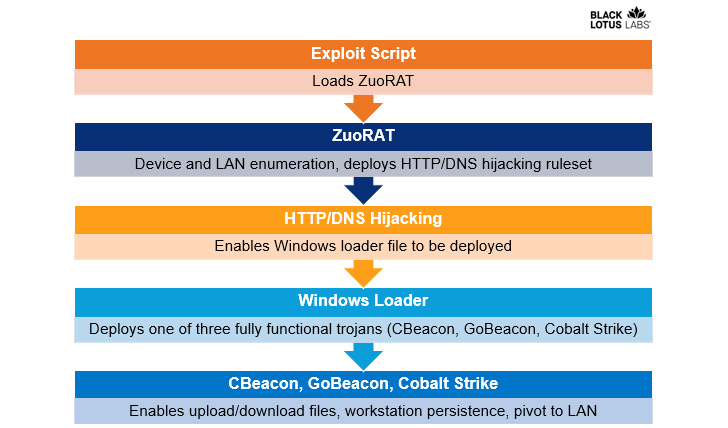
“ZuoRAT is a MIPS file compiled for SOHO routers that can
enumerate a host and internal LAN, capture packets being
transmitted over the infected device, and perform
person-in-the-middle attacks (DNS and HTTPS hijacking based on
predefined rules),” the researchers said.
Also included is a function to harvest TCP connections over
ports 21 and 8443, which are associated with FTP and web browsing,
potentially enabling the adversary to keep tabs on the users’
internet activity behind the compromised router.
Other capabilities of ZuoRAT allow the attackers to monitor DNS
and HTTPS traffic with an aim to hijack the requests and redirect
the victims to malicious domains using preset rules that are
generated and stored in temporary directories in an attempt to
resist forensic analysis.
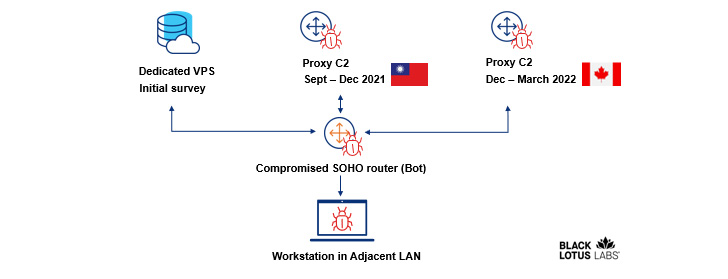
That’s not the only step taken by the hackers to conceal its
activities, for the attacks rely on an obfuscated, multi-stage C2
infrastructure that involves utilizing a virtual private server to
drop the initial RAT exploit and leveraging the compromised routers
themselves as proxy C2 servers.
To further avoid detection, the staging server has been spotted
hosting seemingly innocuous content, in one instance mimicking a
website called “muhsinlar.net,” a propaganda portal[2]
set up for the Turkestan Islamic Party (TIP[3]), a Uyghur extremist
outfit originating from China.
The identity of the adversarial collective behind the campaign
remains unknown, although an analysis of the artifacts has revealed
possible references to the Chinese province of Xiancheng and the
use of Alibaba’s Yuque and Tencent for command-and-control
(C2).
The elaborate and evasive nature of the operation coupled with
the tactics used in the attacks to remain undercover point toward
potential nation-state activity, Black Lotus Labs noted.
“The capabilities demonstrated in this campaign — gaining access
to SOHO devices of different makes and models, collecting host and
LAN information to inform targeting, sampling and hijacking network
communications to gain potentially persistent access to in-land
devices and intentionally stealth C2 infrastructure leveraging
multistage siloed router to router communications — points to a
highly sophisticated actor,” the researchers concluded.
References
- ^
Mirai
botnet (thehackernews.com) - ^
propaganda portal
(gnet-research.org) - ^
TIP
(en.wikipedia.org)
Read more https://thehackernews.com/2022/06/zuorat-malware-hijacking-home-office.html