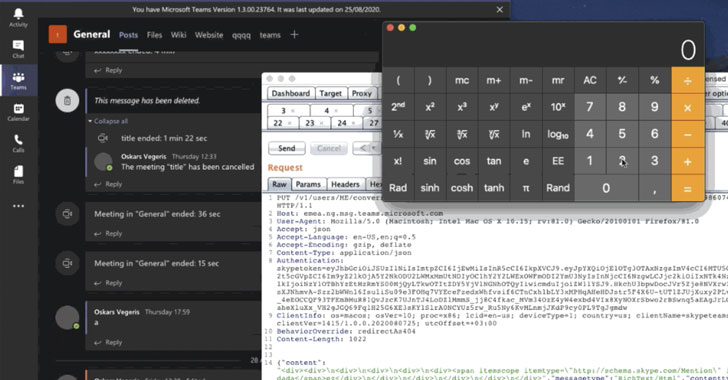
A zero-click remote code execution (RCE) bug in Microsoft Teams
desktop apps could have allowed an adversary to execute arbitrary
code by merely sending a specially-crafted chat message and
compromise a target’s system.
The issues were reported to the Windows maker by Oskars Vegeris[1], a security engineer
from Evolution Gaming, on August 31, 2020, before they were
addressed at the end of October.
“No user interaction is required, exploit executes upon seeing
the chat message,” Vegeris explained in a technical write-up.
The result is a “complete loss of confidentiality and integrity
for end users — access to private chats, files, internal network,
private keys and personal data outside MS Teams,” the researcher
added.
Worse, the RCE is cross-platform — affecting Microsoft Teams for
Windows (v1.3.00.21759), Linux (v1.3.00.16851), macOS
(v1.3.00.23764), and the web (teams.microsoft.com) — and could be
made wormable, meaning it could be propagated by automatically
reposting the malicious payload to other channels.
This also means the exploit can be passed on from one account to
a whole group of users, thereby compromising an entire channel.
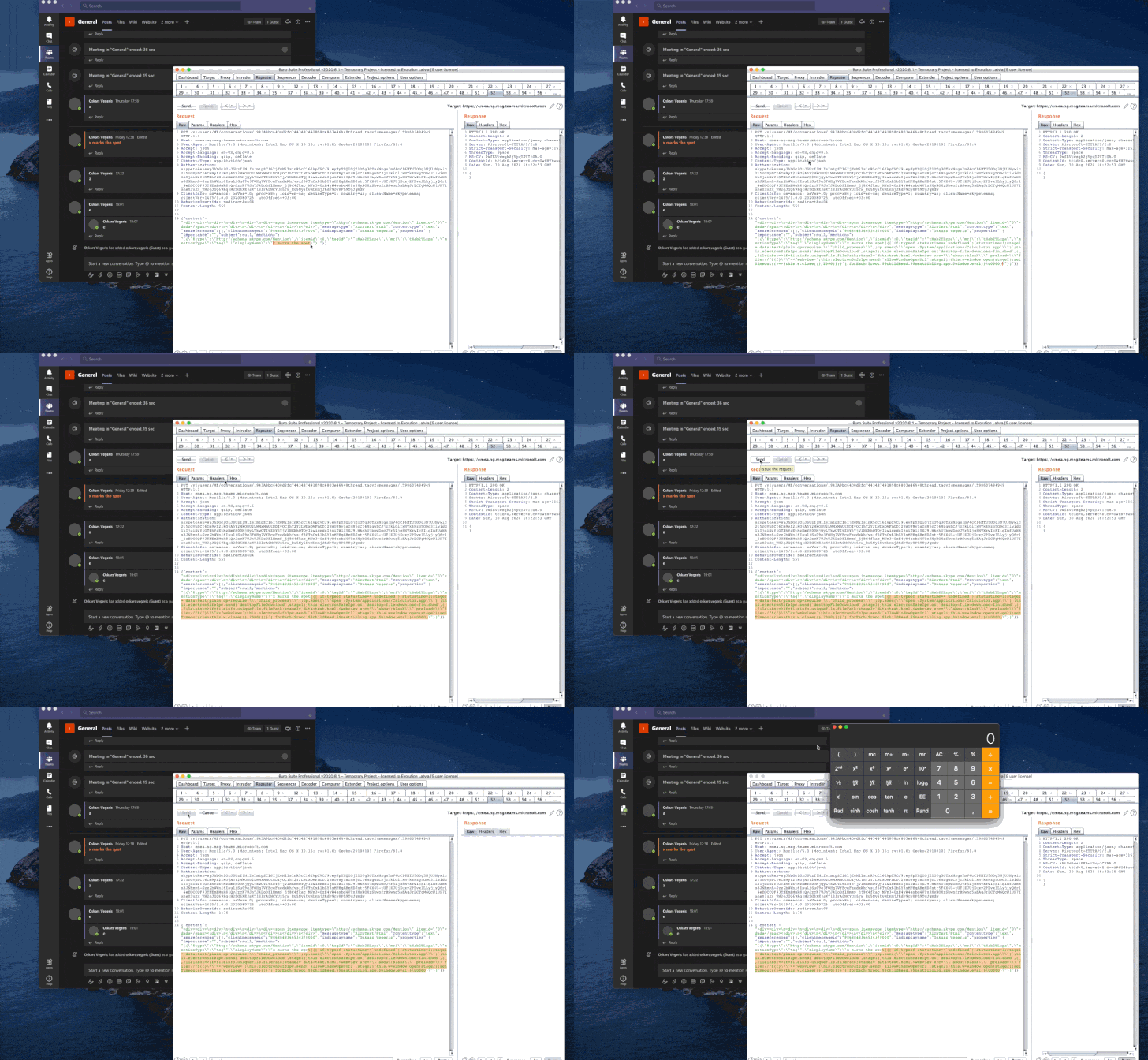
To achieve this, the exploit chain strings together a cross-site
scripting (XSS) flaw present in the Teams ‘@mentions[2]‘ functionality and a
JavaScript-based RCE payload to post a harmless-looking chat
message containing a user mention either in the form of a direct
message or to a channel.
Simply visiting the chat at the recipient’s end leads to the
execution of the payload, allowing it to be exploited to log users’
SSO tokens to local storage for exfiltration and execute any
command of the attacker’s choice.
This is not the first time such RCE flaws were observed in Teams
and other enterprise-focused messaging apps.
Chief among them is a separate RCE vulnerability in Microsoft
Teams (CVE-2020-17091) that the company patched as part of its
November 2020 Patch Tuesday[3] last month.
Earlier this August, Vegeris also disclosed a critical
“wormable” flaw in Slack’s desktop version[4]
that could have allowed an attacker to take over the system by
merely sending a malicious file to another Slack user.
Then in September, networking equipment maker Cisco patched a
similar flaw[5]
in its Jabber video conferencing and messaging app for Windows
that, if exploited, could allow an authenticated, remote attacker
to execute arbitrary code.
References
- ^
Oskars
Vegeris (github.com) - ^
@mentions
(support.microsoft.com) - ^
November
2020 Patch Tuesday (thehackernews.com) - ^
Slack’s
desktop version (hackerone.com) - ^
similar
flaw (thehackernews.com)