Enterprises depend on SaaS applications for countless functions,
like collaboration, marketing, file sharing, and more. But
problematically, they often lack the resources to configure those
apps to prevent cyberattacks, data exfiltration, and other
risks.
Catastrophic and costly data breaches result from SaaS security
configuration errors. The Verizon 2020 Data Breach Investigations
Report found that errors are the second largest cause of data
breaches, accounting for about one in three breaches.
Of those, misconfigurations are by far the most common, often
resulting in the exposure of databases or file system contents
directly on a cloud service.
Businesses tend to be as vulnerable as the weakest security
settings they have enabled for their SaaS applications. To
illustrate, Adaptive Shield’s team has discovered SaaS setting
errors that leave companies open to one-click corporate espionage,
exposing their entire cloud, along with massive amounts of video
conferencing data in this new WFH era.
Eliminate all SaaS
misconfigurations[1]
IT security teams must do more to protect their organizations
from risks caused by poorly configured SaaS apps. Here are five
SaaS configuration errors we see all the time that you should be
checking on and correcting as needed:
1) Make sure your SaaS system admins use MFA, even if
SSO is enabled.
SSO has become a key feature in securing access for SaaS apps;
however, there are still some users that can, by design, bypass
this control. For maintenance reasons, most SaaS vendors enable
system owners to login with their username and password even though
SSO is turned on. Make sure mandatory multi-factor authentication
is enabled for these super users. If your admins rely on username
and passwords, and an admin’ credentials become compromised,
attackers will be able to access the account.
2) Shared mailboxes are sitting ducks, prized by
hackers. Fix yours.
Many companies use shared mailboxes for financial, customer, and
other types of sensitive information. We’ve found that
organizations have one shared mailbox for every 20 employees on
average. These present issues because they have no clear owner, and
every user has a password, which is static because no one changes
them. The problems are so acute that Microsoft even recommends
blocking sign-in for shared mailbox accounts.
3) Manage external users with access to internal
information.
Many businesses today exchange information using collaboration
tools. While external sharing is a great way to extend your
organization to your suppliers and partners, it comes with a risk
of losing control over your data. Make sure to define a
collaboration policy with external users and set proper limitations
across all SaaS apps.
4) You don’t know what you can’t see; turn on auditing
to maximize visibility and control.
As a security expert, you must be aware of the information you
are missing. While the default audited actions are sufficient for
some organizations, for others, it may be a major security gap.
Make sure you understand what you’re not seeing and optimize if
gaps exist.
5) Make sure no data entities are anonymously
accessible without your knowledge.
Maintaining complete control over your corporate data is not an
easy task. And it only gets harder as you add SaaS apps. Identify
which resources are publicly exposed, such as dashboards, forms,
discussions, or any other data entities, and act now to fix
them.
 |
| Image credit: Adaptive Shield |
How to Finally Take Control of SaaS Security
Adaptive Shield – Take full control of your
native SaaS security[2]
Although SaaS platforms have dozens or even hundreds of built-in
security configuration controls, it is the responsibility of the
client to set them correctly. Security teams are overwhelmed,
trying to manage thousands of settings across all their apps.
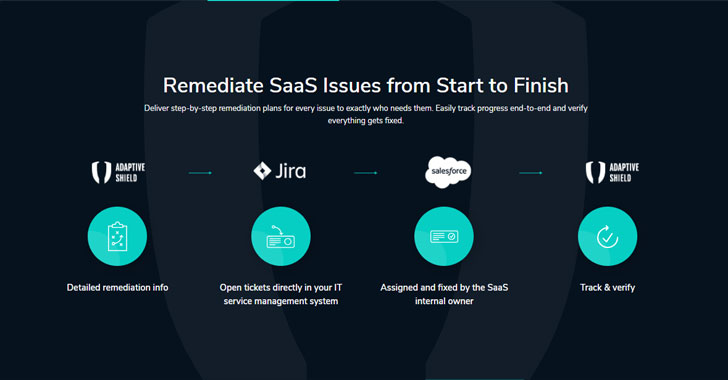
Adaptive Shield analyzes, identifies, and prioritizes SaaS
applications’ weaknesses and provides ongoing monitoring, to enable
continuous security for all global settings and user privileges.
Adaptive Shield solves SaaS misconfiguration challenges like those
listed above and thousands more by providing automated, complete
control of SaaS application security.
The mission is to give security teams one common platform to
manage their SaaS app security effortlessly. Want to learn more
about what we do and how we can help your organization use SaaS
applications with greater confidence? Visit
www.adaptive-shield.com
Get started today and gain complete control
of your SaaS security[3]
References
- ^
Eliminate all SaaS
misconfigurations (www.adaptive-shield.com) - ^
Adaptive
Shield – Take full control of your native SaaS security
(www.adaptive-shield.com) - ^
Get
started today and gain complete control of your SaaS security
(www.adaptive-shield.com)