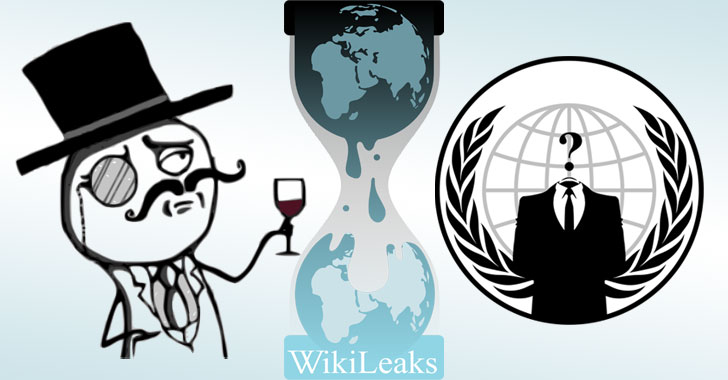
indictment against WikiLeaks founder Julian Assange accusing him of
collaborating with computer hackers, including those affiliated
with the infamous LulzSec and “Anonymous” hacking groups.
The new superseding indictment[1]
does not contain any additional charges beyond the prior 18-count
indictment filed against Assange in May 2019, but it does “broaden
the scope of the conspiracy surrounding alleged computer intrusions
with which Assange was previously charged,” the DoJ said.
In May 2019, Assange was charged
with 18 counts under the old U.S. Espionage Act for unlawfully
publishing classified military and diplomatic documents on his
popular WikiLeaks website in 2010, which he obtained from former
Army intelligence analyst Chelsea Manning.
[2]
Assange has been alleged to have obtained those classified
documents by conspiring with Manning to crack a password hash to a
classified U.S. Department of Defense computer.
According to the new superseding indictment [PDF[3]] unsealed Wednesday,
Assange and others at WikiLeaks also recruited hackers at
conferences in Europe and Asia and conspired with them to commit
computer intrusions to benefit WikiLeaks.
Since the early days of WikiLeaks, Assange has spoken in
conferences about his own history as a “famous teenage hacker in
Australia” and encouraged others to hack to obtain information for
WikiLeaks.
“In 2009, for instance, Assange told the Hacking At Random
conference that WikiLeaks had obtained nonpublic documents from the
Congressional Research Service by exploiting “a small
vulnerability” inside the document distribution system of the
United States Congress, and then asserted that “[t]his is what any
one of you would find if you were actually looking.”,” the DoJ
said.
Not just that, the indictment also accused Assange of gaining
unauthorized access to a government computer system of a NATO
country (30 member states from North America and Europe) in
2010.
Two years later, “Assange communicated directly with a leader of
the hacking group LulzSec (who by then was cooperating with the
FBI),” and provided him a list of targets to hack.
“With respect to one target, Assange asked the LulzSec leader to
look for (and provide to WikiLeaks) mail and documents, databases,
and pdfs. In another communication, Assange told the LulzSec leader
that the most impactful release of hacked materials would be from
the CIA, NSA, or the New York Times,” the DoJ said.
Assange also obtained and published on WikiLeaks emails from a
data breach committed against a U.S. intelligence consulting
company by a hacker affiliated with “Anonymous” and LulzSec.
According to that hacker, Assange indirectly asked him to spam that
victim company again.”
Assange was arrested in April
2019 in London[4]
after Ecuador abruptly withdrew his asylum, and was later sentenced to 50
weeks in U.K. prison[5]
for breaching his bail conditions in 2012.
The 48-year-old is currently in prison in the U.K., where he is
currently awaiting possible extradition to the United States,
pending a September hearing.
If convicted for all counts, Assange could face a total maximum
sentence of 175 years in the U.S. prison for his alleged role in
“one of the largest compromises of classified information in the
history of the United States.”
References
- ^
indictment
(www.justice.gov) - ^
Assange was charged with 18 counts
(thehackernews.com) - ^
PDF
(www.justice.gov) - ^
arrested in April 2019 in London
(thehackernews.com) - ^
sentenced to 50 weeks in U.K.
prison (thehackernews.com)