
you’re protected right now. What do you do?
Traditionally, you would have to go with one of the options
below.
Option 1 – Manually check that IoCs have been updated across
your security controls.
This would require checking that security controls such as your
email gateway, web gateway, and endpoint security have all been
updated with the latest threats’ indicators of compromise (IoCs)
usually published by AV companies who detect the malware binaries
first.
Option 2 – Create a ‘carbon copy’ of your network and run the
threat’s binary on that copy.
While safe, IT and security teams may be unaware of certain
variations from the real deal. So while the attack simulation is
running against an ‘ideal’ copy, your real network may have
undergone inadvertent changes, such as a firewall running in
monitoring mode, a patch not being installed on time, and other
unintentional variations. The resulting mirror image has
inadvertently become a ‘filtered’ one.
Option 3 – Build a homegrown simulation.
While effective, developing your own malware simulation is a
time- and resource-intensive effort that usually requires a
dedicated threats or vulnerability assessment team.
Moreover, even if you have the resources, the turnaround time
for getting a live and safe simulation to work may not be
ideal.
Option 4 – Run an automated simulation of the threat
in your production environment.
What if you could challenge your controls with a threat on the
day that it hits the headlines? This is where automated security
effectiveness testing can help.
By running simulations of the latest cyber attacks against the
controls required to detect them correctly, you can make sure your
current security arsenal is catching risky IoCs, and close any gaps
faster.
Testing Security Control Effectiveness Faster
Using a dedicated golden image of a standard workstation (or
server), attack simulations can be run continually on a designated
system in a production network. This way, a real user’s data is not
jeopardized, while enabling you to check the latest threat’s
ability to bypass your security controls.
By running ongoing or daily simulations of the newest menaces
across your network, you can determine if your controls are
catching IoCs such as command & control (C2) URLs and malicious
file hashes.
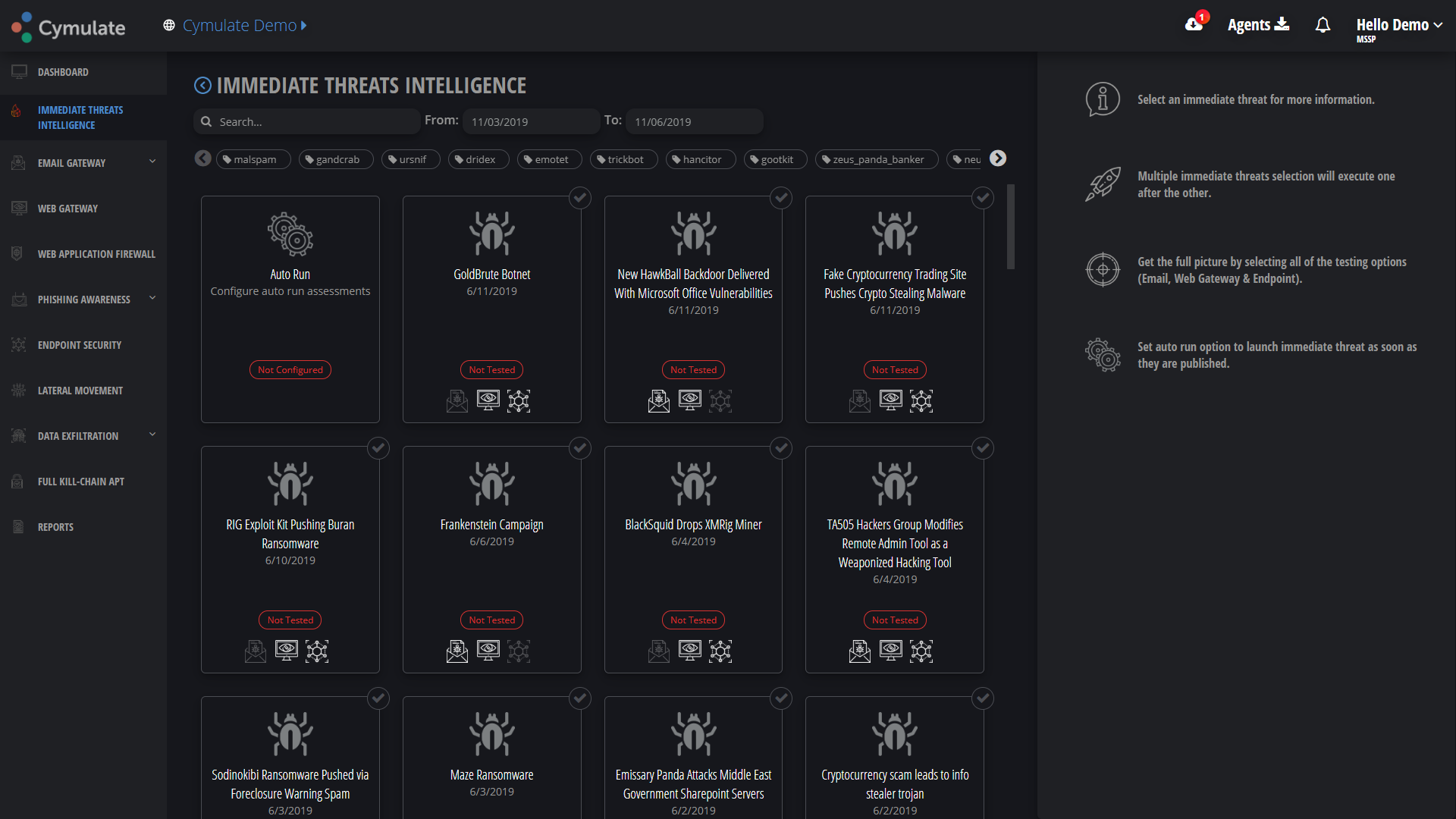 |
| Immediate Threats Available for Simulation One Day After Their Discovery [click the image to view full size] |
Real vs. Simulated Cyber Attacks – What’s the Difference?
So what is the difference between a real attack and a simulated
one? First and foremost, simulations usually run on a dedicated
system to avoid compromising a real user’s system.
For C2 communications, a simulation will attempt to establish a
connection over HTTP/S, with an agent installed on the endpoint
serving as a proxy to block any malicious requests sent and
dropping the connection at the end of the test.
When testing endpoint security controls, rather than executing a
real payload, one simulation technique involves dropping a malware
sample to see if security controls can detect and remove it.
To test the effectiveness of an email gateway, a simulated attack[2]
will send emails with weaponized attachments that contain different
malicious behaviors but are harmless to the target system. An agent
sitting on top of the email client handles incoming emails and
deletes them immediately thereafter.
Immediate Insights against Immediate Threats
What kind of insights can simulations uncover? Challenging email
security controls can reveal whether your email gateway is blocking
multi-layer nested files, whether a policy is set up to filter out
spoofed email addresses or rarely-used file formats, or whether
archive files (e.g., ZIP) are scanned to prevent executables from
landing in a user’s mailbox.
To prevent drive-by-downloads, it may alert that your web
gateway is not blocking downloads associated with the newest
threat’s URLs. And vis-à-vis endpoint security, you may learn that
your current solution is failing to block or detect dropped
payloads on disk.
 |
| Immediate Threats Simulation Results – Blocked or Penetrated [click the image to view full size] |
Ready to test the effectiveness of your security controls against
the very latest threats?
Get started
here[3], or learn more about
SaaS-based breach and attack
simulation[4].
References
- ^
Robinhood
(www.2-spyware.com) - ^
simulated attack
(cymulate.com) - ^
Get started here
(cymulate.com) - ^
breach and attack simulation
(cymulate.com)
Read more http://feedproxy.google.com/~r/TheHackersNews/~3/Cj3DSu2dZtI/breach-attack-simulation.html