What is the IPv6 used for?
IPv6 is the newest version of internet protocol formulated by the Internet Engineering Task Force (IETF), which helps identify and local endpoint systems on a computer network and route online traffic while addressing the problem of IPv4 address depletion due to prolonged internet use worldwide.6
Is 5G IPv4 or IPv6?
IPv6
Assuring backlink compatibility. IPv6 will have a major role to play in 5G, as IPv4 addresses, which are already in short supply, could never suffice the ever-growing connection demand further down the road. That said, the majority of systems in place are IPv4-compatible only.
Which is faster IPv4 or IPv6?
IPv6 is faster than IPv4 in network devices because it lacks network-address translation (NAT). Using IPv6 is a better choice for people that require high speed for their network processing.
https://test-ipv6.com/
Your IPv4 address on the public Internet appears to be 197.210.77.5
Your Internet Service Provider (ISP) appears to be VCG-AS
No IPv6 address detected [more info]
You appear to be able to browse the IPv4 Internet only. You will not be able to reach IPv6-only sites.
To ensure the best Internet performance and connectivity, ask your ISP about native IPv6. [more info]
Your DNS server (possibly run by your ISP) appears to have IPv6 Internet access.
You appear to have no IPv6 at this time..
You appear to have no IPv6 address.
It looks like you have only IPv4 Internet service at this time. Don’t feel bad – most people are in this position right now. Most Internet service providers are not quite yet ready to provide IPv6 Internet to residential customers.
Many of the visitors to the site are new to what IPv6 is. If you don’t know why IPv6 matters, see the Why IPv6 FAQ. This will give you a bit of background of what to expect with IPv4 in the coming months and years; and perhaps some incentive to ask your ISP when they will offer IPv6.
If you strongly believe you have IPv6, but we were unable to detect it: it means one of a couple of things. Either your organization is blocking the use of IPv6 to talk to the outside Internet through network policy; or perhaps what you see with IPv6 on your host is not a global address. Any address starting with “::”, “fc”, “fd”, or “fe” are unable to work with the public IPv6 Internet.
If you are savvy with technology, you can be an early adopter of IPv6, consider learning more about 6to4 providers (managed 6to4 tunnel services). The use of automatic tunnels is discourage
What is IPv6?
IPv6 is the next generation Internet Protocol (IP) address standard intended to supplement and eventually replace IPv4, the protocol many Internet services still use today. Every computer, mobile phone, home automation component, IoT sensor and any other device connected to the Internet needs a numerical IP address to communicate between other devices. The original IP address scheme, called IPv4, is running out of addresses due to its widespread usage from the proliferation of so many connected devices.
What is IPv4?
IPv4 stands for Internet Protocol version 4. It is the underlying technology that makes it possible for us to connect our devices to the web. Whenever a device accesses the Internet, it is assigned a unique, numerical IP address such as 99.48.227.227. To send data from one computer to another through the web, a data packet must be transferred across the network containing the IP addresses of both devices.
Why Support IPv6? What are the benefits of IPv6?
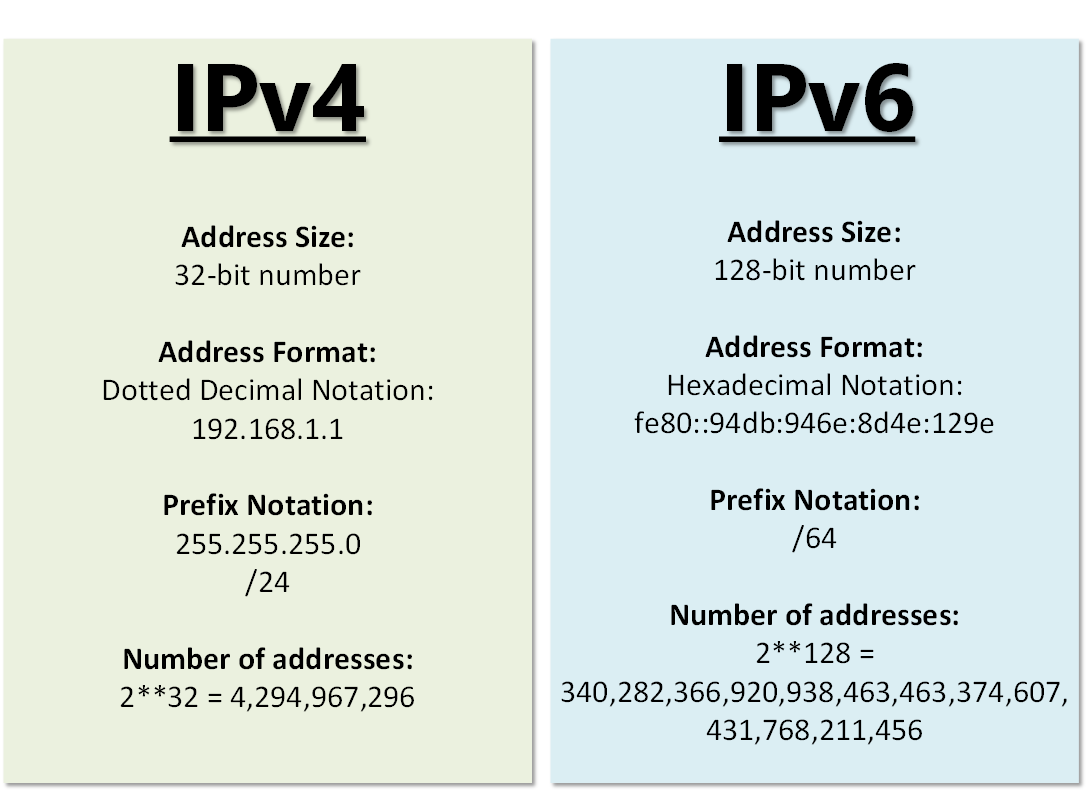
IPv6 (Internet Protocol version 6) is the sixth revision to the Internet Protocol and the successor to IPv4. It functions similarly to IPv4 in that it provides the unique IP addresses necessary for Internet-enabled devices to communicate. However, it does have one significant difference: it utilizes a 128-bit IP address.
Key benefits to IPv6 include:
No more NAT (Network Address Translation)
Auto-configuration
No more private address collisions
Better multicast routing
Simpler header format
Simplified, more efficient routing
True quality of service (QoS), also called “flow labeling”
Built-in authentication and privacy support
Flexible options and extensions
Easier administration (no more DHCP)
IPv4 uses a 32-bit address for its Internet addresses. That means it can provide support for 2^32 IP addresses in total â around 4.29 billion. That may seem like a lot, but all 4.29 billion IP addresses have now been assigned, leading to the address shortage issues we face today.
IPv6 utilizes 128-bit Internet addresses. Therefore, it can support 2^128 Internet addresses—340,282,366,920,938,463,463,374,607,431,768,211,456 of them to be exact. The number of IPv6 addresses is 1028 times larger than the number of IPv4 addresses. So there are more than enough IPv6 addresses to allow for Internet devices to expand for a very long time.
The text form of the IPv6 address is xxxx:xxxx:xxxx:xxxx:xxxx:xxxx:xxxx:xxxx, where each x is a hexadecimal digit, representing 4 bits. Leading zeros can be omitted. The double colon (::) can be used once in the text form of an address, to designate any number of 0 bits.
With Dual-IP stacks, your computers, routers, switches, and other devices run both protocols, but IPv6 is the preferred protocol. A typical procedure for businesses is to start by enabling both TCP/IP protocol stacks on the wide area network (WAN) core routers, then perimeter routers and firewalls, followed by data-center routers and finally the desktop access routers.
What are the 3 types of 5G?
Image result
The 5G networking architecture consists of three different network types that will work together in the future, but the three tiers of radio signals have different characteristics.
Low Band 5G. Low band spectrum 5G is best understood as a blanket layer for nationwide coverage. …
Mid Band 5G. …
mmWave High Band 5G.