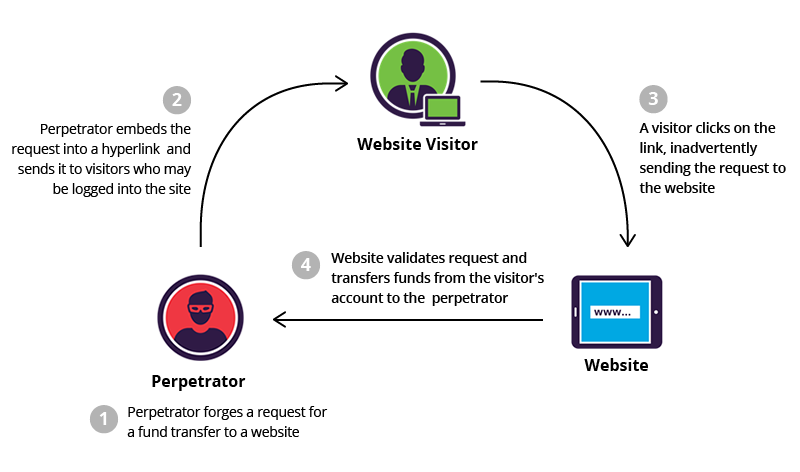
Cross-site request forgery, also known as one-click attack or session riding and abbreviated as CSRF (sometimes pronounced sea-surf) or XSRF, is a type of malicious exploit of a website or web application where unauthorized commands are submitted from a user that the web application trusts.
XSS vs CSRF
In this section, we’ll explain the differences between XSS and CSRF, and discuss whether CSRF tokens can help to prevent XSS attacks.
What is the difference between XSS and CSRF?
Cross-site scripting (or XSS) allows an attacker to execute arbitrary JavaScript within the browser of a victim user.
Cross-site request forgery (or CSRF) allows an attacker to induce a victim user to perform actions that they do not intend to.
The consequences of XSS vulnerabilities are generally more serious than for CSRF vulnerabilities:
- CSRF often only applies to a subset of actions that a user is able to perform. Many applications implement CSRF defenses in general but overlook one or two actions that are left exposed. Conversely, a successful XSS exploit can normally induce a user to perform any action that the user is able to perform, regardless of the functionality in which the vulnerability arises.
- CSRF can be described as a “one-way” vulnerability, in that while an attacker can induce the victim to issue an HTTP request, they cannot retrieve the response from that request. Conversely, XSS is “two-way”, in that the attacker’s injected script can issue arbitrary requests, read the responses, and exfiltrate data to an external domain of the attacker’s choosing.
Can CSRF tokens prevent XSS attacks?
Some XSS attacks can indeed be prevented through effective use of CSRF tokens. Consider a simple reflected XSS vulnerability that can be trivially exploited like this:
https://insecure-website.com/status?message=<script>/*+Bad+stuff+here...+*/</script>
Now, suppose that the vulnerable function includes a CSRF token:
https://insecure-website.com/status?csrf-token=CIwNZNlR4XbisJF39I8yWnWX9wX4WFoz&message=<script>/*+Bad+stuff+here...+*/</script>
Assuming that the server properly validates the CSRF token, and rejects requests without a valid token, then the token does prevent exploitation of the XSS vulnerability. The clue here is in the name: “cross-site scripting”, at least in its reflected form, involves a cross-site request. By preventing an attacker from forging a cross-site request, the application prevents trivial exploitation of the XSS vulnerability.
Some important caveats arise here:
- If a reflected XSS vulnerability exists anywhere else on the site within a function that is not protected by a CSRF token, then that XSS can be exploited in the normal way.
- If an exploitable XSS vulnerability exists anywhere on a site, then the vulnerability can be leveraged to make a victim user perform actions even if those actions are themselves protected by CSRF tokens. In this situation, the attacker’s script can request the relevant page to obtain a valid CSRF token, and then use the token to perform the protected action.
- CSRF tokens do not protect against stored XSS vulnerabilities. If a page that is protected by a CSRF token is also the output point for a stored XSS vulnerability, then that XSS vulnerability can be exploited in the usual way, and the XSS payload will execute when a user visits the page.
Cross Site Request Forgery (CSRF)
Contributor(s): Dave Wichers, Davisnw, Paul Petefish, Adar Weidman, Michael Brooks, Ahsan Mir, Dc, D0ubl3 h3lix, Jim Manico, Robert Gilbert, Tgondrom, Pawel Krawczyk, Brandt, A V Minhaz, Kevin Lorenzo, Andrew Smith, Christina Schelin, Ari Elias-Bachrach, Sarciszewski, kingthorin, Ben Spatafora
Overview
Cross-Site Request Forgery (CSRF) is an attack that forces an end user to execute unwanted actions on a web application in which they’re currently authenticated. With a little help of social engineering (such as sending a link via email or chat), an attacker may trick the users of a web application into executing actions of the attacker’s choosing. If the victim is a normal user, a successful CSRF attack can force the user to perform state changing requests like transferring funds, changing their email address, and so forth. If the victim is an administrative account, CSRF can compromise the entire web application.
Related Security Activities
How to Review Code for CSRF Vulnerabilities
See the OWASP Code Review Guide article on how to review code for CSRF vulnerabilities.
How to Test for CSRF Vulnerabilities
See the OWASP Testing Guide article on how to test for CSRF vulnerabilities.
How to Prevent CSRF Vulnerabilities
See the CSRF Prevention Cheat Sheet for prevention measures.
Listen to the OWASP Top Ten CSRF Podcast.
Most frameworks have built-in CSRF support such as Joomla, Spring, Struts, Ruby on Rails, .NET and others.
Use OWASP CSRF Guard to add CSRF protection to your Java applications. You can use CSRFProtector Project to protect your PHP applications or any project deployed using Apache Server.
John Melton also has an excellent blog post describing how to use the native anti-CSRF functionality of the OWASP ESAPI.
Description
CSRF is an attack that tricks the victim into submitting a malicious request. It inherits the identity and privileges of the victim to perform an undesired function on the victim’s behalf (though note that this is not true of login CSRF, a special form of the attack described below). For most sites, browser requests automatically include any credentials associated with the site, such as the user’s session cookie, IP address, Windows domain credentials, and so forth. Therefore, if the user is currently authenticated to the site, the site will have no way to distinguish between the forged request sent by the victim and a legitimate request sent by the victim.
CSRF attacks target functionality that causes a state change on the server, such as changing the victim’s email address or password, or purchasing something. Forcing the victim to retrieve data doesn’t benefit an attacker because the attacker doesn’t receive the response, the victim does. As such, CSRF attacks target state-changing requests.
An attacker can use CSRF to obtain the victim’s private data via a special form of the attack, known as login CSRF. The attacker forces a non-authenticated user to log in to an account the attacker controls. If the victim does not realize this, they may add personal data—such as credit card information—to the account. The attacker can then log back into the account to view this data, along with the victim’s activity history on the web application.
It’s sometimes possible to store the CSRF attack on the vulnerable site itself. Such vulnerabilities are called “stored CSRF flaws”. This can be accomplished by simply storing an IMG or IFRAME tag in a field that accepts HTML, or by a more complex cross-site scripting attack. If the attack can store a CSRF attack in the site, the severity of the attack is amplified. In particular, the likelihood is increased because the victim is more likely to view the page containing the attack than some random page on the Internet. The likelihood is also increased because the victim is sure to be authenticated to the site already.
Synonyms
CSRF attacks are also known by a number of other names, including XSRF, “Sea Surf”, Session Riding, Cross-Site Reference Forgery, and Hostile Linking. Microsoft refers to this type of attack as a One-Click attack in their threat modeling process and many places in their online documentation.
Prevention measures that do NOT work
A number of flawed ideas for defending against CSRF attacks have been developed over time. Here are a few that we recommend you avoid.
Using a secret cookie
Remember that all cookies, even the secret ones, will be submitted with every request. All authentication tokens will be submitted regardless of whether or not the end-user was tricked into submitting the request. Furthermore, session identifiers are simply used by the application container to associate the request with a specific session object. The session identifier does not verify that the end-user intended to submit the request.
Only accepting POST requests
Applications can be developed to only accept POST requests for the execution of business logic. The misconception is that since the attacker cannot construct a malicious link, a CSRF attack cannot be executed. Unfortunately, this logic is incorrect. There are numerous methods in which an attacker can trick a victim into submitting a forged POST request, such as a simple form hosted in an attacker’s Website with hidden values. This form can be triggered automatically by JavaScript or can be triggered by the victim who thinks the form will do something else.
Multi-Step Transactions
Multi-Step transactions are not an adequate prevention of CSRF. As long as an attacker can predict or deduce each step of the completed transaction, then CSRF is possible.
URL Rewriting
This might be seen as a useful CSRF prevention technique as the attacker cannot guess the victim’s session ID. However, the user’s session ID is exposed in the URL. We don’t recommend fixing one security flaw by introducing another.
HTTPS
HTTPS by itself does nothing to defend against CSRF.
However, HTTPS should be considered a prerequisite for any preventative measures to be trustworthy.
Examples
How does the attack work?
There are numerous ways in which an end user can be tricked into loading information from or submitting information to a web application. In order to execute an attack, we must first understand how to generate a valid malicious request for our victim to execute. Let us consider the following example: Alice wishes to transfer $100 to Bob using the bank.com web application that is vulnerable to CSRF. Maria, an attacker, wants to trick Alice into sending the money to Maria instead. The attack will comprise the following steps:
- Building an exploit URL or script
- Tricking Alice into executing the action with Social Engineering
GET scenario
If the application was designed to primarily use GET requests to transfer parameters and execute actions, the money transfer operation might be reduced to a request like:
GET http://bank.com/transfer.do?acct=BOB&amount=100 HTTP/1.1
Maria now decides to exploit this web application vulnerability using Alice as the victim. Maria first constructs the following exploit URL which will transfer $100,000 from Alice’s account to Maria’s account. Maria takes the original command URL and replaces the beneficiary name with herself, raising the transfer amount significantly at the same time:
http://bank.com/transfer.do?acct=MARIA&amount=100000
The social engineering aspect of the attack tricks Alice into loading this URL when Alice is logged into the bank application. This is usually done with one of the following techniques:
- sending an unsolicited email with HTML content
- planting an exploit URL or script on pages that are likely to be visited by the victim while they are also doing online banking
The exploit URL can be disguised as an ordinary link, encouraging the victim to click it:
<a href="http://bank.com/transfer.do?acct=MARIA&amount=100000">View my Pictures!</a>
Or as a 0x0 fake image:
<img src="http://bank.com/transfer.do?acct=MARIA&amount=100000" width="0" height="0" border="0">
If this image tag were included in the email, Alice wouldn’t see anything. However, the browser will still submit the request to bank.com without any visual indication that the transfer has taken place.
A real life example of CSRF attack on an application using GET was a uTorrent exploit from 2008 that was used on a mass scale to download malware.
POST scenario
The only difference between GET and POST attacks is how the attack is being executed by the victim. Let’s assume the bank now uses POST and the vulnerable request looks like this:
POST http://bank.com/transfer.do HTTP/1.1

acct=BOB&amount=100
Such a request cannot be delivered using standard A or IMG tags, but can be delivered using a FORM tags:
<form action="http://bank.com/transfer.do" method="POST">

<input type="hidden" name="acct" value="MARIA"/>
<input type="hidden" name="amount" value="100000"/>
<input type="submit" value="View my pictures"/>

</form>
This form will require the user to click on the submit button, but this can be also executed automatically using JavaScript:
<body onload="document.forms[0].submit()">

<form...
Other HTTP methods
Modern web application APIs frequently use other HTTP methods, such as PUT or DELETE. Let’s assume the vulnerable bank uses PUT that takes a JSON block as an argument:
PUT http://bank.com/transfer.do HTTP/1.1

{ "acct":"BOB", "amount":100 }
Such requests can be executed with JavaScript embedded into an exploit page:
<script>
function put() {
    var x = new XMLHttpRequest();
    x.open("PUT","http://bank.com/transfer.do",true);
    x.setRequestHeader("Content-Type", "application/json");
    x.send(JSON.stringify({"acct":"BOB", "amount":100}));
}
</script>

<body onload="put()">
Fortunately, this request will not be executed by modern web browsers thanks to same-origin policy restrictions. This restriction is enabled by default unless the target web site explicitly opens up cross-origin requests from the attacker’s (or everyone’s) origin by using CORS with the following header:
Access-Control-Allow-Origin: *
Related Attacks
Related Controls
- Add a per-request nonce to the URL and all forms in addition to the standard session. This is also referred to as “form keys”. Many frameworks (e.g., Drupal.org 4.7.4+) either have or are starting to include this type of protection “built-in” to every form so the programmer does not need to code this protection manually.
- Add a hash (session id, function name, server-side secret) to all forms.
- For .NET, add a session identifier to ViewState with MAC (described in detail in the DotNet Security Cheat Sheet).
- Checking the referrer header in the client’s HTTP request can prevent CSRF attacks. Ensuring that the HTTP request has come from the original site means that attacks from other sites will not function. It is very common to see referrer header checks used on embedded network hardware due to memory limitations.
- XSS can be used to bypass both referrer and token based checks simultaneously. For instance, the Samy worm used an
XMLHttpRequestto obtain the CSRF token to forge requests.
- XSS can be used to bypass both referrer and token based checks simultaneously. For instance, the Samy worm used an
- “Although CSRF is fundamentally a problem with the web application, not the user, users can help protect their accounts at poorly designed sites by logging off the site before visiting another, or clearing their browser’s cookies at the end of each browser session.” –http://en.wikipedia.org/wiki/Cross-site_request_forgery#_note-1
References
- OWASP Cross-Site Request Forgery (CSRF) Prevention Cheat Sheet
- The Cross-Site Request Forgery (CSRF/XSRF) FAQ
“This paper serves as a living document for Cross-Site Request Forgery issues. This document will serve as a repository of information from existing papers, talks, and mailing list postings and will be updated as new information is discovered.”*
- Testing for CSRF
- CSRF (aka Session riding) paper from the OWASP Testing Guide project.
- CSRF Vulnerability: A ‘Sleeping Giant’
- Overview Paper
- Client Side Protection against Session Riding
- Martin Johns and Justus Winter’s interesting paper and presentation for the 4th OWASP AppSec Conference which described potential techniques that browsers could adopt to automatically provide CSRF protection – PDF paper
- OWASP CSRF Guard
- J2EE, .NET, and PHP Filters which append a unique request token to each form and link in the HTML response in order to provide universal coverage against CSRF throughout your entire application.
- OWASP CSRF Protector
- Anti CSRF method to mitigate CSRF in web applications. Currently implemented as a PHP library & Apache 2.x.x module
- A Most-Neglected Fact About Cross Site Request Forgery (CSRF)
- Aung Khant, http://yehg.net, explained the danger and impact of CSRF with imperiling scenarios.
- Pinata-CSRF-Tool: CSRF POC tool
- Pinata makes it easy to create Proof of Concept CSRF pages. Assists in Application Vulnerability Assessment.