proving to be a goldmine of opportunity for attackers to stage a
variety of malware attacks, phishing campaigns, and create scam
sites and malicious tracker apps.
Now in a fresh twist, third-party Android app developers too
have begun to take advantage of the situation to use
coronavirus-related keywords in their app names, descriptions, or
in the package names so as to drop malware, perpetrate financial
theft and rank higher in Google Store searches related to the
topic.
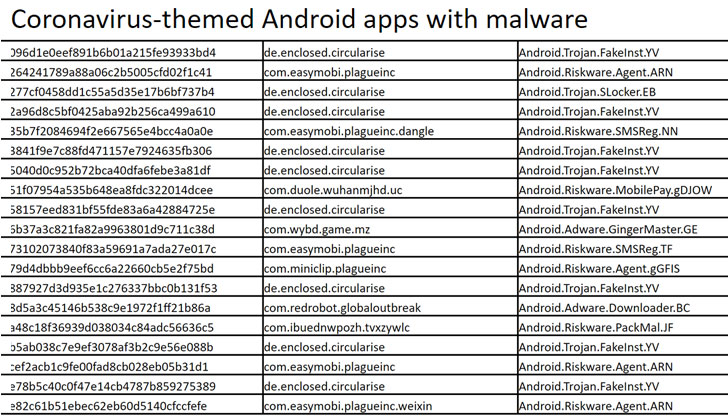
“Most malicious apps found are bundle threats that range from
ransomware to SMS-sending malware, and even spyware designed to
clean out the contents of victims’ devices for personal or
financial data,” Bitdefender researchers said in a telemetry
analysis report shared
with The Hacker News.
[1]
The find by Bitdefender is the latest in an avalanche of
digital threats piggybacking on the coronavirus pandemic.
Using Coronavirus-Related Keywords to Rank in Game Play Store
Searches
As people increasingly sought out applications that provided
information about COVID-19, malware authors have sneaked in adware,
banking trojans (e.g., Anubis, Cerberus,
Joker), and
information stealers under the guise of live tracker apps and those
that help users identify common symptoms of the illness.
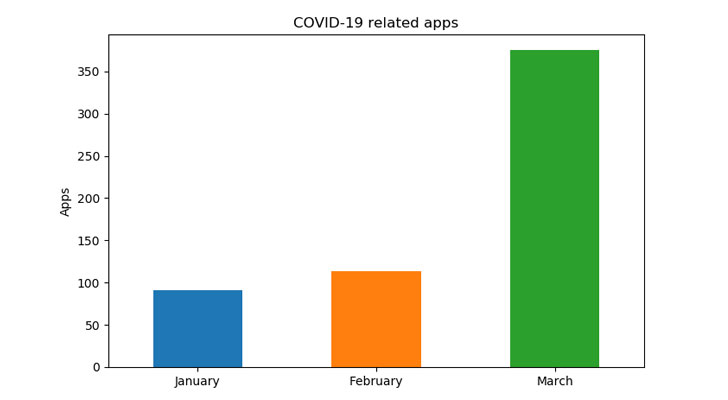
coronavirus-related keywords in their manifest (package name,
activities, receivers, etc.),” the researchers observed.
“This means that a major component of the application was named
in a way – or the application contains strings – that relates it to
the recent outbreak. Out of the total, 560 are clean, 9 are
Trojans, and 10 are Riskware.”
What’s more, some apps such as Bubble Shooter Merge and Galaxy
Shooter – Falcon Squad have even changed their name and description
to ride on the coronavirus pandemic by including keywords that
ensure their apps rank higher when people search for coronavirus in
the Google Play store.

capitalizing on sensitive events and its adjustments to Google
Play search results to intentionally filter out
potentially malicious apps when searching for keywords like
“corona” or “coronavirus.”
COVID-19 Themed Attacks Galore
From cyberattacks to phishing scams, from extortion emails to
malicious websites, a long list of digital threats
have leveraged on the coronavirus outbreak in recent weeks. It’s
amply clear that these attacks exploit coronavirus fears and
people’s hunger for information about the outbreak.
- Router Hacking — A recently discovered hack targeted
home and small-office routers to redirect users to malicious sites
that pose as COVID-19 informational resources in an attempt to
install “Oski[9]” malware that steals
passwords and cryptocurrency credentials. - Email Scams and Phishing — Spam emails related to the
health concern have taken up close to 2.5 percent of total spam volume[10], indicating how email
scams tied to the pandemic have steadily increased just in the
month of March. What’s more, at least 42,578 “covid” or “corona”
domain names have been newly registered since the start of the
month, with over 2,500 new domains registered on average every
single day in the last two weeks. - Spear Phishing Attacks — Attackers have been
found actively abusing the names
and logos[11] of many companies and
organizations in extortion[12] and phishing campaigns,
including the World Health Organization (WHO) and the United States
Centers for Disease Control (CDC), and send specially crafted RTF
documents[13] in an attempt to
hoodwink their victims into downloading information stealers,
remote access trojans (RATs), credential harvesters. - Ransomware Attacks — Cybercriminals behind the
Maze ransomware attacked the IT network of Hammersmith
Medicines Research[14] (HMR), a medical
facility on standby to help carry out trials of any possible
coronavirus vaccine, and published personal details of thousands of
former patients after the company declined to pay a ransom. The
development comes after the cybercrime group made a public promise
not to attack medical research organizations during the coronavirus
pandemic. - Fake Apps — There has been a rise in scam
campaigns and rogue
apps[15] that purport to sell
coronavirus cures
or face masks[16], or ask for investments
in fraudulent companies that claimed to be developing vaccines, or
urge users to make donations for
fake charities[17]. - Banking Malware and Payment Card Hacking — The
operators of Ginp banking
Trojan[18] began using information
about people infected with coronavirus as a bait to lure Android
users in Spain into giving away credit card data.
How to Protect Yourself
All this spate of attacks have led to the US Cybersecurity and
Infrastructure Security Agency (CISA) to
issue warnings about the rise of Coronavirus-themed scams, and the
World Health
Organization (WHO) to release warnings of phishing scams
impersonating their organization.
To safeguard from such threats, it’s always recommended that
users install apps only from legitimate marketplaces, seek
information only from official sources, and be wary of any emails
attempting to get recipients to open attachments or click
links.
The FBI has also issued an advisory[21], urging users to watch
out for fake CDC emails and phishing emails asking recipients to
verify their personal information —
“Scammers are leveraging the COVID-19 pandemic to steal your
money, your personal information, or both. Don’t let them. Protect
yourself and do your research before clicking on links purporting
to provide information on the virus; donating to a charity online
or through social media; contributing to a crowdfunding campaign,
purchasing products online; or giving up your personal information
in order to receive money or other benefits.”
References
- ^
report
(labs.bitdefender.com) - ^
avalanche of digital threats
(thehackernews.com) - ^
Anubis
(thehackernews.com) - ^
Cerberus
(thehackernews.com) - ^
Joker
(security.googleblog.com) - ^
policy against capitalizing on
sensitive events (blog.google) - ^
filter out
(play.google.com) - ^
digital threats
(www.trendmicro.com) - ^
Oski
(labs.bitdefender.com) - ^
spam volume
(news.sophos.com) - ^
abusing the names and logos
(www.proofpoint.com) - ^
extortion
(nakedsecurity.sophos.com) - ^
crafted RTF documents
(research.checkpoint.com) - ^
Hammersmith Medicines Research
(www.forbes.com) - ^
rogue apps
(www.zscaler.com) - ^
coronavirus cures or face masks
(blog.barracuda.com) - ^
donations for fake charities
(www.consumer.ftc.gov) - ^
Ginp banking Trojan
(www.kaspersky.com) - ^
CISA
(www.us-cert.gov) - ^
World Health Organization
(www.who.int) - ^
issued an advisory
(www.ic3.gov)
Read more http://feedproxy.google.com/~r/TheHackersNews/~3/s4ej0ch0JFs/coronavirus-covid-apps-android.html