
Some widely sold D-Link VPN router models have been found
vulnerable to three new high-risk security vulnerabilities, leaving
millions of home and business networks open to cyberattacks—even if
they are secured with a strong password.
Discovered by researchers at Digital Defense, the three security
shortcomings were responsibly disclosed to D-Link on August 11,
which, if exploited, could allow remote attackers to execute
arbitrary commands on vulnerable networking devices via
specially-crafted requests and even launch denial-of-service
attacks.
D-Link DSR-150, DSR-250, DSR-500, and DSR-1000AC and other VPN
router models in the DSR Family running firmware version 3.14 and
3.17 are vulnerable to the remotely exploitable root command
injection flaw.
The Taiwanese networking equipment maker confirmed[1]
the issues in an advisory on December 1, adding that the patches
were under development for two of three flaws, which have now been
released to the public at the time of writing.
“From both WAN and LAN interfaces, this vulnerability could be
exploited over the Internet,” Digital Defense said in a report
published today and shared with The Hacker News.
“Consequently, a remote, unauthenticated attacker with access to
the router’s web interface could execute arbitrary commands as
root, effectively gaining complete control of the router.”
The flaws stem from the fact that the vulnerable component, the
“Lua CGI,” is accessible without authentication and lacks
server-side filtering, thus making it possible for an attacker —
authenticated or otherwise — to inject malicious commands that will
be executed with root privileges.
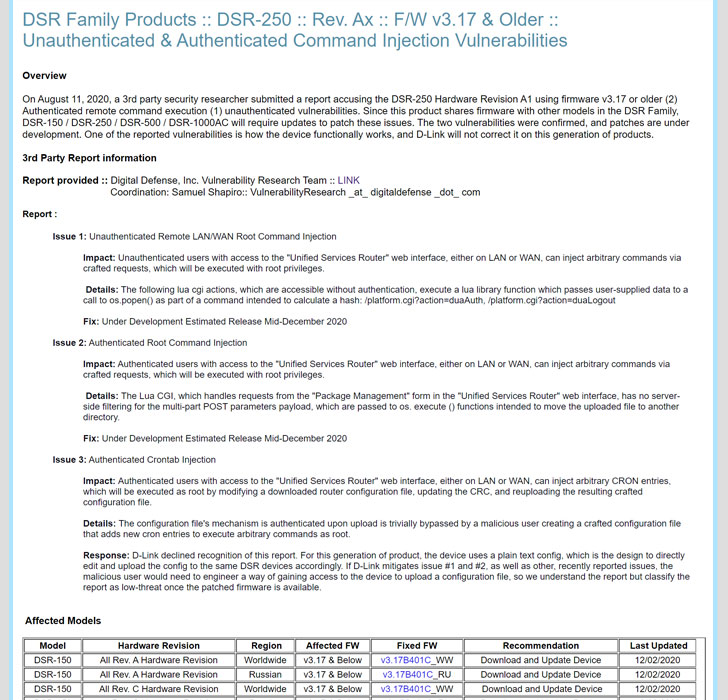
A separate vulnerability reported by Digital Defense concerns
the modification of the router configuration file to inject rogue
CRON entries and execute arbitrary commands as the root user.
However, D-Link said it will not correct this flaw “on this
generation of products,” stating this is the intended function.
“The device uses a plain text config, which is the design to
directly edit and upload the config to the same DSR devices
accordingly,” the company said.
“If D-Link mitigates issue #1 and #2, as well as other, recently
reported issues, the malicious user would need to engineer a way of
gaining access to the device to upload a configuration file, so we
understand the report but classify the report as low-threat once
the patched firmware is available.”
With the unprecedented rise in work from home as a result of the
COVID-19 pandemic, more employees may be connecting to corporate
networks using one of the affected devices, Digital Defense
cautioned.
As organizations have scrambled to adapt to remote work and
offer secure remote access to enterprise systems, the change has
created new attack surfaces, with flaws in VPNs[2]
becoming popular targets for attackers to gain entry into internal
corporate networks.
It’s recommended that businesses using the affected products
apply the relevant updates as and when they are available.
References
- ^
confirmed
(supportannouncement.us.dlink.com) - ^
flaws in
VPNs (thehackernews.com)