
Threat actors are increasingly mimicking legitimate applications
like Skype, Adobe Reader, and VLC Player as a means to abuse trust
relationships and increase the likelihood of a successful social
engineering attack.
Other most impersonated legitimate apps by icon include 7-Zip,
TeamViewer, CCleaner, Microsoft Edge, Steam, Zoom, and WhatsApp, an
analysis from VirusTotal has revealed.
“One of the simplest social engineering tricks we’ve seen
involves making a malware sample seem a legitimate program,”
VirusTotal said[1]
in a Tuesday report. “The icon of these programs is a critical
feature used to convince victims that these programs are
legitimate.”
It’s no surprise that threat actors resort to a variety of
approaches to compromise endpoints by tricking unwitting users into
downloading and running seemingly innocuous executables.
This, in turn, is primarily achieved by taking advantage of
genuine domains in a bid to get around IP-based firewall defenses.
Some of the top abused domains are discordapp[.]com,
squarespace[.]com, amazonaws[.]com, mediafire[.]com, and
qq[.]com.
In total, no fewer than 2.5 million suspicious files downloaded
from 101 domains belonging to Alexa’s top 1,000 websites have been
detected.
The misuse of Discord has been well-documented, what with the
platform’s content delivery network (CDN) becoming a fertile ground for hosting
malware[2] alongside Telegram,
while also offering a “perfect communications hub for
attackers.”
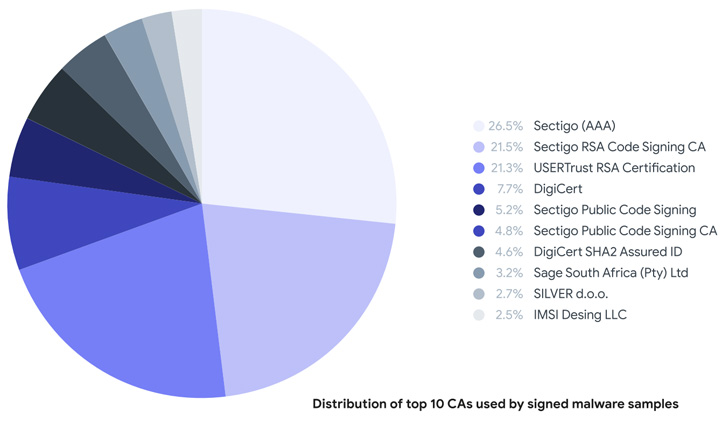
Another oft-used technique is the practice of signing malware
with valid certificates stolen from other software makers. The
malware scanning service said it found more than one million
malicious samples since January 2021, out of which 87% had a
legitimate signature when they were first uploaded to its
database.
VirusTotal said it also uncovered 1,816 samples since January
2020 that masqueraded as legitimate software by packaging the
malware in installers for other popular software such as Google
Chrome, Malwarebytes, Zoom, Brave, Mozilla Firefox, and Proton
VPN.
Such a distribution method can also result in a supply chain
when attackers manage to break into a legitimate software’s update
server or gain unauthorized access to the source code, making it
possible to sneak the malware in the form of trojanized
binaries.
Alternatively, legitimate installers are being packed in
compressed files along with malware-laced files, in one case
including the legitimate Proton VPN installer and malware that
installs the Jigsaw ransomware.
That’s not all. A third method, albeit more sophisticated,
entails incorporating the legitimate installer as a portable executable resource[3] into the malicious
sample so that the installer is also executed when the malware is
run so as to give an illusion that the software is working as
intended.
“When thinking about these techniques as a whole, one could
conclude that there are both opportunistic factors for the
attackers to abuse (like stolen certificates) in the short and mid
term, and routinely (most likely) automated procedures where
attackers aim to visually replicate applications in different
ways,” the researchers said.
References
- ^
said
(blog.virustotal.com) - ^
fertile
ground for hosting malware
(thehackernews.com) - ^
portable
executable resource (docs.microsoft.com)
Read more https://thehackernews.com/2022/08/virustotal-reveals-most-impersonated.html