Days after Microsoft[1], Secureworks[2], and Volexity[3]
shed light on a new spear-phishing activity unleashed by the
Russian hackers who breached SolarWinds IT management software, the
U.S. Department of Justice (DoJ) Tuesday said it intervened to take
control of two command-and-control (C2) and malware distribution
domains used in the campaign.
The court-authorized domain seizure 1m took place on May 28, the
DoJ said, adding the action was aimed at disrupting the threat
actors’ follow-on exploitation of victims as well as block their
ability to compromise new systems. The department, however,
cautioned that the adversary might have deployed additional
backdoor accesses in the interim period between when the initial
compromises occurred, and the seizures took place last week.
“[The] action is a continued demonstration of the Department’s
commitment to proactively disrupt hacking activity prior to the
conclusion of a criminal investigation,” said[4]
Assistant Attorney General John C. Demers for the Justice
Department’s National Security Division. “Law enforcement remains
an integral part of the U.S. government’s broader disruption
efforts against malicious cyber-enabled activities, even prior to
arrest, and we will continue to evaluate all possible opportunities
to use our unique authorities to act against such threats.”
The two domains in question — theyardservice[.]com and
worldhomeoutlet[.]com — were used to communicate and control a
Cobalt Strike beacon called NativeZone[5]
that the actors implanted on the victim networks. The wide-scale
campaign, which was detected on May 25, leveraged a compromised
USAID account at a mass email marketing company called Constant
Contact to send phishing emails to approximately 3,000 email
accounts at more than 150 different organizations.
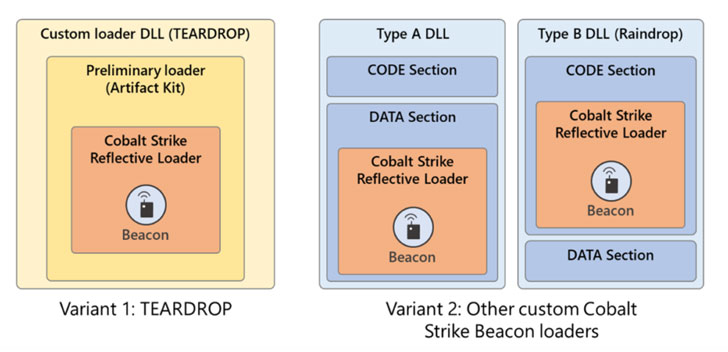
Once the recipients clicked on the embedded link in the email
message, a sub-domain of theyardservice[.]com was used to gain an
initial foothold into the victim machine, exploiting it to retrieve
the Cobalt Strike backdoor to maintain persistent presence and
potentially deliver additional payloads. “The actors’ instance of
the Cobalt Strike tool received C2 communications via other
subdomains of theyardservice[.]com, as well as the domain
worldhomeoutlet[.]com,” the DoJ said.
Microsoft attributed the ongoing intrusions to the Russian threat actor[6]
it tracks as Nobelium, and by the wider cybersecurity community
under the monikers APT29, UNC2452 (FireEye), SolarStorm (Unit 42),
StellarParticle (Crowdstrike), Dark Halo (Volexity), and Iron
Ritual (Secureworks).
The company has since identified three more unique pieces of
malware[7] used in the infection
chain, namely BoomBox, EnvyScout, and VaporRage, adding to the
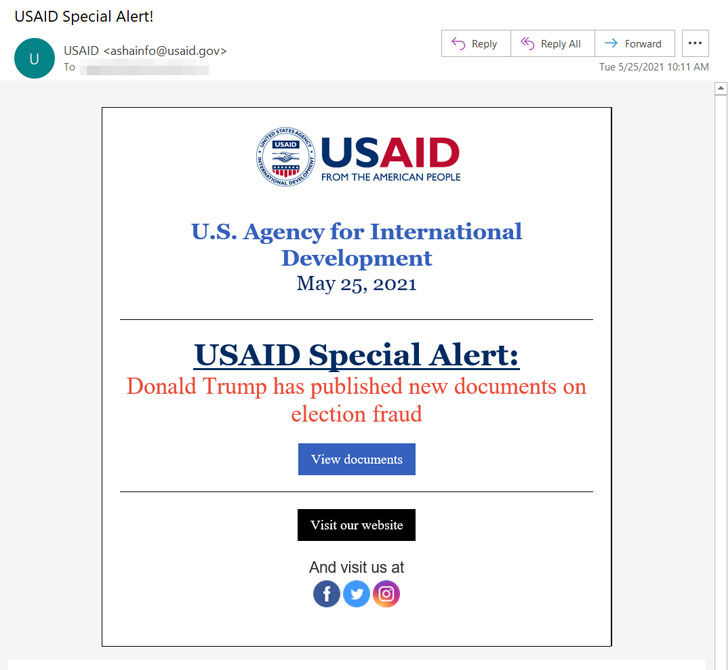
attackers’ growing arsenal of hacking tools such as Sunburst[8], Sunspot[9], Raindrop[10], Teardrop[11], GoldMax, GoldFinder, Sibot[12], and Flipflop[13], once again
demonstrating Nobelium’s operational security priorities when
targeting potentially high-risk and high-visibility
environments.
While BoomBox is a downloader to obtain a later-stage payload
from an actor-controlled Dropbox account, VaporRage is a shellcode
loader used to download, decode, and execute an arbitrary payload
fully in-memory. EnvyScout, on the other hand, is a malicious
dropper capable of de-obfuscating and writing a malicious ISO file
to disk and is delivered in the form of a malicious HTML attachment
to spear-phishing emails.
The attacker’s practice of changing tactics several times over
the course of its latest campaign underscores the widespread damage
that could be inflicted on individual victims, government agencies,
non-governmental organizations, and private businesses, not to
mention reflect on its pattern of establishing access on one system
or account and then using it as a jumping-off point to gain access
to numerous targets.
In “significantly” differing from the SolarWinds hack by way of
evolving its tools and tradecraft, the modus operandi enables a
high level of stealth that allows them to remain undetected for
extended periods of time, the researchers noted.
“Nobelium is an actor that operates with rapid operational
tempo, often leveraging temporary infrastructure, payloads, and
methods to obfuscate their activities,” Microsoft said. “Such
design and deployment patterns, which also include staging of
payloads on a compromised website, hamper traditional artifacts and
forensic investigations, allowing for unique payloads to remain
undiscovered.”
References
- ^
Microsoft
(www.microsoft.com) - ^
Secureworks
(www.secureworks.com) - ^
Volexity
(www.volexity.com) - ^
said
(www.justice.gov) - ^
NativeZone
(thehackernews.com) - ^
Russian
threat actor (thehackernews.com) - ^
three
more unique pieces of malware
(www.microsoft.com) - ^
Sunburst
(thehackernews.com) - ^
Sunspot
(thehackernews.com) - ^
Raindrop
(thehackernews.com) - ^
Teardrop
(thehackernews.com) - ^
GoldMax, GoldFinder, Sibot
(thehackernews.com) - ^
Flipflop
(www.volexity.com)