the Microsoft’s Windows operating system that, under a certain
scenario, could allow a remote attacker to execute arbitrary code
on Windows machine.
Discovered by security researcher John Page (@hyp3rlinx), the
vulnerability was reported to the
Microsoft security team through Trend Micro’s Zero Day Initiative
(ZDI) Program over 6 months ago, which the tech giant has refused
to patch, at least for now.
[1]
The vulnerability, which has not been assigned any CVE number,
actually resides within the processing of a vCard file—a standard
file format for storing contact information for a person or
business, which is also supported by Microsoft Outlook.
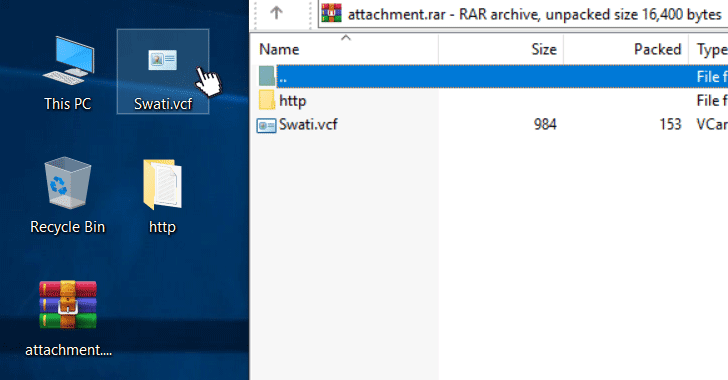
According to the researcher, a remote attacker can maliciously
craft a VCard file in a way that the contact’s website URL stored
within the file points to a local executable file, which can be
sent within a zipped file via an email or delivered separately via
drive-by-download techniques.
website URL, the Windows operating system would run the malicious
executable without displaying any warning, instead of opening the
web address on the browser.
“Crafted data in a VCard file can cause Windows to display a
dangerous hyperlink,” the researcher writes in an advisory. “The
user interface fails to provide any indication of the hazard. An
attacker can leverage this vulnerability to execute code in the
context of the current user.”
[2]
Obviously, “user interaction is required to exploit this
vulnerability in that the target must visit a malicious page or
open a malicious file.”
Although the attack requires user’s interaction, leaving the
vulnerability unpatched would leave an opportunity for
sophisticated attackers to target Windows users at large.
The researcher has also published proof-of-concept exploit code
for the vulnerability, which has been assigned a CVSS 3.0 score of
7.8.
Read more http://feedproxy.google.com/~r/TheHackersNews/~3/ZxsAQ321JTo/vcard-windows-hacking.html