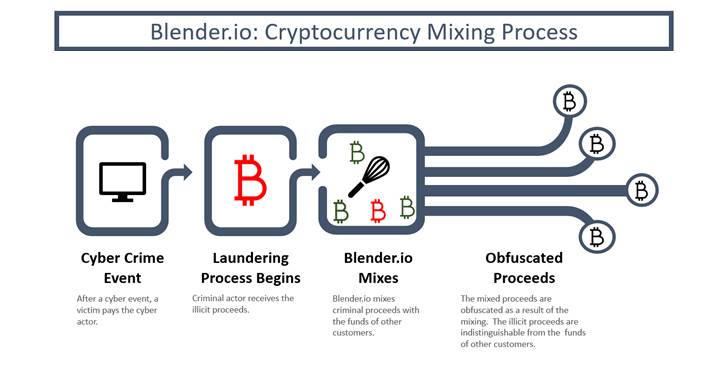
The U.S. Treasury Department on Friday moved to sanction virtual
currency mixer Blender.io, marking the first time a mixing service
has been subjected to economic blockades.
The move signals continued efforts on the part of the government
to prevent North Korea’s Lazarus Group from laundering the funds
stolen from the unprecedented hack of Ronin
Bridge[1] in late March.
The newly imposed sanctions, issued by the U.S. Office of
Foreign Assets Control (OFAC), target 45 Bitcoin addresses linked
to Blender.io and four new wallets linked to Lazarus Group, an
advanced persistent with ties to the Democratic People’s Republic
of Korea (DPRK).
“Blender was used in processing over $20.5 million of the
illicit proceeds,” the Treasury said[2], adding it was utilized
by DPRK to “support its malicious cyber activities and
money-laundering of stolen virtual currency.”
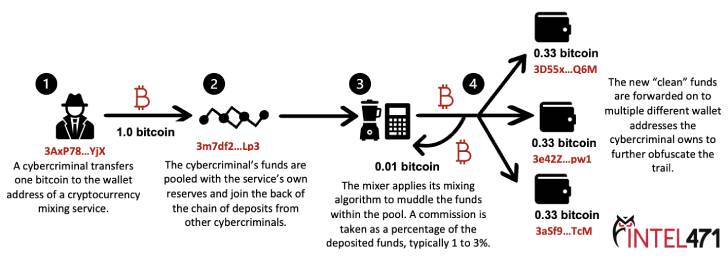
Cryptocurrency mixers, also called tumblers[3], are privacy-focused
services that allow users to move cryptocurrency assets between
accounts without leaving a transaction trail by obfuscating their
origins.
Mixers like Blender are known to take a “dynamic” service fee
that ranges anywhere between 0.6% and 2.5% every time money is
transferred to a wallet address under its control. Since its launch
in 2017, Blender is estimated to have transferred more than $500
million worth of Bitcoin.
“Through these services, threat actors can achieve their end
goal of cashing out and keeping the criminal underground liquid
through the trade of illicit goods and services,” Intel 471
noted[4]
in a report published in November 2021.
The Ronin Bridge hack saw the state-sponsored cyber hacking
group stealing $540 million from a decentralized protocol that
permits users to transfer their crypto between Ethereum and the
popular blockchain game Axie Infinity.
On April 16, the Treasury Department blocklisted[5]
the Ethereum wallet address that received the stolen digital
currency, although by then the Lazarus Group had managed to launder
18% of the siphoned funds (about $97 million) through centralized
exchanges and an Ethereum mixing service called Tornado Cash.
Over the past two weeks, around $273.9 million of Ether was sent
to four of the newly-sanctioned addresses, according to blockchain
analytics firm Elliptic, with one of those addresses already moving
$37 million through Tornado Cash, leaving behind $236 million.
“The transactions involved amounts significantly larger than
their previous laundering efforts,” the company said[6]. “The ramping up of
laundering efforts in this manner potentially reflects a growing
desperation by the hackers.”
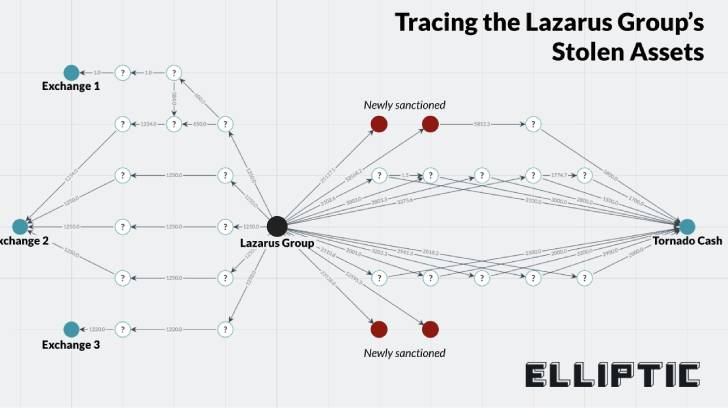
Furthermore, the sanctioning of Blender is evidence that the
“Lazarus Group had moved some of the stolen funds into Bitcoin,”
Elliptic pointed out.
On top of that, Blender is also said to have helped a number of
the Russia-aligned ransomware gangs launder their money, including
TrickBot[7], Conti[8]
(formerly Ryuk), Sodinokibi[9]
(aka REvil), and Gandcrab[10].
In the midst of all this, crypto exchange Binance on April 22
revealed[11] that it had managed to
recover $5.8 million worth of the Axie Infinity stolen funds that
were spread across 86 accounts.
The development comes a month after the Treasury sanctioned[12] virtual currency
exchange Garantex for assisting criminal actors in laundering over
$100 million in ill-gotten funds.
Last year, the department penalized two cryptocurrency exchanges
SUEX[13] and CHATEX[14] for facilitating
financial transactions for ransomware actors and cashing out the
money extorted from victims.
In recent years, North Korea has been attached to a string of
cyber-enabled heists from cryptocurrency exchanges and financial
entities as a way of getting around international
sanctions[15] and generating revenue
for its nuclear weapons program.
Last month, U.S. cybersecurity and intelligence agencies
warned[16] of a new set of
cyberattacks carried out by the Lazarus Group targeting blockchain
companies with rogue cryptocurrency apps.
“Virtual currency mixers that assist illicit transactions pose a
threat to U.S. national security interests,” said Brian E. Nelson,
undersecretary of the Treasury for Terrorism and Financial
Intelligence.
“We are taking action against illicit financial activity by the
DPRK and will not allow state-sponsored thievery and its
money-laundering enablers to go unanswered.”
References
- ^
unprecedented hack of Ronin Bridge
(thehackernews.com) - ^
said
(home.treasury.gov) - ^
tumblers
(en.wikipedia.org) - ^
noted
(intel471.com) - ^
blocklisted
(thehackernews.com) - ^
said
(www.elliptic.co) - ^
TrickBot
(thehackernews.com) - ^
Conti
(thehackernews.com) - ^
Sodinokibi
(thehackernews.com) - ^
Gandcrab
(thehackernews.com) - ^
revealed
(twitter.com) - ^
sanctioned
(thehackernews.com) - ^
SUEX
(thehackernews.com) - ^
CHATEX
(thehackernews.com) - ^
getting around international
sanctions (en.wikipedia.org) - ^
warned
(thehackernews.com)
Read more https://thehackernews.com/2022/05/us-sanctions-cryptocurrency-mixer.html