The U.S. government on Thursday released a cybersecurity
advisory outlining multiple intrusion campaigns conducted by
state-sponsored Russian cyber actors from 2011 to 2018 that
targeted the energy sector in the U.S. and beyond.
“The [Federal Security Service] conducted a multi-stage campaign
in which they gained remote access to U.S. and international Energy
Sector networks, deployed ICS-focused malware, and collected and
exfiltrated enterprise and ICS-related data,” the U.S. government
said[1], attributing the attacks
to an APT actor known as Energetic Bear[2].
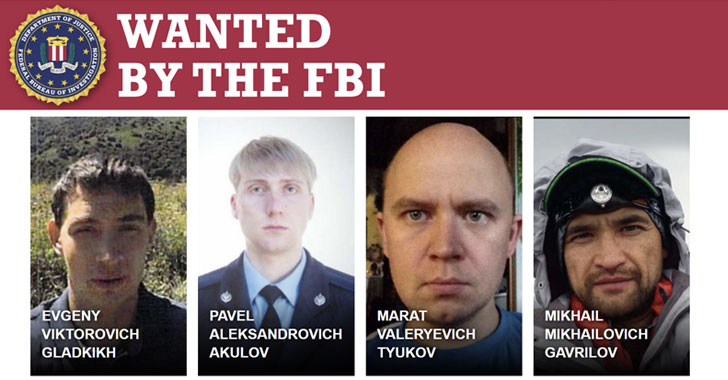
In addition, the Justice Department charged[3]
four Russian government employees, including three officers of the
Russian Federal Security Service and a computer programmer at the
Central Scientific Research Institute of Chemistry and Mechanics
(TsNIIKhM), for their roles in carrying out the attacks on oil
refineries, nuclear facilities, and energy companies.
The four Russian nationals are Pavel Aleksandrovich Akulov(36),
Mikhail Mikhailovich Gavrilov (42), and Marat Valeryevich Tyukov
(39), and Evgeny Viktorovich Gladkikh (36).
The seven-year-long global energy sector campaign is said to
have taken advantage of spear-phishing emails, trojanized software
updates, and redirects to rogue websites (aka watering holes) to
gain initial access, using it to deploy remote access trojans like
Havex[4]
on compromised systems.
Also detailed by the security agencies is a 2017 campaign
engineered by cyber actors with ties to TsNIIKhM with the goal of
manipulating the industrial control systems of an unnamed oil
refinery located in the Middle East by leveraging a piece of
malware called TRITON.
“TRITON was designed to specifically target Schneider Electric’s
Triconex Tricon safety systems and is capable of disrupting those
systems,” the Cybersecurity and Infrastructure Security Agency
(CISA), the Federal Bureau of Investigation (FBI), and the
Department of Energy (DOE) said.
Collectively, the hacking campaigns are alleged to have singled
out thousands of computers, at hundreds of companies and
organizations, in approximately 135 countries, the FBI said[5].
“The potential of cyberattacks to disrupt, if not paralyze, the
delivery of critical energy services to hospitals, homes,
businesses and other locations essential to sustaining our
communities is a reality in today’s world,” said U.S. Attorney
Duston Slinkard for the District of Kansas. “We must acknowledge
there are individuals actively seeking to wreak havoc on our
nation’s vital infrastructure system, and we must remain vigilant
in our effort to thwart such attacks.”
References
Read more https://thehackernews.com/2022/03/us-charges-4-russian-govt-employees.html