Apr 05, 2023Ravie Lakshmanan

The threat actor behind the information-stealing malware known
as Typhon Reborn has resurfaced with an updated
version (V2) that packs in improved capabilities to evade detection
and resist analysis.
The new version is offered for sale on the criminal underground
for $59 per month, $360 per year, or alternatively, for $540 for a
lifetime subscription.
“The stealer can harvest and exfiltrate sensitive information
and uses the Telegram API to send stolen data to attackers,” Cisco
Talos researcher Edmund Brumaghin said[1]
in a Tuesday report.
Typhon was first documented[2]
by Cyble in August 2022, detailing its myriad features, including
hijacking clipboard content, capturing screenshots, logging
keystrokes, and stealing data from crypto wallet, messaging, FTP,
VPN, browser, and gaming apps.
Based on another stealer malware called Prynt Stealer[3], Typhon is also capable
of delivering the XMRig cryptocurrency miner. In November 2022,
Palo Alto Networks Unit 42 unearthed[4]
an updated version dubbed Typhon Reborn.
“This new version has increased anti-analysis techniques and it
was modified to improve the stealer and file grabber features,”
Unit 42 said, pointing out the removal of existing features like
keylogging and cryptocurrency mining in an apparent attempt to
lower the chances of detection.
The latest V2 variant, per Cisco Talos, was marketed by its
developer on January 31, 2023, on the Russian language dark web
forum XSS.
“Typhon Reborn stealer is a heavily refactored and improved
version of the older and unstable Typhon Stealer,” the malware
author said, in addition to touting its inexpensive price and the
absence of any backdoors.
Like other malware, V2 comes with options to avoid infecting systems[5]
that are located in the Commonwealth of Independent States (CIS)
countries. It, however, notably excludes Ukraine and Georgia from
the list.
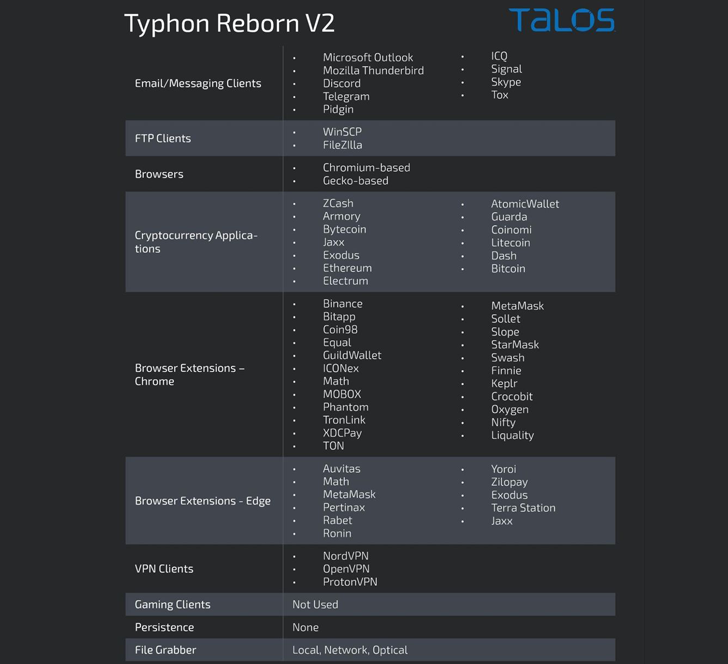
Besides incorporating more anti-analysis and anti-virtualization
checks, Typhon Reborn V2 removes its persistence features, instead
opting to terminate itself after exfiltrating the data.
The malware ultimately transmits the collected data in a
compressed archive via HTTPS using the Telegram API, marking
continued abuse of the messaging platform.
“Once the data has been successfully transmitted to the
attacker, the archive is then deleted from the infected system,”
Brumaghin said. “The malware then calls [a self-delete function] to
terminate execution.”
UPCOMING WEBINAR
Learn to Secure the Identity Perimeter – Proven Strategies
Improve your business security with our upcoming expert-led
cybersecurity webinar: Explore Identity Perimeter strategies!
Don’t Miss Out – Save Your Seat![6]
The findings come as Cyble disclosed a new Python-based stealer
malware named Creal that targets cryptocurrency users via phishing
sites mimicking legitimate crypto mining services like Kryptex.
The malware is no different from Typhon Reborn in that it’s
equipped to siphon cookies and passwords from Chromium-based web
browsers as well as data from instant messaging, gaming, and crypto
wallet apps.
That said, the malware’s source code is available on GitHub,
thereby allowing other threat actors to alter the malware to suit
their needs and making it a potent threat.
“Creal Stealer is capable of exfiltrating data using Discord
webhooks and multiple file-hosting and sharing platforms such as
Anonfiles and Gofile,” Cyble said[7]
in a report published last week.
“The trend of using open source code in malware is increasing
among cybercriminals, since it allows them to create sophisticated
and customized attacks with minimal expenses.”
Found this article interesting? Follow us on Twitter [8]
and LinkedIn[9]
to read more exclusive content we post.
References
- ^
said
(blog.talosintelligence.com) - ^
first
documented (blog.cyble.com) - ^
Prynt
Stealer (thehackernews.com) - ^
unearthed
(thehackernews.com) - ^
avoid
infecting systems (thehackernews.com) - ^
Don’t
Miss Out – Save Your Seat! (thehacker.news) - ^
said
(blog.cyble.com) - ^
Twitter
(twitter.com) - ^
LinkedIn
(www.linkedin.com)
Read more https://thehackernews.com/2023/04/typhon-reborn-stealer-malware.html