Mar 29, 2023Ravie Lakshmanan
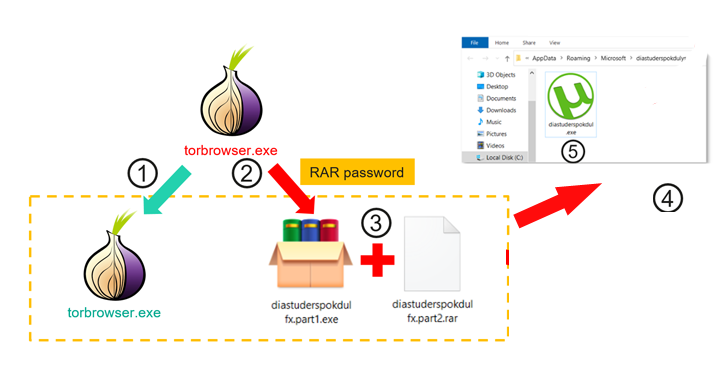
Trojanized installers for the TOR anonymity browser are being
used to target users in Russia and Eastern Europe with clipper malware[1]
designed to siphon cryptocurrencies since September 2022.
“Clipboard injectors […] can be silent for years, show no
network activity or any other signs of presence until the
disastrous day when they replace a crypto wallet address,” Vitaly
Kamluk, director of global research and analysis team (GReAT) for
APAC at Kaspersky, said[2].
Another notable aspect of clipper malware is that its nefarious
functions are not triggered unless the clipboard data meet specific
criteria, making it more evasive.
It’s not immediately clear how the installers are distributed,
but evidence points to the use of torrent downloads or some unknown
third-party source since the Tor Project’s website has been
subjected[3]
to blockades[4]
in Russia[5]
in recent years.
Regardless of the method used, the installer launches the
legitimate executable, while also simultaneously launching the
clipper payload that’s designed to monitor the clipboard
content.
“If the clipboard contains text, it scans the contents with a
set of embedded regular expressions,” Kamluk noted. “Should it find
a match, it is replaced with one randomly chosen address from a
hardcoded list.”
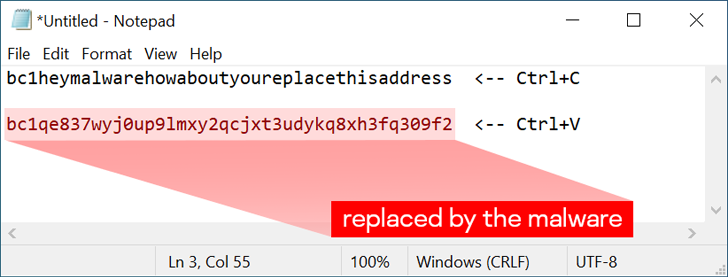
Each sample is packed with thousands of possible replacement
addresses that’s selected at random. It also comes with the ability
to disable the malware by means of a special hotkey combination
(Ctrl+Alt+F10), an option likely added during the testing
phase.
The Russian cybersecurity firm said it recorded roughly 16,000
detections, of which a majority are registered in Russia and
Ukraine, followed by the U.S., Germany, Uzbekistan, Belarus, China,
the Netherlands, the U.K., and France. In all, the threat has been
spotted in 52 countries worldwide.
WEBINAR
Discover the Hidden Dangers of Third-Party SaaS Apps
Are you aware of the risks associated with third-party app
access to your company’s SaaS apps? Join our webinar to learn about
the types of permissions being granted and how to minimize
risk.
The scheme is estimated to have netted the operators almost
$400,00 in illicit profits through the theft of Bitcoin, Litecoin,
Ether, and Dogecoin. The amount of Monero assets plundered is not
known owing to the privacy features[7]
built into the service.
It’s suspected that the campaign could be larger in scope due to
the possibility that the threat actors could be leveraging other
software installers and hitherto unseen delivery methods to target
unwary users.
To secure against such threats, it’s always recommended to
download software only from reliable and trusted sources.
Found this article interesting? Follow us on Twitter [8]
and LinkedIn[9]
to read more exclusive content we post.
References
Read more https://thehackernews.com/2023/03/trojanized-tor-browser-installers.html