and connect to the Internet. Companies maintain an online presence
through their official websites, blogs, and social media pages.
People use online services to conduct day to day activities like
banking. And of course, there are many businesses that are
completely based on the web like online markets, e-Commerce
websites and financial services.
All of these activities create opportunities for cyber attacks.
Various threats can affect websites, online services, API
endpoints, and the applications used or provided by businesses.
Such devastating attacks include privacy intrusion, DDoS attacks[1], data breaches,
defacements of websites, online store shutdowns, scraping, payment
fraud, abuse of online services, and backdoor installations.
The 2019 Cost of Cybercrime Study by Accenture reports that
there has been a 67% increase in cyber attacks over the last five
years. The corresponding increase in financial terms is pegged at
72% or a $13 million average cost of cybercrime (in 2018).
It only makes perfect sense to beef up cybersecurity. Robust
protection is critical for businesses of all sizes. Even small
businesses can become victims. Cybercrimes are typically
indiscriminate, and since there are more small businesses than
larger ones, statistics would show that the bulk of cyber-attacks
tend to affect small businesses.
According to the Verizon 2019 Data Breach Investigations Report,
43% of cyber attacks were aimed at small businesses.
Considering all the severity and prevalence of potential
attacks, it’s not right to randomly select a cybersecurity solution
to have. It’s advisable to look for the following attributes or
features:
1.) Multi-feature Solution
If you are going to spend on a cybersecurity solution, make sure
it’s one that is capable of addressing virtually all of the
possible attacks.
To be clear, there is no real all-in-one cybersecurity solution
available anywhere. You may find software marketed as such, but
they are unlikely to live up to the label. After all, it’s
difficult to set the perimeters as to what is “all” when it comes
to cyber-attacks.
Cybercriminals find new ways to achieve their felonious goals in
cyberspace as their attacks are thwarted. These new attacks may not
be covered by the products advertised as all-in-one solutions.
 |
| Image Credits: Reblaze |
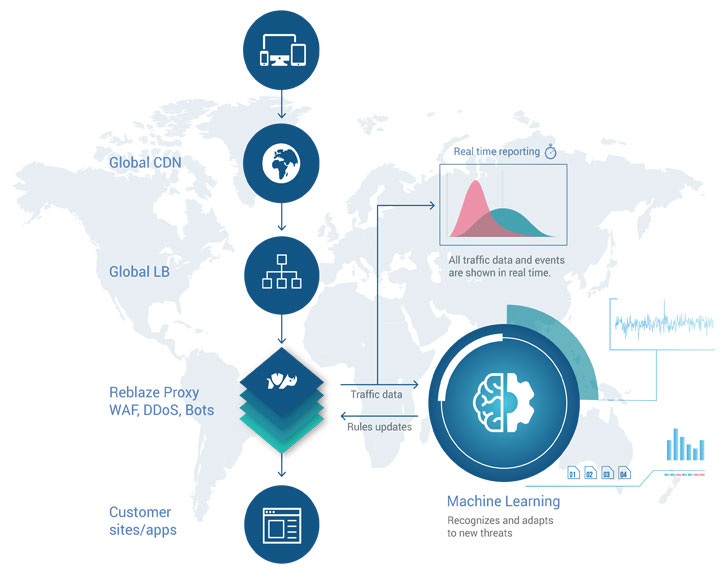
The goal should be to find a solution that provides the features
that cover as many threats as possible. Don’t settle for something
that only detects and prevents malware infection, even as it does
this in real-time.
It’s impractical to use multiple cybersecurity solutions to
address different threats to your infrastructure. Aside from taking
up more space and computing resources, the use of several software
can be costly.
2.) Monitoring
Robust cybersecurity is achieved when you are aware of what’s going
on with your computer, network, and online assets. That’s why it
greatly helps if you use a tool that readily presents a variety of
useful information.
These include your web traffic data, the CPU and RAM used by
different applications, new programs installed, and the new files
created in your device.
Choose a security solution that comes with robust monitoring
functions that operate seamlessly with the rest of your
infrastructure. If you can quickly see your web traffic stats
(incoming and outgoing), for example, you can see if something
anomalous is happening in your system.
A consistent stream of outgoing traffic even when you are not
uploading anything can mean that someone is stealing your files
discreetly. If you find new files in your computer or software that
you can’t remember downloading or installing, it could mean that
malware has infected your device.
3.) Bot Management
At present, the majority of cyber-attacks are no longer conducted
by individual hackers. The number of human hackers has increased
over the years, but not at the same exponential rate the number of
cyber attacks has grown.
Most attempts to defeat cybersecurity defenses are undertaken
automatically by bots[2]. It is estimated that
around 40% of Internet traffic is generated by malicious bots
trying to find their way into networks, devices, or online accounts
to infect.
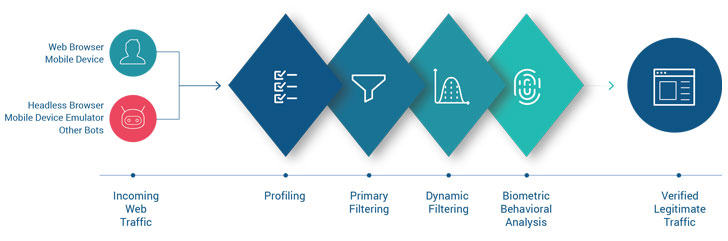
The cybersecurity solution you choose needs to be designed with
bots in mind. It should have essential anti-bot functions such as
rate-limiting, signature detection, blacklisting, reCAPTCH, and
other strategies that can detect bot activity and stop them in
their tracks before they can create any damage.
 |
| Image Credits: Reblaze |
Additionally, it should have tools to counter advanced bot
deployment strategies such as JSON payload inspection and other
data integrity assurance systems, advanced environmental
identification, biometric behavioral programming, and API scheme
ingestion.
4.) Artificial Intelligence
AI and machine learning are not just about creating interactive
robots or virtual entities capable of conversing with humans in a
natural way. It can also be applied in fortifying cybersecurity.
AI development has significantly advanced that it can be trained
to enhance the effectiveness and efficiency of cyber threat
detection and prevention. With the help of deep learning
algorithms, security systems can be trained to more effectively and
rapidly identify potential threats based on data collected from
computer users worldwide.
At the same time, AI helps minimize the inefficiencies caused by
false positives.
Be wary of deceptive marketing, though. You may find many
security systems that are advertised to have AI or machine learning
capabilities, but they may not actually deliver the expected
benefits.
Go over tech reviews or comments from knowledgeable users first
to ascertain that the AI-powered solution you are getting works,
especially when it comes to establishing behavioral profiles of
users of apps, websites, and API endpoints.
5.) Full Management and Support
Lastly, give preference to security solutions that are supplied
with full management and
support[3].
You may be tech-savvy to some extent, but you may not have
enough competence to manage a cybersecurity system with advanced
functions. Setting up and administering a security system takes
time and can be prone to mistakes, so it’s better to let the real
experts handle it (remotely).
You can just learn how it works (and do it on your own) as you
use the system, but don’t try to DIY your way around as you try to
secure your business or digital assets. Also, inquire about the
dependability and competence of the support team of the solution
you are considering. Make sure you will not be having support
problems later on.
Conclusion
In summary, the best possible cybersecurity solution to get is one
that comes with multiple features to deal with as many types of
threats as possible.
Notably, it should be equipped with robust monitoring functions,
advanced bot management, an AI-backed ability to identify and
handle threats and attacks, and competent remote management and
support.
Not many security solutions provide the aforementioned
attributes. However, if you want the best possible protection for
your business, you need to examine your options based on the points
discussed above prudently.
For example, Reblaze[4]. Unlike traditional
cybersecurity solutions, Reblaze is a cloud-based, fully managed
protective shield for sites and web applications that blocks
hostile traffic in the cloud, before it reaches the protected
network.
Reblaze is a comprehensive web security solution, providing a
next-gen WAF, DoS and DDoS protection, bot mitigation, scraping
prevention, CDN, load balancing, and more.
Reblaze offers a unique combination of benefits,
including:
- Machine learning to provide accurate and adaptive threat
detection. - Dedicated Virtual Private Clouds to ensure maximum
privacy. - Top-tier infrastructure to assure maximum performance.
- Fine-grained ACLs to enable precise traffic regulation.
- An intuitive web-based management console to provide real-time
traffic control.
References
- ^
DDoS attacks
(www.reblaze.com) - ^
bots
(www.reblaze.com) - ^
full management and support
(www.reblaze.com) - ^
Reblaze
(www.reblaze.com)
Read more http://feedproxy.google.com/~r/TheHackersNews/~3/V3IQTdCvjoc/web-application-cybersecurity.html