
Close to 14 million Linux-based systems are directly exposed to
the Internet, making them a lucrative target for an array of
real-world attacks that could result in the deployment of malicious
web shells, coin miners, ransomware, and other trojans.
That’s according to an in-depth look at the Linux threat
landscape published by U.S.-Japanese cybersecurity firm Trend Micro[1], detailing the top
threats and vulnerabilities affecting the operating system in the
first half of 2021, based on data amassed from honeypots, sensors,
and anonymized telemetry.
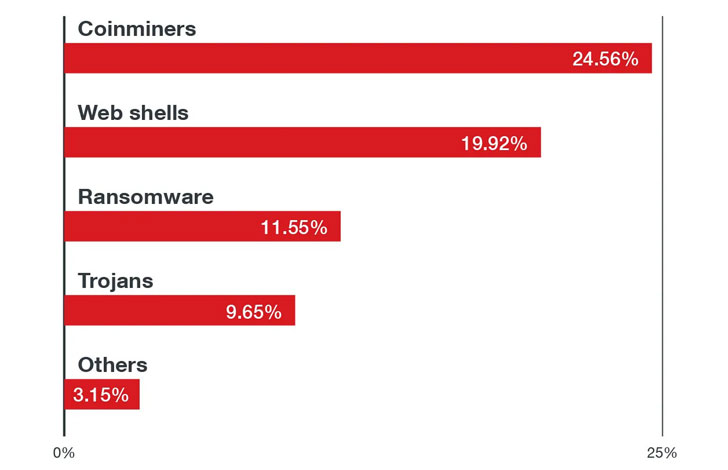
The company, which detected nearly 15 million malware events
aimed at Linux-based cloud environments, found coin miners and
ransomware to make up 54% of all malware, with web shells
accounting for a 29% share.
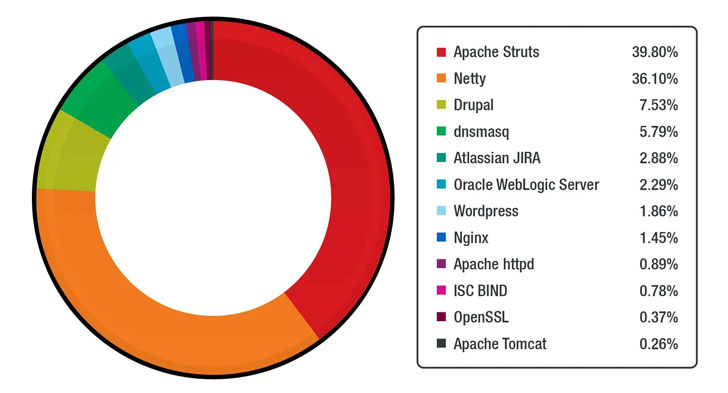
In addition, by dissecting over 50 million events reported from
100,000 unique Linux hosts during the same time period, the
researchers found 15 different security weaknesses that are known
to be actively exploited in the wild or have a proof of concept
(PoC) —
- CVE-2017-5638[2] (CVSS score: 10.0) –
Apache Struts 2 remote code execution (RCE) vulnerability - CVE-2017-9805[3] (CVSS score: 8.1) –
Apache Struts 2 REST plugin XStream RCE vulnerability - CVE-2018-7600[4] (CVSS score: 9.8) –
Drupal Core RCE vulnerability - CVE-2020-14750[5] (CVSS score: 9.8) –
Oracle WebLogic Server RCE vulnerability - CVE-2020-25213[6] (CVSS score: 10.0) –
WordPress File Manager (wp-file-manager) plugin RCE
vulnerability - CVE-2020-17496[7] (CVSS score: 9.8) –
vBulletin ‘subwidgetConfig’ unauthenticated RCE vulnerability - CVE-2020-11651[8] (CVSS score: 9.8) –
SaltStack Salt authorization weakness vulnerability - CVE-2017-12611[9] (CVSS score: 9.8) –
Apache Struts OGNL expression RCE vulnerability - CVE-2017-7657[10] (CVSS score: 9.8) –
Eclipse Jetty chunk length parsing integer overflow
vulnerability - CVE-2021-29441[11] (CVSS score: 9.8) –
Alibaba Nacos AuthFilter authentication bypass vulnerability - CVE-2020-14179[12] (CVSS score: 5.3) –
Atlassian Jira information disclosure vulnerability - CVE-2013-4547[13] (CVSS score: 8.0) –
Nginx crafted URI string handling access restriction bypass
vulnerability - CVE-2019-0230[14] (CVSS score: 9.8) –
Apache Struts 2 RCE vulnerability - CVE-2018-11776[15] (CVSS score: 8.1) –
Apache Struts OGNL expression RCE vulnerability - CVE-2020-7961[16] (CVSS score: 9.8) –
Liferay Portal untrusted deserialization vulnerability
Even more troublingly, the 15 most commonly used Docker images
on the official Docker Hub repository has been revealed to harbor
hundreds of vulnerabilities spanning across python, node,
wordpress, golang, nginx, postgres, influxdb, httpd, mysql, debian,
memcached, redis, mongo, centos, and rabbitmq, underscoring the
need to secure containers[17] from a wide range of
potential threats at each stage of the development pipeline.
“Users and organizations should always apply security best
practices, which include utilizing the security by design approach,
deploying multilayered virtual patching or vulnerability shielding,
employing the principle of least privilege, and adhering to the
shared responsibility model,” the researchers concluded.
References
- ^
Trend
Micro (www.trendmicro.com) - ^
CVE-2017-5638
(nvd.nist.gov) - ^
CVE-2017-9805
(nvd.nist.gov) - ^
CVE-2018-7600
(nvd.nist.gov) - ^
CVE-2020-14750
(nvd.nist.gov) - ^
CVE-2020-25213
(nvd.nist.gov) - ^
CVE-2020-17496
(nvd.nist.gov) - ^
CVE-2020-11651
(nvd.nist.gov) - ^
CVE-2017-12611
(nvd.nist.gov) - ^
CVE-2017-7657
(nvd.nist.gov) - ^
CVE-2021-29441
(nvd.nist.gov) - ^
CVE-2020-14179
(nvd.nist.gov) - ^
CVE-2013-4547
(nvd.nist.gov) - ^
CVE-2019-0230
(nvd.nist.gov) - ^
CVE-2018-11776
(nvd.nist.gov) - ^
CVE-2020-7961
(nvd.nist.gov) - ^
secure
containers (www.trendmicro.com)
Read more http://feedproxy.google.com/~r/TheHackersNews/~3/ecvux2Zv6Zo/top-15-vulnerabilities-attackers.html