Jan 30, 2023Ravie Lakshmanan
A new Golang-based information stealer malware dubbed
Titan Stealer is being advertised by threat actors
through their Telegram channel.
“The stealer is capable of stealing a variety of information
from infected Windows machines, including credential data from
browsers and crypto wallets, FTP client details, screenshots,
system information, and grabbed files,” Uptycs security researchers
Karthickkumar Kathiresan and Shilpesh Trivedi said[1]
in a recent report.
Details of the malware were first documented[2]
by cybersecurity researcher Will Thomas (@BushidoToken) in November
2022 by querying the IoT search engine Shodan.
Titan is offered as a builder, enabling customers to customize
the malware binary to include specific functionalities and the kind
of information to be exfiltrated from a victim’s machine.
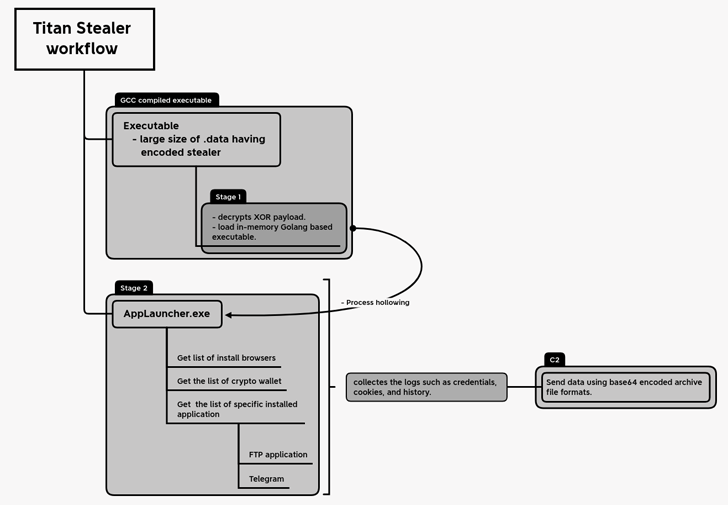
The malware, upon execution, employs a technique known as
process hollowing[3]
to inject the malicious payload into the memory of a legitimate
process known as AppLaunch.exe, which is the Microsoft .NET
ClickOnce Launch Utility.
Some of the major web browsers targeted by Titan Stealer include
Google Chrome, Mozilla Firefox, Microsoft Edge, Yandex, Opera,
Brave, Vivaldi, 7 Star Browser, Iridium Browser, and others. The
crypto wallets singled out are Armory, Armory, Bytecoin, Coinomi,
Edge Wallet, Ethereum, Exodus, Guarda, Jaxx Liberty, and Zcash.
It’s also capable of gathering the list of installed
applications on the compromised host and capturing data associated
with the Telegram desktop app.
The amassed information is subsequently transmitted to a remote
server under the attacker’s control as a Base64-encoded archive
file. Furthermore, the malware comes with a web panel that enables
adversaries to access the stolen data.
The exact modus operandi used to distribute the malware is
unclear as yet, but traditionally threat actors have leveraged a
number of methods, such as phishing, malicious ads, and cracked
software.
“One of the primary reasons [threat actors] may be using Golang
for their information stealer malware is because it allows them to
easily create cross-platform malware that can run on multiple
operating systems, such as Windows, Linux, and macOS,” Cyble
said[4]
in its own analysis of Titan Stealer.
“Additionally, the Go compiled binary files are small in size,
making them more difficult to detect by security software.”
The development arrives a little over two months after SEKOIA
detailed another Go-based malware referred to as Aurora Stealer[5]
that’s being put to use by several criminal actors in their
campaigns.
The malware is typically propagated[6]
via lookalike websites of popular software, with the same domains
actively updated to host trojanized versions of different
applications.
It has also been observed taking advantage of a method known as
padding to artificially inflate the size of the executables to as
much as 260MB by adding random data so as to evade detection by
antivirus software.
The findings come close on the heels of a malware campaign[7]
that has been observed delivering Raccoon and Vidar using hundreds
of fake websites masquerading as legitimate software and games.
Team Cymru, in an analysis[8]
published earlier this month, noted that “Vidar operators have
split their infrastructure into two parts; one dedicated to their
regular customers and the other for the management team, and also
potentially premium / important users.”
Found this article interesting? Follow us on Twitter [9]
and LinkedIn[10] to read more exclusive
content we post.
References
- ^
said
(www.uptycs.com) - ^
first
documented (blog.bushidotoken.net) - ^
process
hollowing (attack.mitre.org) - ^
said
(blog.cyble.com) - ^
Aurora
Stealer (thehackernews.com) - ^
typically propagated
(blog.cyble.com) - ^
malware
campaign (thehackernews.com) - ^
analysis
(www.team-cymru.com) - ^
Twitter
(twitter.com) - ^
LinkedIn
(www.linkedin.com)
Read more https://thehackernews.com/2023/01/titan-stealer-new-golang-based.html