
Cybersecurity researchers on Tuesday disclosed a now-patched
security flaw in TikTok that could have potentially enabled an
attacker to build a database of the app’s users and their
associated phone numbers for future malicious activity.
Although this flaw only impacts those users who have linked a
phone number with their account or logged in with a phone number,
successful exploitation of the vulnerability could have resulted in
data leakage and privacy violation, Check Point Research said in an
analysis[1]
shared with The Hacker News.
TikTok has deployed a fix to address the shortcoming following
responsible disclosure from Check Point researchers.
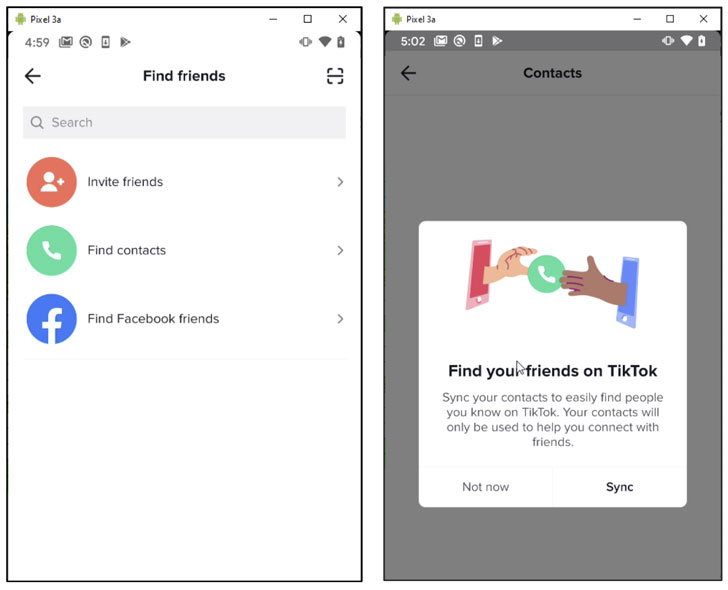
The newly discovered bug resides in TikTok’s “Find friends[2]” feature that allows
users to sync their contacts with the service to identify potential
people to follow.
The contacts are uploaded to TikTok via an HTTP request in the
form of a list that consists of hashed contact names and the
corresponding phone numbers.
The app, in the next step, sends out a second HTTP request that
retrieves the TikTok profiles connected to the phone numbers sent
in the previous request. This response includes profile names,
phone numbers, photos, and other profile related information.
While the upload and sync contact requests are limited to 500
contacts per day, per user, and per device, Check Point researchers
found a way to get around the limitation by getting hold of the
device identifier, session cookies set by the server, a unique
token called “X-Tt-Token” that’s set when logging into the account
with SMS and simulate the whole process from an emulator running
Android 6.0.1.
It’s worth noting that in order to request data from the TikTok
application server, the HTTP requests must include X-Gorgon and
X-Khronos headers for server verification, which ensures that the
messages are not tampered with.
But by modifying the HTTP requests — the number of contacts the
attacker wants to sync — and re-signing them with an updated
message signature, the flaw made it possible to automate the
procedure of uploading and syncing contacts on a large scale and
create a database of linked accounts and their connected phone
numbers.
This is far from the first time the popular video-sharing app
has been found to contain security weaknesses.
In January 2020, Check Point researchers discovered[3]
multiple vulnerabilities within the TikTok app that could have been
exploited to get hold of user accounts and manipulate their
content, including deleting videos, uploading unauthorized videos,
making private “hidden” videos public, and revealing personal
information saved on the account.
Then in April, security researchers Talal Haj Bakry and Tommy
Mysk exposed[4]
flaws in TikTok that made it possible for attackers to display
forged videos, including those from verified accounts, by
redirecting the app to a fake server hosting a collection of fake
videos.
Eventually, TikTok launched a bug bounty
partnership[5] with HackerOne last
October to help users or security professionals flag technical
concerns with the platform. Critical vulnerabilities (CVSS score 9
– 10) are eligible for payouts between $6,900 to $14,800, according
to the program.
“Our primary motivation, this time around, was to explore the
privacy of TikTok,” said Oded Vanunu, head of products
vulnerabilities research at Check Point. “We were curious if the
TikTok platform could be used to gain private user data. It turns
out that the answer was yes, as we were able to bypass multiple
protection mechanisms of TikTok that lead to privacy
violation.”
“An attacker with that degree of sensitive information could
perform a range of malicious activities, such as spear phishing or
other criminal actions.”
References
- ^
analysis
(blog.checkpoint.com) - ^
Find
friends (support.tiktok.com) - ^
discovered
(research.checkpoint.com) - ^
exposed
(www.mysk.blog) - ^
bug bounty partnership
(hackerone.com)