Dec 29, 2022Ravie Lakshmanan

Thousands of Citrix Application Delivery Controller (ADC) and
Gateway endpoints remain vulnerable to two critical security flaws
disclosed by the company over the last few months.
The issues in question are CVE-2022-27510[1]
and CVE-2022-27518[2]
(CVSS scores: 9.8), which were addressed by the virtualization
services provider on November 8 and December 13, 2022,
respectively.
While CVE-2022-27510 relates to an authentication bypass[3]
that could be exploited to gain unauthorized access to Gateway user
capabilities, CVE-2022-27518 concerns a remote code execution bug
that could enable the takeover of affected systems.
Citrix and the U.S. National Security Agency (NSA), earlier this
month, warned[4]
that CVE-2022-27518 is being actively exploited in the wild by
threat actors, including the China-linked APT5 state-sponsored
group.
Now, according to a new analysis[5]
from NCC Group’s Fox-IT research team, thousands of internet-facing
Citrix servers are still unpatched, making them an attractive
target for hacking crews.
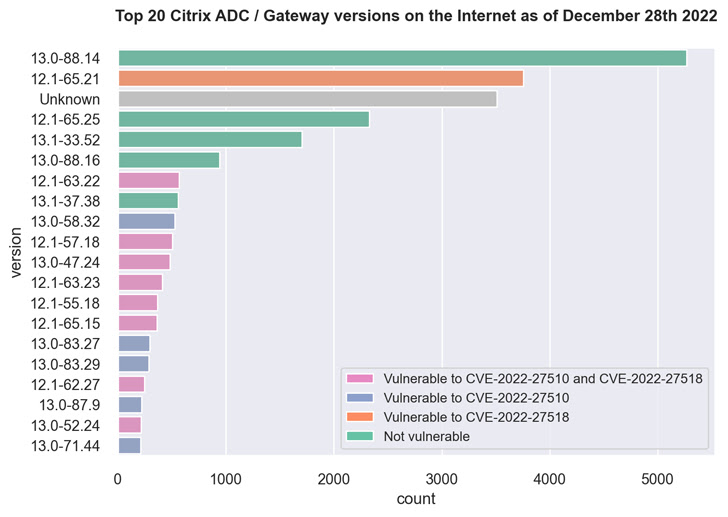
This includes over 3,500 Citrix ADC and Gateway servers running
version 12.1-65.21 that are susceptible to CVE-2022-27518, as well
as more than 500 servers running 12.1-63.22 that are vulnerable to
both flaws.
A majority of the servers, amounting to no less than 5,000, are
running 13.0-88.14, a version that’s immune to CVE-2022-27510 and
CVE-2022-27518.
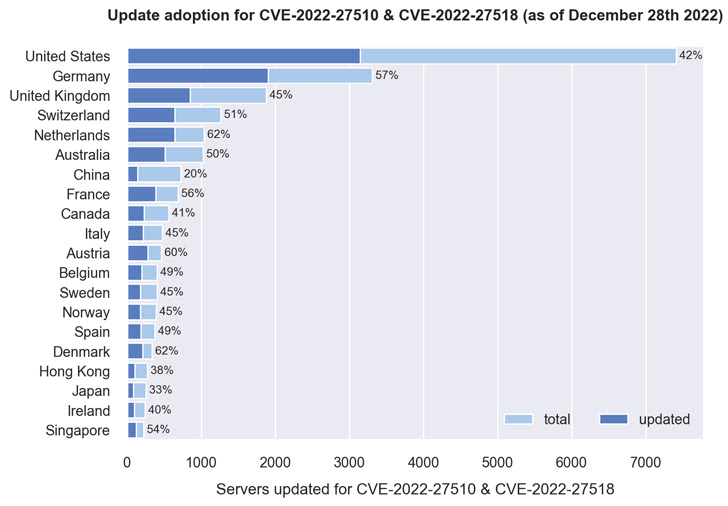
A country-wise breakdown shows that more than 40% of servers
located in Denmark, the Netherlands, Austria, Germany, France,
Singapore, Australia, the U.K., and the U.S. have been updated,
with China faring the worst, where only 20% of nearly 550 servers
have been patched.
Fox-IT said it was able to deduce the version information[6]
from an MD5-like hash value present in the HTTP response of login
URL (i.e., “ns_gui/vpn/index.html”) and mapping it to their
respective versions.
Found this article interesting? Follow us on Twitter [7]
and LinkedIn[8]
to read more exclusive content we post.
References
- ^
CVE-2022-27510
(nvd.nist.gov) - ^
CVE-2022-27518
(nvd.nist.gov) - ^
authentication bypass
(support.citrix.com) - ^
warned
(thehackernews.com) - ^
new
analysis (blog.fox-it.com) - ^
version
information (gist.github.com) - ^
Twitter
(twitter.com) - ^
LinkedIn
(www.linkedin.com)
Read more https://thehackernews.com/2022/12/thousands-of-citrix-servers-still.html