
A malicious extension for Chromium-based web browsers has been
observed to be distributed via a long-standing Windows information
stealer called ViperSoftX.
Czech-based cybersecurity company dubbed the rogue browser
add-on VenomSoftX owing to its standalone features that enable it
to access website visits, steal credentials and clipboard data, and
even swap cryptocurrency addresses via an adversary-in-the-middle
(AiTM) attack.
ViperSoftX, which first came to light[1]
in February 2020, was characterized by Fortinet[2]
as a JavaScript-based remote access trojan and cryptocurrency
stealer. The malware’s use of a browser extension to advance its
information-gathering goals was documented by Sophos threat analyst
Colin Cowie[3]
earlier this year.
“This multi-stage stealer exhibits interesting hiding
capabilities, concealed as small PowerShell scripts on a single
line in the middle of otherwise innocent-looking large log files,
among others,” Avast researcher Jan Rubín said[4]
in a technical write-up.
“ViperSoftX focuses on stealing cryptocurrencies, clipboard
swapping, fingerprinting the infected machine, as well as
downloading and executing arbitrary additional payloads, or
executing commands.”
The distribution vector used to propagate ViperSoftX is
typically achieved through cracked software for Adobe Illustrator
and Microsoft Office that are hosted on file-sharing sites.
The downloaded executable file comes with a clean version of
cracked software along with additional files that set up
persistence on the host and harbor the ViperSoftX PowerShell
script.
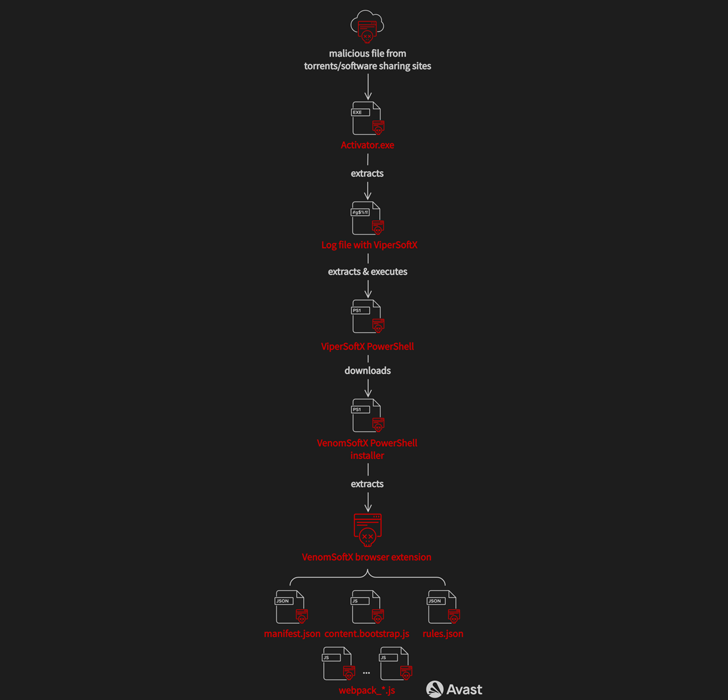
Newer variants of the malware are also capable of loading the
VenomSoftX add-on, which is retrieved from a remote server, to
Chromium-based browsers such as Google Chrome, Microsoft Edge,
Opera, Brave, and Vivaldi.
This is achieved by searching for LNK files for the browser
applications and modifying the shortcuts with a “–load-extension[5]” command line switch
that points to the path where the unpacked extension is stored.
“The extension tries to disguise itself as well known and common
browser extensions such as Google Sheets,” Rubín explained. “In
reality, the VenomSoftX is yet another information stealer deployed
onto the unsuspecting victim with full access permissions to every
website the user visits from the infected browser.”
It’s worth noting that the –load-extension tactic has also been
put to use by another browser-based information stealer referred to
as ChromeLoader[6]
(aka Choziosi Loader or ChromeBack).
VenomSoftX, like ViperSoftX, is also orchestrated to steal
cryptocurrencies from its victims. But unlike the latter, which
functions as a clipper[7]
to reroute fund transfers to an attacker-controlled wallet,
VenomSoftX tampers with API requests to crypto exchanges to drain
the digital assets.
Services targeted by the extension include Blockchain.com,
Binance, Coinbase, Gate.io, and Kucoin.
The development marks a new level of escalation to traditional
clipboard swapping, while also not raising any immediate suspicion
as the wallet address is replaced at a much more fundamental
level.
Avast said it has detected and blocked over 93,000 infections
since the start of 2022, with a majority of the impacted users
located in India, the U.S., Italy, Brazil, the U.K., Canada,
France, Pakistan, and South Africa.
An analysis of the hard-coded wallet addresses in the samples
reveals that the operation has netted its authors a sum total of
about $130,421 as of November 8, 2022, in various cryptocurrencies.
The collective monetary gain has since dropped to $104,500.
“Since the transactions on blockchains/ledgers are inherently
irreversible, when the user checks the transaction history of
payments afterward, it is already too late,” Rubín said.
References
- ^
came to
light (twitter.com) - ^
Fortinet
(www.fortinet.com) - ^
Colin
Cowie (www.th3protocol.com) - ^
said
(decoded.avast.io) - ^
–load-extension
(peter.sh) - ^
ChromeLoader
(thehackernews.com) - ^
clipper
(thehackernews.com)
Read more https://thehackernews.com/2022/11/this-malware-installs-malicious-browser.html