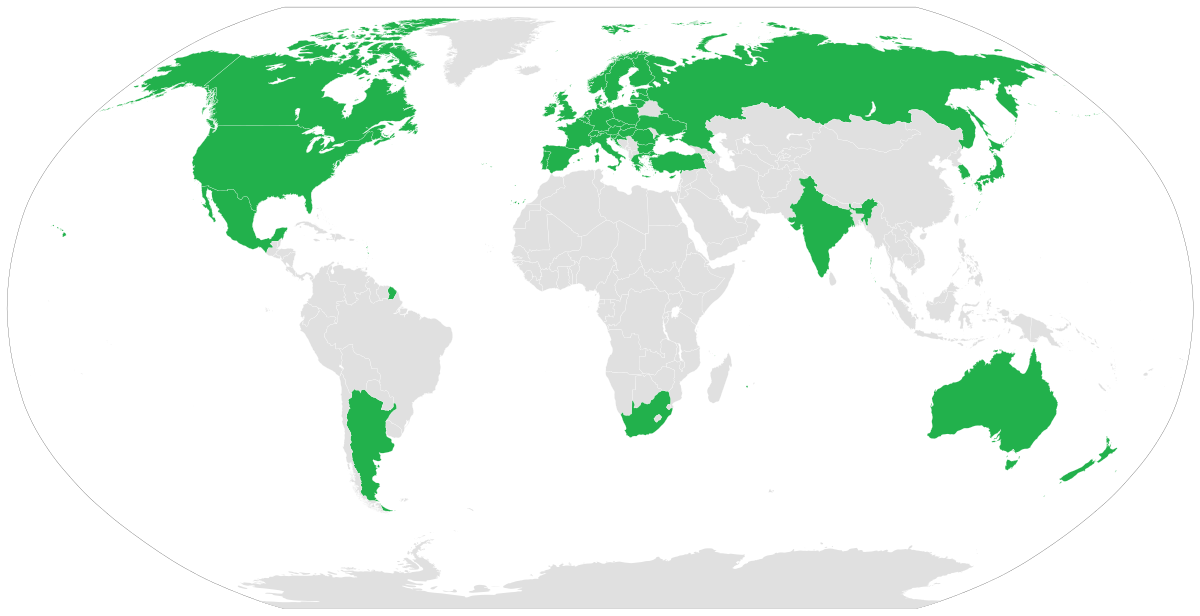
The Wassenaar Arrangement is a multilateral export control regime established to promote transparency and responsibility in the transfer of conventional arms and dual-use goods and technologies. It was founded in Wassenaar, Netherlands, in 1996 and currently consists of 42 participating states, including many major arms-exporting countries.
The NSG’s guidelines are not legally binding, but they carry significant political weight. They serve as a framework for member countries to regulate their nuclear exports and coordinate their efforts to prevent the proliferation of nuclear weapons.
The NSG has been involved in several high-profile cases, such as the negotiations and discussions surrounding the nuclear programs of countries like Iran and North Korea. The group plays a crucial role in shaping global non-proliferation efforts and maintaining the integrity of the nuclear non-proliferation regime.
The primary objective of the Wassenaar Arrangement is to prevent the proliferation of weapons of mass destruction (WMD) by controlling the export of items that could be used in their development or delivery. It seeks to achieve this goal by maintaining lists of controlled items, technologies, and software that member states agree to regulate and restrict their export.
The arrangement divides items into two main categories: “List of Dual-Use Goods and Technologies” and “Munitions List.” The List of Dual-Use Goods and Technologies includes items that have both civilian and military applications and can potentially be used in the production or development of WMDs. The Munitions List comprises conventional arms and related equipment.
Member states of the Wassenaar Arrangement have committed to implementing national export controls and exchanging information on transfers of controlled items. The arrangement operates on the basis of consensus, meaning that decisions and changes to the control lists require unanimous agreement among the participating states.
The Wassenaar Arrangement is not a legally binding treaty, but it serves as a framework for voluntary cooperation among its members. Each participating state is responsible for implementing its own national export control measures in line with the guidelines and control lists provided by the arrangement.
The Wassenaar Arrangement plays an important role in promoting non-proliferation and responsible arms trade. It contributes to international security by enhancing transparency, preventing the diversion of sensitive technologies, and encouraging responsible export practices among its member states.
At a Glance
The Wassenaar Arrangement (WA) is a voluntary multilateral export control regime that provides members a space to exchange information regarding exports of sensitive conventional weapons and dual-use goods and technologies in hopes of preventing the proliferation of such items. It was formed in 1996 as the successor to the Cold War-era Coordinating Committee for Multilateral Export Controls (COCOM) and currently has 42 participating members.
Overview
Member states of the WA provide semiannual reports on transfers and denials to non-members of weapons in categories from the UN Register of Conventional arms and of dual-use goods from the Wassenaar Dual-Use List. The goal of the information exchanges within the WA is to promote transparency, responsibility and accountability among members with regard to sensitive materials. This transparency allows members to avoid destabilizing accumulations of arms and dual-use goods and technologies by any state, particularly those of concern. The Wassenaar Dual-Use List contains a Basic List of controlled technology, which is subdivided into a Sensitive List, and further subdivided into a Very Sensitive List. Members report semiannually on license denials from the Basic List and within 30-60 days of denials and semiannually on transfers from the Sensitive List. Transfers of items from the Very Sensitive List are subject to extreme discretion in licensing decisions.
Its predecessor, COCOM, was formed as a Cold War-era measure to implement stricter regulations on exports going to the former Soviet Union and Eastern bloc and was disbanded in 1994 before the formation of the WA. Unlike COCOM, the WA does not specifically target any state or region, but is more geopolitically neutral. Despite this, members generally have common understandings to more strictly limit transfers going to states of concern, like Iran, Iraq, Libya and North Korea to prevent their accumulation of arms and sensitive materials.
Membership Obligations
The NSG provides further clarity for nuclear weapon states and the guidelines promote effective implementation of peaceful nuclear cooperation that is consistent with pre-existing non-proliferation norms. The open channels of communication among participants strengthens the international solidarity in transfers of sensitive materials. The clarifications provided by the NSG encourage assurance of compliance with non-proliferation standards.
The NSG Today
To be members, states must produce and export arms or associated dual-use technologies. They also must implement national export control laws that prohibit the sale of arms or sensitive dual-use goods to areas of concern. Members are expected to behave in accordance with international non-proliferation norms and standards, like the Nuclear Non-Proliferation Treaty (NPT), the Missile Technology Control Regime (MTCR), the Chemical Weapons Convention (CWC), and the UN Register of Conventional Arms.
WA members are also expected to maintain export controls based on the control lists of the WA: the Munitions List and the Dual-Use List. Experts of member states regularly review and update these lists; however, the decision to approve or deny controlled items is up to individual states. Unlike COCOM, the WA does not have a no undercut rule, meaning if one member state denies a transfer, another member may approve it. Similar to COCOM, the WA does not have any vetoes of proposed exports and does not have prior reviews of proposed exports on a case-by-case basis.
Russian membership has proven controversial. On one hand, it allows the international community some transparency on export activity, but Russia’s participation has not led to the expected improvement in Russian behavior in approving exports to unstable regions. Russia has also obstructed updates to control lists on occasion and has tended to treat information exchanges as intelligence gathering opportunities, leading others to question if Russian participation is actually in line with the goals of the arrangement.
Israel, China and Belarus, three major arms control exporters, are notable non-members.