
Today I discuss an attack vector conducive to
cross-organizational spread, in-home local propagation. Though
often overlooked, this vector is especially relevant today, as many
corporate employees remain working from home.
In this post, I contrast in-home local propagation with
traditional vectors through which a threat (ransomware in
particular) spreads throughout an organization. I discuss the
reasons this type of spread is problematic for employees and
corporations alike. Finally, I offer simple solutions to mitigate
the risk of such tactics.
Why Should IT and Security Stakeholders
Care?
Today’s long cycle attacks are often reconnoitering the victim
environment for weeks, if not months. In this time, the attacker
gains a tremendous amount of knowledge about systems in the
victim’s footprint. This additional loiter time in the victim’s
environment, coupled with ad-hoc maintained work-from-home
environments, presents both an ingress avenue for
attacks into their network as well as an egress
avenue for attack out of your network into your employees’
personal devices.
Contrasting Tactics
- Traditional Spread — For some time in 2020, even with a shift to WFH[1], ransomware continued to
propagate through some of the same vectors it had previously.
Spread was common through email, malicious websites, server
vulnerabilities, private cloud, and file shares. Often this was
sufficient to get the attacker to saturate in the victim’s
environment. However, prior to our WFH lifestyle, when it came to
cross-organizational spread, many of these vectors were largely
inapplicable. This leads to a natural containment of an infection
to a single organization.
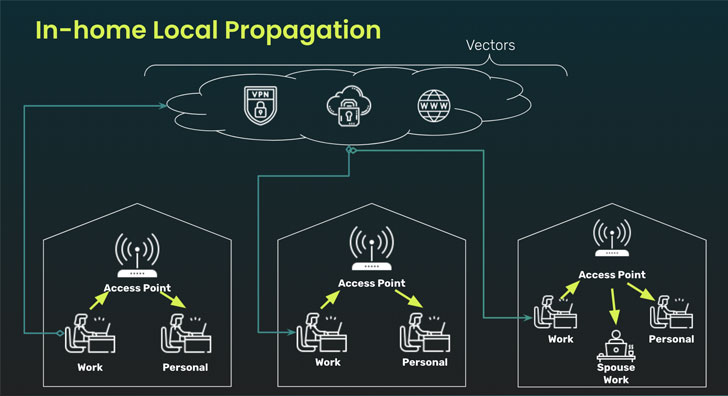
- In-home Local Propagation — Recently, attackers have been
jumping zones from their initial corporate victims into adjacent
systems, including other endpoints in a victim’s home. It isn’t
100% clear if this is due to a natural extension of the
reconnaissance they are doing as a part of their double-extortion
ransom endeavors (where a ransom is demanded to decrypt files and a
second ransom is demanded not to leak stolen files), or if this is
because they are cluing into the fact that additional victims are
meters away.
This jump to physically local systems can be made via
traditional propagation vectors, such as open file shares, via
local (to the home network) exploitation of vulnerabilities, or via
the access points (APs) themselves. Home APs / Routers are
often:
- Consumer-grade
- Poorly configured (often with standard/default admin
passwords) - Lacking encryption or any security measures between
devices - And, you can forget about detection and response, as no logs
from these devices will be making it back to anybody’s SIEM, SOC,
nor MDR service provider.
This leaves an opportunity for threat actors to spread via
in-home local propagation.
There are a couple of distinct advantages for them doing so.
Infection of employees’ personal devices:
- While this could mean another party to potentially fork-over
the ransom payment (the employee), the real value in spreading to
an employee’s personal device is leverage to force or influence the
corporate payment. Imagine for a moment that the employee in
question is the IT Director, and by encouraging their leadership
team to pay the ransom to restore business continuity, that they
also believe they could get their family photo album, gaming
machine, or spouse’s work laptop decrypted.
Infection of third-party corporate devices
- As described above previously, the ways to jump to separate
corporate environments were either limited or well-defended. But,
with employees across different companies cohabitating (spouses,
roommates) or sharing internet access (neighbors) – the next
potential corporate victim is just a stepping stone away, likely
via a poorly-configured AP/Router at that.
Consequences
- In-home local propagation represents a greater liability for
companies facing a ransomware attack, as the victims span corporate
and organizational boundaries. - Furthermore, the ability to mitigate risk is limited, as they
are unlikely to have direct control over the network infrastructure
of employees working from home. In fact, this separation is
vehemently defended by employees themselves, citing privacy
concerns – another potential liability for you.
Remediative Steps
To mitigate the risk of in-home local
propagation of ransomware[2]
(or other nasty malware, for that matter), IT and security teams
can consider the following steps:
- Encourage a robust configuration of employee-owned networking
devices - Ensure a sound remote software update capability, to keep
client endpoint hygiene at a decent level. - Identify and remediate vulnerabilities across client
endpoints - Engage in detection and response (threat hunting) activities
across your endpoints and environment.
I hope this article has called attention to a vector that is
especially relevant in the current landscape. For more information
about in-home local propagation, check out our webinar titled the
Evolution of Ransomware-as-a-Service and
Malware Delivery Mechanisms[3]
where I discuss this phenomenon with an expert panel of
cybersecurity professionals. Or, to hear more about other
developments in ransomware, check out our whitepaper on the
Rise of Ransomware-as-a-Service[4], to which I
contributed.
Note — This article is contributed and written by Sean
Hittel, Distinguished Security Engineer at ActZero.ai. He has
over 20 years of experience in new concept threat protection engine
design.
ActZero.ai challenges cybersecurity coverage for small
to mid-size enterprises MB and mid-market companies. Their
Intelligent MDR provides 24/7 monitoring, protection, and response
support that goes well beyond other third-party software solutions.
Their teams of data scientists leverage cutting-edge technologies
like AI and ML to scale resources, identify vulnerabilities and
eliminate more threats in less time. They actively partner with
customers to drive security engineering, increase internal
efficiencies and effectiveness and, ultimately, build a mature
cybersecurity posture. Whether shoring up an existing security
strategy or serving as the primary line of defense, ActZero enables
business growth by empowering customers to cover more ground.
References
- ^
even
with a shift to WFH (actzero.ai) - ^
To
mitigate the risk of in-home local propagation of ransomware
(actzero.ai) - ^
Evolution of Ransomware-as-a-Service
and Malware Delivery Mechanisms
(actzero.ai) - ^
Rise of
Ransomware-as-a-Service (actzero.ai)