It’s not news that phishing attacks are getting more complex and
happening more often. This year alone, APWG reported a
record-breaking total of 1,097,811 phishing attacks.[1] These attacks continue
to target organizations and individuals to gain their sensitive
information.
The hard news: they’re often successful, have a
long-lasting negative impact on your organization and employees,
including:
- Loss of Money
- Reputation damage
- Loss of Intellectual property
- Disruptions to operational activities
- Negative effect on company culture
The harder news: These often could have been
easily avoided.
Phishing, educating your employees, and creating a cyber
awareness culture? These are topics we’re sensitive to and
well-versed in. So, how can you effectively protect your
organization against phishing attempts? These best practices will
help transform your employees’ behavior and build organizational
resilience to phishing attacks.
Plan for total workforce training:
According to the 2022 Tessian Security Cultures Report[2], “security leaders
underestimate just how much they should be a part of the employee
experience” across onboarding, role changes, offboarding,
relocations, and day-to-day activities.
But we’ve repeatedly seen that ad hoc, scattershot employee
training attempts don’t work. If you want sufficient internal
defenses against sophisticated phishing threats, you should train
100% of your employees monthly.
Granted, it isn’t easy if your team is growing rapidly or spread
across different locations and time zones. Yet doing anything less
than 100% employee training leaves you with too many security holes
and opportunities for hackers to break in. Unfortunately, it also
means you have no way of knowing your employees’ level of threat
awareness or whether they know how to react to threats. You might
be missing your weakest link or getting into a scenario that could
have been easily avoided.
Apply Continuous Training
Ever been told there’ll be a fire evacuation drill? Likely, you
weren’t caught off guard when the practice started and could have
paid more attention. That’s the thing about drills; they’re in
place to prepare us for present and future threats.
Cybersecurity training is no different. While it can quickly
become ticking a compliance box to satisfy minimum requirements. To
prevent it, you need to catch your staff off guard. Knowing that a
threat could present itself at any time keeps employees vigilant
and accountable between more extensive training campaigns.
It would be best if you kept giving your employees these
unexpected opportunities to learn on an ongoing basis. They will
likely make easily avoidable mistakes if they only receive
occasional simulations. You might miss new employees without
sufficient cybersecurity training, or it might take time for them
to revisit and build on this training.
The solution: Conducting consistent
cybersecurity training is the best way to keep it top of mind for
everyone—train for yesterday, today, and tomorrow.
Deploy Adaptive Content
You might use cybersecurity understanding or departments as
categories. Start by segmenting your workforce into groups. Then,
develop adaptive training based on each group’s needs – and even
based on individual behavior. That’s critical to adequately address
the challenges of given scenarios of future attack campaigns.
These can include data or password requests, messages from
legitimate sources, or realistic content tailored to an
organization’s specific role or department.
You strengthen employees’ defenses by adapting your content to
individual responses and specific attack vectors. Doing so turns
the human element from a security gap to a security advantage.
Localize Your Cybersecurity Training
English might be your corporate language, but it might not be
every employee’s mother tongue, and cultural contexts might be
perceived differently in some branches.
Using employees’ mother tongue within a location’s cultural
context will dramatically enhance their learning retention. By
citing local references (such as national holidays, significant
news sources, popular social media platforms, and more), you make
your simulations more believable and relatable. Your employees will
likely pay better attention during training and will be less
susceptible to attacks.
Lastly, there could be different implications regarding email
compliance standards in different places. Ensure your team is aware
of that and incorporate the necessary precautions in these
locations’ training.
Back Your Cyber Training with Data
Science
In our experience, one in every five employees is a “serial
clicker.” Serial clickers click, open, and download attachments
that often place them and your organization in danger. They might
be a new or existing employee. We’ve seen it all, from entry-level
positions[3]
to company stakeholders.
They’re not trained or equipt to reliably identify phishing
attacks, nor understand how dangerous and their destructive impact.
So they keep clicking links in emails that they shouldn’t have
opened.
The good news: We believe serial clickers can be cured[4] because we’ve seen it
repeatedly happen with employee training and education.
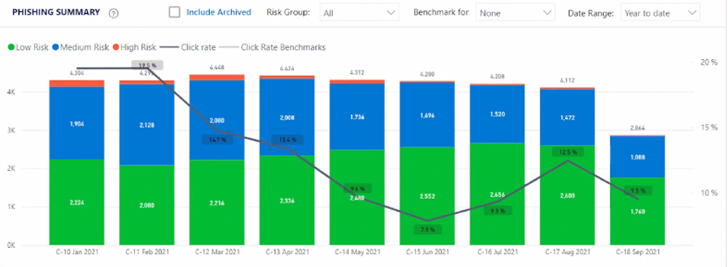
We know that serial clickers are just some of the ones to worry
about. Employees respond differently to a variety of attack
vectors. It’s recommended to use data science to understand how
employee groups within your organization – from new hires,
executive leadership, and veteran employees – respond to potential
threats.
Once you analyze the data to understand these groups’ behavior,
you can develop programs that shift them toward a more discerning
approach to email management based on their specific needs and
their current place in their cybersecurity awareness journey.
These programs must include expert knowledge, adjusted
frequency, timely reminders, custom
simulations[5], and training content
designed for highly susceptible groups while respecting employees’
privacy.
Automate Your Cybersecurity Education
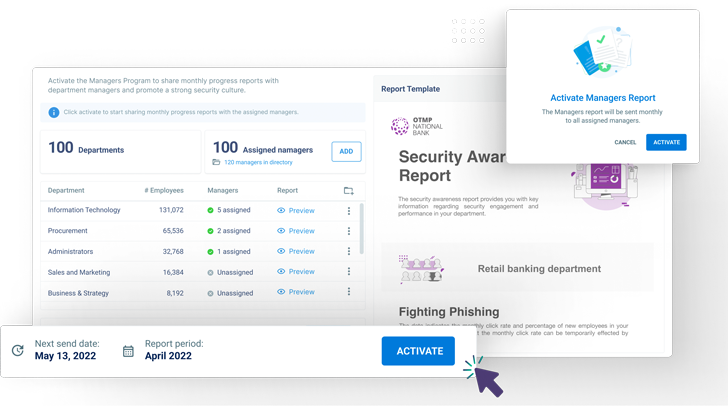
Regardless of the size of your organization, the complexity
required to run a training program like the one described above can
be challenging. Whether you’re looking at it from the perspective
of time, resources, or economics, it’s almost impossible without a
truly automated solution that has expert knowledge baked into the
software.
CybeReady provides a fully-automated platform[6] powered by machine
learning technology. It mitigates the risks of human error through
an educational approach that continuously provides frequent,
adaptive, engaging training. Get in touch today to foster a culture
that cares, retains information to keep your organization
safe,[7] and feels accountable.
Make your organization cyber-ready. Learn how you can upgrade your
security awareness program with a short, perosanilized
demo[8].
References
- ^
1,097,811 phishing attacks.
(docs.apwg.org) - ^
Tessian
Security Cultures Report (www.tessian.com) - ^
positions
(www.cnbc.com) - ^
serial
clickers can be cured (cybeready.com) - ^
custom simulations
(cybeready.com) - ^
fully-automated platform
(cybeready.com) - ^
keep your organization safe,
(cybeready.com) - ^
perosanilized demo
(cybeready.com)
Read more https://thehackernews.com/2022/11/the-5-cornerstones-for-effective-cyber.html