end-to-end encrypted messaging app, Telegram, has been found
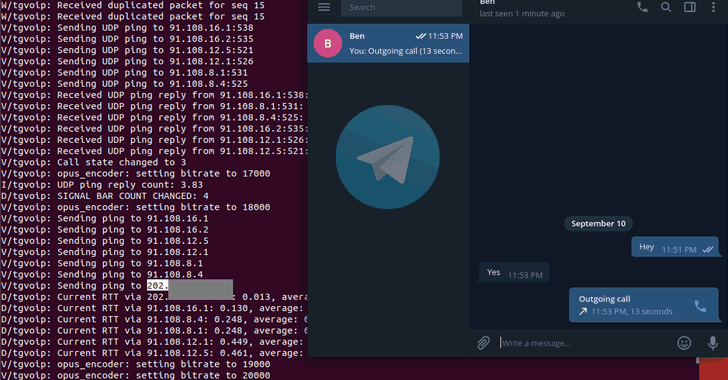
leaking both users’ private and public IP addresses by default
during voice calls.
With 200 million monthly active users as of March 2018, Telegram[1] promotes itself as an
ultra-secure instant messaging service that lets its users make
end-to-end encrypted chat and voice call with other users over the
Internet.
Security researcher Dhiraj Mishra uncovered a vulnerability
(CVE-2018-17780) in the official Desktop version of Telegram
(tdesktop) for Windows, Mac, and Linux, and Telegram Messenger for
Windows apps that was leaking users’ IP addresses by default during
voice calls due to its peer-to-peer (P2P) framework.
[2]
To improve voice quality, Telegram by default uses a P2P framework
for establishing a direct connection between the two users while
initiating a voice call, exposing the IP addresses of the two
participants.
Telegram Calls Could Leak Your IP Address
However, just like Telegram provides the ‘Secret Chat’ option for
users who want their chats to be end-to-end encrypted, the company
does offer an option called “Nobody,” which users can enable to
prevent their IP addresses from being exposed during voice calls.
Enabling this feature will cause your Telegram voice calls to be
routed through Telegram’s servers, which will eventually decrease
the audio quality of the call.
However, Dhiraj found that this Nobody option is only available
to mobile users, and not for Telegram for Desktop (tdesktop) and
Telegram Messenger for Windows apps, revealing the location of all
desktop users regardless of how careful they might be
otherwise.
To get an IP address of someone, all an attacker needs to do is
initiate a call. As soon as the recipients pick a call, the flaw
will reveal their IP address.
Dhiraj reported his findings to the Telegram team, and the
company patched the issue in both 1.3.17 beta and 1.4.0 versions of
Telegram for Desktop by providing an option of setting your “P2P to
Nobody/My Contacts.”
Users can enable the option by heading towards Settings → Private
and Security → Voice Calls → Peer-To-Peer to Never or Nobody.
Dhiraj was also awarded a €2,000 (about $2,300) bug bounty for
finding and responsibly disclosing the issue to the company.
Leaking of IP addresses for an app that’s meant to be secured is
a real concern and does serve as a reminder that you can’t blindly
depend on even the most secure and privacy-focused services.
Telegram Messenger Leaks SOCKS5 Proxy Credentials
(Unpatched)
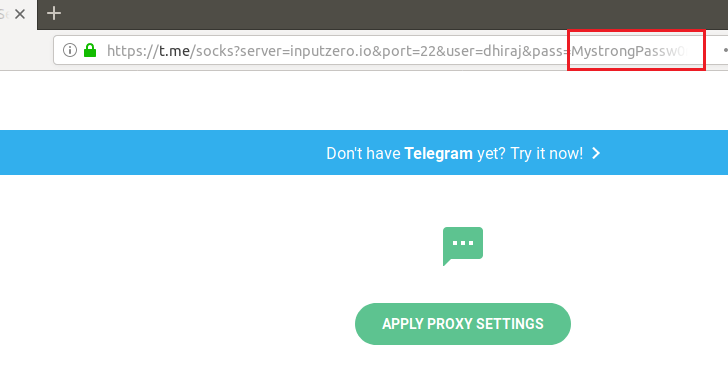
flaw (CVE-2018-17613) in Telegram for Desktop
that leaks SOCKS5 proxy credentials in plaintext, when used, as it
is an optional feature.
“The link which gets generated have the password in plaintext,
SOCKS5 is a transport protocol, and by itself, it is not encrypted.
Requests transmit the credentials in plain text which is considered
a bad security practice,” Dhiraj said.
“However, the URL which gets generated via telegram is in HTTPS
but, URI producers should not provide a URI that contains a
username or password that is intended to be secret. URIs are
frequently displayed by browsers, stored in clear text bookmarks,
and logged by user agent history and intermediary applications
(proxies).”
fix it anytime soon, as the company believes the feature is working
as intended.
Earlier this year, the desktop version for Telegram was also
found to be affected by a zero-day
vulnerability[4]
that had been exploited in the wild since the past year to spread
malware that mines cryptocurrencies.
References
- ^
Telegram
(thehackernews.com) - ^
uncovered
(www.inputzero.io) - ^
CVE-2018-17613
(www.inputzero.io) - ^
zero-day vulnerability
(thehackernews.com)
Read more http://feedproxy.google.com/~r/TheHackersNews/~3/6cNeBx6N8vo/hack-telegram-messenger.html
